Between Mexico and Guatemala · driving
La Mesilla border crossing by car: Mexico to Guatemala and back
Mexican immigration sits about five kilometres before the border. Your passport and your car are dealt with at different points, and driving north the order changes. Nothing walks you through it — you have to know where to stop.
The short version
I have used this crossing for about twenty years — first on buses, and for a long time now driving my own Mexican-plated car, usually with two children in the back. This is the sequence in both directions, what I actually paid this month, and the one decision on the way home that took me years to work out.
What this is
This is one person’s experience of one crossing, written from San Cristóbal de las Casas. It is not immigration or customs advice. Fees, hours and requirements change, and officials apply them; where something is official I have linked the authority rather than printed my own version of the rule.
Official travel advice — checked October 2026
The UK government advises against all but essential travel within 40 km of the Guatemalan border in southern Chiapas and within 5 km of it on the Guatemalan side — both take in this crossing — and to the town of La Democracia, which the road to Huehuetenango runs through. Travelling against that advice could invalidate your travel insurance. My twenty years here are my experience, not a safety rating: read the UK advice for Chiapas and for Huehuetenango, or your own government’s, before you go.
✓ paid — what I handed over, with the receipt ~ estimated — from memory, worth checking
Southbound at a glance — Mexico to Guatemala, own vehicle
Mexican immigration → 5 km of road → fumigation → Guatemalan immigration → vehicle permit → La Mesilla
On this page
01 — Orientation
How the crossing is laid out
The thing that catches people out is the geography. Coming from Comitán, you stop at the Mexican immigration office at Ciudad Cuauhtémoc, which is about five kilometres short of the actual border, at the foot of a mountain range. That is where your passport is stamped. Then you drive — or take a colectivo taxi if you are on public transport — up the road to the Guatemalan side at La Mesilla, and do everything else there.
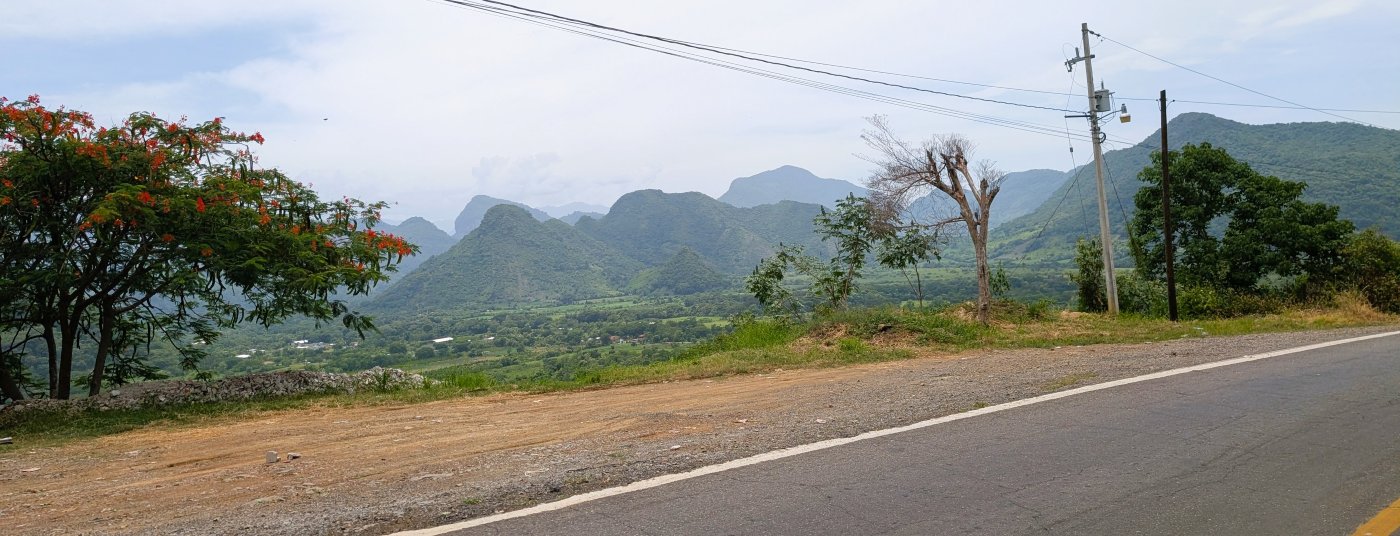
Coming the other way, the order reverses: Guatemalan formalities at La Mesilla, then the five kilometres down to Ciudad Cuauhtémoc for Mexico.
Getting between the two immigration offices without a shuttle
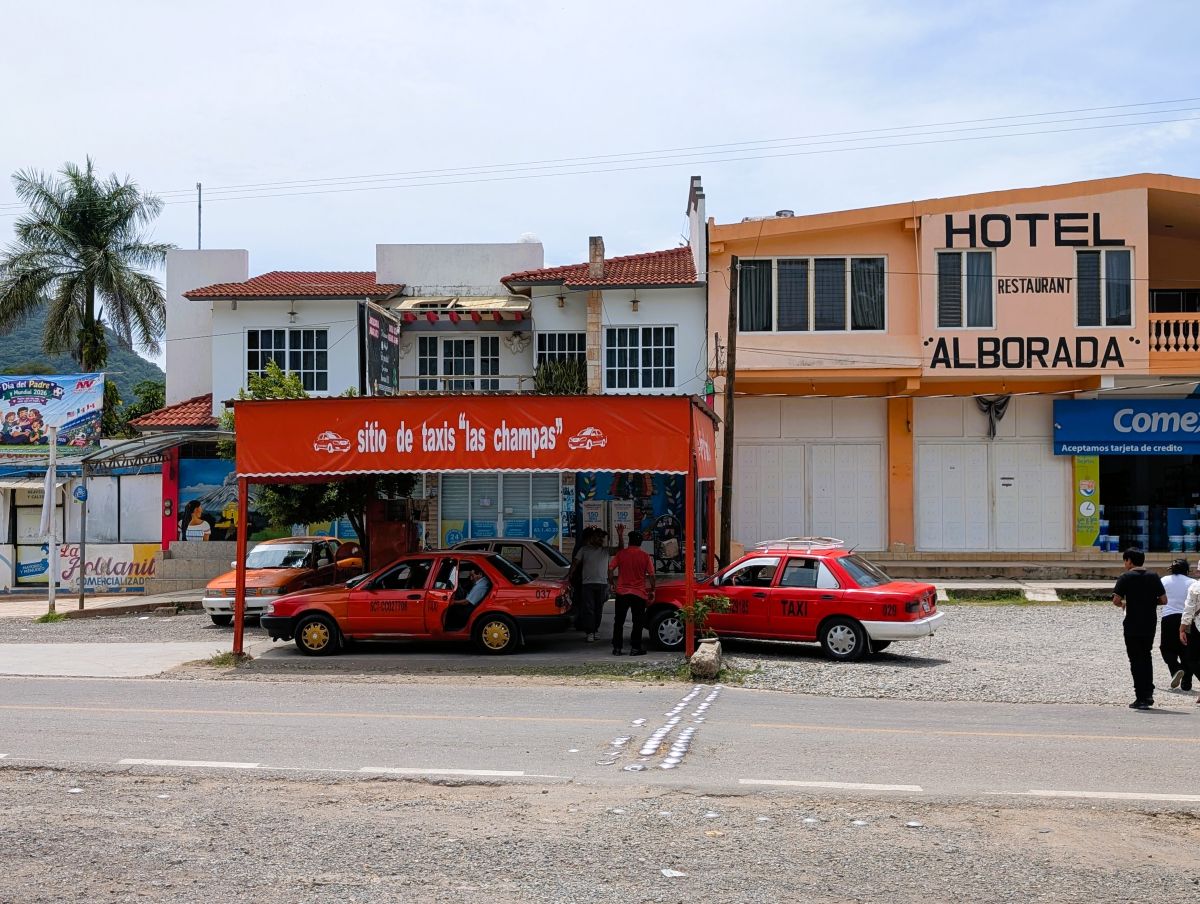
If you’re not in your own car, the link between the two posts is the colectivo taxi. They run from the “Las Champas” rank at Ciudad Cuauhtémoc, on the Mexican side. In August 2026 I checked the fare with the drivers directly: MX$20 a head if you wait for the car to fill, or MX$100 to take the whole taxi to yourself. Ask before you get in — that’s confirmed with the drivers rather than a posted tariff, but it’s a real quote, not a guess. It’s the same five kilometres either way; the only question is whether you share it.
02 — Scope
Why this guide covers La Mesilla
What I can and can’t tell you
There are several ways across between Chiapas and Guatemala. I have used three of them, and only one of them often enough to write about properly.
- Ciudad Cuauhtémoc–La Mesilla — the highland route towards Huehuetenango, Xela, Atitlán and Antigua. The one I drive, in both directions, and the one this page covers.
- Talismán–El Carmen, near Tapachula — I have crossed here, but on the coastal route rather than regularly. Mentioned for routing only; I haven’t documented it step by step.
- Carmen Xhán–Gracias a Dios — I crossed here once, in 2012. No directions on this page; see below.
- El Ceibo, towards Petén and Tikal — I have never used it, so I am not comparing it.
Routing and first-hand use only. I’m not ranking these as safer, easier or better in general — that isn’t mine to say.
Why there are no directions for Gracias a Dios
I crossed at Carmen Xhán–Gracias a Dios once, in 2012, while I was working in remote parts of Huehuetenango. What stayed with me was how isolated it felt: a single street, none of the market-day bustle you get at La Mesilla, and a Mexican immigration post that looked abandoned. I was carrying money to change and I did not feel comfortable.
That was fourteen years ago and I have no current knowledge of the place, so I am not going to describe a route through it. Current official advice covers that area — check the UK advice for Chiapas and for Huehuetenango, or your own government’s, and take that over my old impression.
03 — Mexico to Guatemala
Southbound, in your own car
What I take to the vehicle desk
Three documents: the tarjeta de circulación, my driving licence and my passport. My July 2026 permit lists exactly those three on its face, in the box recording what was presented.
The car needs to be in your name. I am asked this every single time, and I have been told by the officials that it has to be. Mine is, so I have never had to find out what happens when it isn’t — if you are planning to drive a car registered to someone else, sort that out before you get to the border rather than at it.
- Stop at Ciudad Cuauhtémoc and get stamped out. Park outside the Mexican immigration office. Everyone in the vehicle needs to go in — this is passports, not the car.
- Drive the five kilometres up to La Mesilla. Nothing happens in between except the road.
- Fumigation — first, before immigration. You’ll be stopped in a coned-off area and the car is sprayed. Get out and pay at the office overlooking your vehicle. ✓ Q17 in July 2026.
- Guatemalan immigration — and say you’re driving. When the official stamps you in, tell them you are travelling in your own vehicle. They hand you a SAT customs and duty form. If you don’t mention it, you don’t get the form, and you’ll start the next step from behind.
- The vehicle permit at SAT. This is the part that takes the time. Fill in the customs form while they work on the permit application, then sign. You pay at the Banrural beside the SAT office, not at the desk — then take the paid receipt back to them. You come away with the permit document and a sticker for the windscreen.
All of it happened in a single visit, on a Sunday — and I’ve now done the full process, passports and vehicle import together, on a Sunday in both July and August 2026. There’s more on that under Sundays and timing below, because the weekend-closure warnings you’ll read elsewhere haven’t matched my experience.
If you entered Mexico by land — check the DNR before you leave
This one catches tourists out, and it has nothing to do with the car. The Derecho de No Residente (DNR) is the fee foreign visitors pay for the immigration document tied to the visitante sin permiso para realizar actividades remuneradas (tourist) category. Under the official rule, a land stay that does not exceed seven days is exempt; if it exceeds seven days, the fee is collected when you leave. The 2026 charge is MX$983. If your dates sit close to the seven-day line, ask INM how they’ll count your stay — the figure is set in the INM 2026 land-entry tariff and the Ley Federal de Derechos.
INM takes this by bank card only, never cash, and you can pay it online or at a Mexican bank beforehand. At Ciudad Cuauhtémoc I was told plainly that payment at the office had to be by Visa or Mastercard — and there’s no bank or ATM in town (August 2026). If this applies to you, I’d pay ahead rather than gamble on the border terminal working.
04 — Costs
What I paid
Own vehicle, Mexican plates · July–August 2026
| Direction | What it was for | Paid | ✓/~ |
|---|---|---|---|
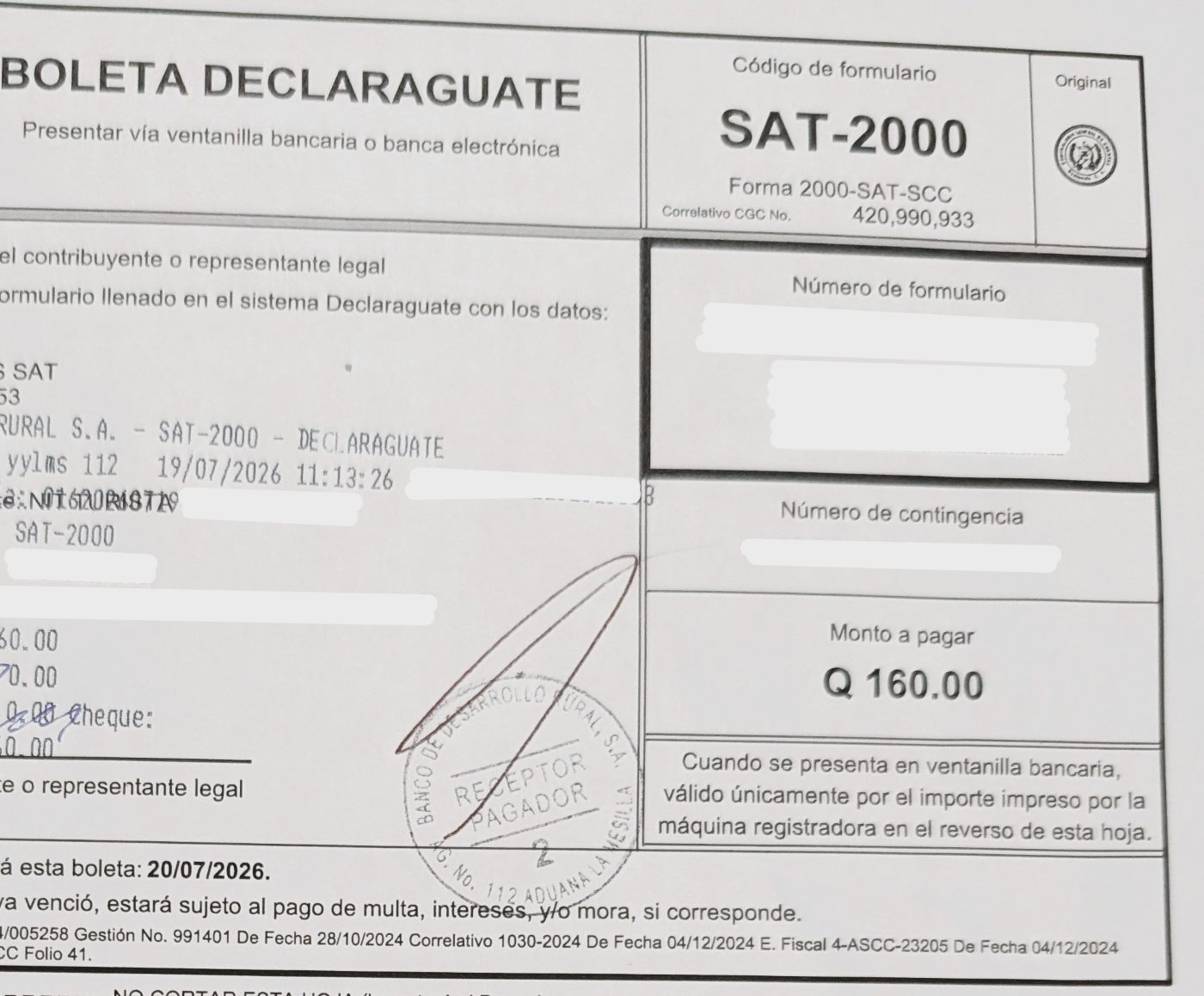
| Mexico → Guatemala | Temporary vehicle permitPermit document + windscreen sticker. It has been this figure every time I’ve crossed. | Q160 | ✓ |
| Mexico → Guatemala | Vehicle fumigationPaid entering Guatemala, July 2026. Receipt held. | Q17 | ✓ |
| Guatemala → Mexico | Vehicle fumigationPaid up at the border on the way home, receipt held. August 2026 — this replaces the estimate I used to carry here. | MX$110 | ✓ |
| Guatemala → Mexico | Vehicle permitNone. The car is Mexican-plated, so coming home it doesn’t need importing. | — |
The permit has been a flat Q160 for as long as I have been doing this — the same figure year after year, and I have the receipts. That makes it one of the more stable numbers on this page, but it is still a record of what I have paid rather than a tariff I am authorised to quote. SAT does break it down — a Q100 calcomanía de turismo (tourism sticker) plus a Q60 authorisation form — but it’s collected as a single Q160 Declaraguate on one slip. You’re never asked for two fees, and you don’t pay twice.
05 — The decision on the way home
The permit decision: hand it back, or keep it
This is the part nobody tells you, because you only meet it if you cross more than once.
When you drive back into Mexico you get a choice. You can hand the permit in — the document along with the sticker off the windscreen — and close it. Or you can keep it, because there is still unused time on it.
Mine, issued at La Mesilla on 19 July 2026, states a plazo inicial autorizado of 90 days and an expiry of 17 October 2026. Yours will carry its own dates, and those — plus whatever the desk records when you leave — are what govern you, not this page.
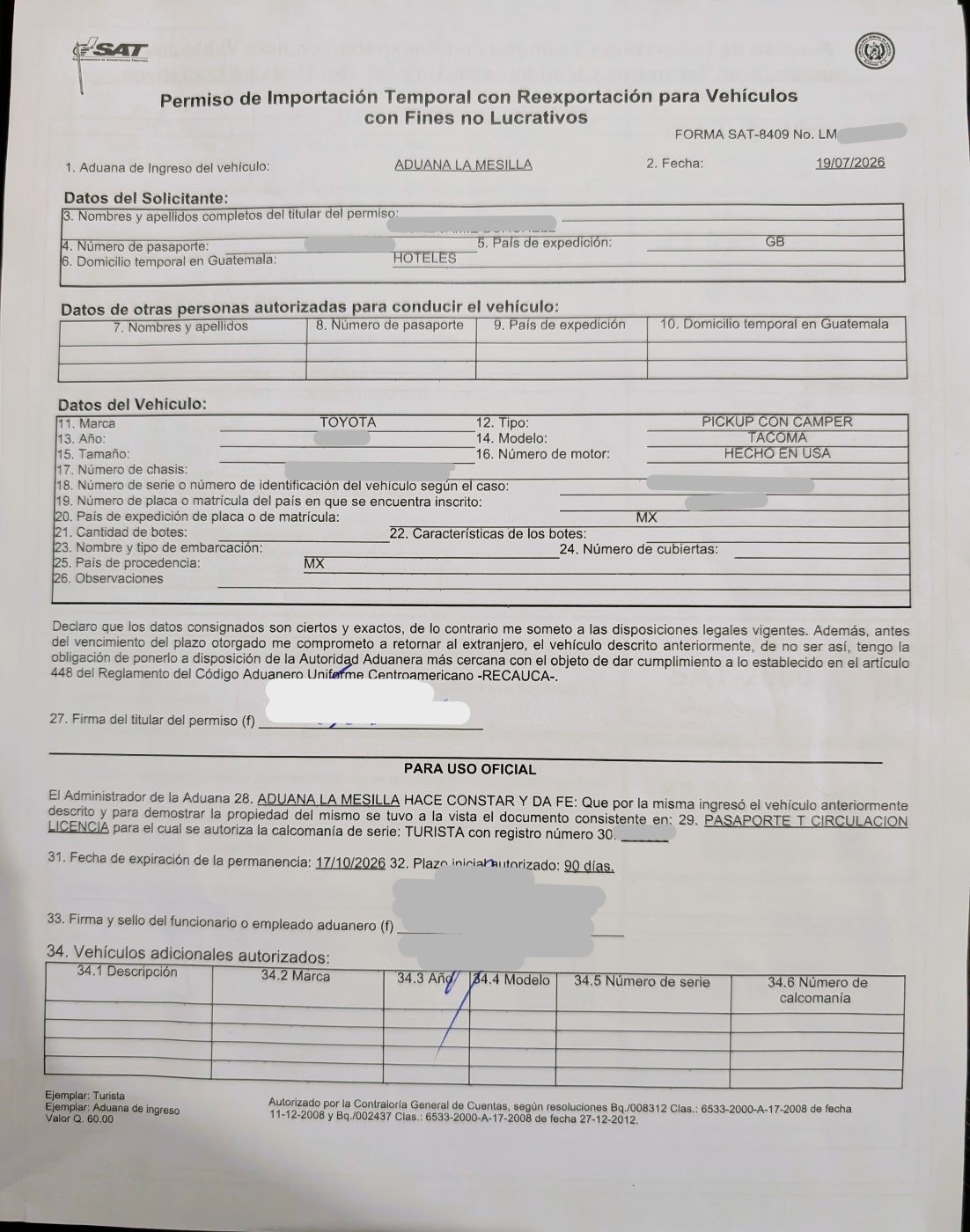
Driving out with it doesn’t burn it. They stamp the date you left onto the permit — a salida temporal — and it can be used again when you come back. The time you didn’t use is still sitting there. Make sure that stamp actually happens; carrying the paperwork into Mexico is not the same thing as having the exit recorded.
So keeping it looks like the obvious win. Spend a month in Guatemala, drive home with the permit, come back while it still has time on it, and you’ve paid once for two trips.
So why do I close it? Because pausing only helps if you’re actually coming back in time. What I have understood over the years is that they want a gap between one permit closing and a new one opening — which means a permit you hold onto and let run out doesn’t free you up the day it expires, it frees you up later than that. Holding an open permit you won’t use costs you your next one.
We travel in the school holidays, so I usually know before I leave Guatemala when our next trip will be. If we’ll be back in time, I keep the permit. If we won’t, I hand it in — and as long as we don’t return for three months or more, I’ve had no trouble opening a new one. It took me a while to be sure of that, because what the officials tell you can be a little vague.
I don’t bother keeping a photo or record of the permit once I’ve handed it in. They tend to check your last entry date in your passport anyway — more than once I’ve been asked whether I’d had an importation permit before — so I just keep to that three-month gap between permits, because it has worked with every official who’s processed mine.
Important caution
Two different things above, and I’d weigh them differently. The permit being stamped and paused on exit is what I have seen happen, repeatedly, at this border. The gap they want before issuing a new permit is my understanding rather than something I can quote you — and it is the half you’d actually plan a trip around. Validity periods and waiting periods are matters for Guatemalan customs; they can change, they may be handled differently at other crossings, and officials apply them. Guatemala’s SAT requirements for temporarily importing a tourist vehicle set out the process, though they don’t publish the waiting period I describe. If your dates are tight, confirm at the desk before you commit.
06 — Guatemala to Mexico
Northbound, coming home
- Guatemalan immigration at La Mesilla. Stamped out.
- Decide about the permit. Hand in the document and the windscreen sticker to close it, or carry it with you. See above.
- Mexican fumigation — up at the border, not down the hill. The two fumigation points sit a few metres apart at the top, one for each country — the northbound spray isn’t waiting for you down at Ciudad Cuauhtémoc, as I used to think. Pay on the spot: ✓ MX$110 in August 2026, receipt held.
- The unsigned left, before the taxi rank. Straight after fumigation you’re usually waved off to the left — no sign, nothing marking it. Go down to the first corner, turn right, follow it a couple of hundred metres, and it drops you back onto the road down to Ciudad Cuauhtémoc. Miss it and you’ll be hunting for where you’re meant to be.
- Drive the five kilometres down to Ciudad Cuauhtémoc.
- Mexican immigration at Ciudad Cuauhtémoc. Passports stamped back in. Nothing to pay for the vehicle — it’s Mexican-plated, so coming home there’s nothing to import.
07 — Sundays & timing
Is La Mesilla open on Sundays, and how long does it take?
Yes, in my experience — and I’d trust that over what you’ll read elsewhere. Plenty of guides warn that this crossing doesn’t process people at weekends. That simply hasn’t been true for me. I’ve crossed here on a Sunday, in one direction or the other and in the car, every year for many years, and it has been open every time, vehicle desk included. The two most recent were both Sundays — the full vehicle import driving into Guatemala in July 2026, and the drive home in August 2026 — and neither hit a closed desk or a hitch.
What I won’t give you is a timetable. The published hours for this crossing don’t even agree with each other, and immigration, customs and the vehicle desk don’t necessarily keep the same one — so I’m not going to print a set of times as fact. Arriving early matters far more than which day it is.
With my own vehicle and nobody in front of me, passports and the vehicle permit together take about forty-five minutes. If there are one or two tourists already partway through importing a car, expect an hour and a half. That’s the single biggest variable in the day, and once you’re in the queue it’s entirely out of your hands.
I arrive as early as I can, for two reasons: the queue is shorter, and it’s hot in both Ciudad Cuauhtémoc and La Mesilla — turning up in the middle of the day with young children and then waiting is genuinely miserable.
The shuttle services come through between about 12.30 and 1.30. When they do, they add twenty to forty minutes overall to getting your passports stamped — that’s the combined delay across both sides, not at each. If you can get there before midday, you’ll avoid some of that wait.
08 — Money & ATMs
Changing money, and finding an ATM
Coming from Mexico, you’ll need quetzales in hand before the crossing is done. The Q160 vehicle permit is paid in quetzales at the Banrural beside the SAT office, fumigation is quetzales, and if you’re on local transport the colectivo and the onward bus to Huehuetenango are cash too. None of those windows take a card. And there’s nowhere to draw quetzales on the Mexican side — Ciudad Cuauhtémoc has no bank and no ATM at all — so this isn’t something you can leave until you’re moving.
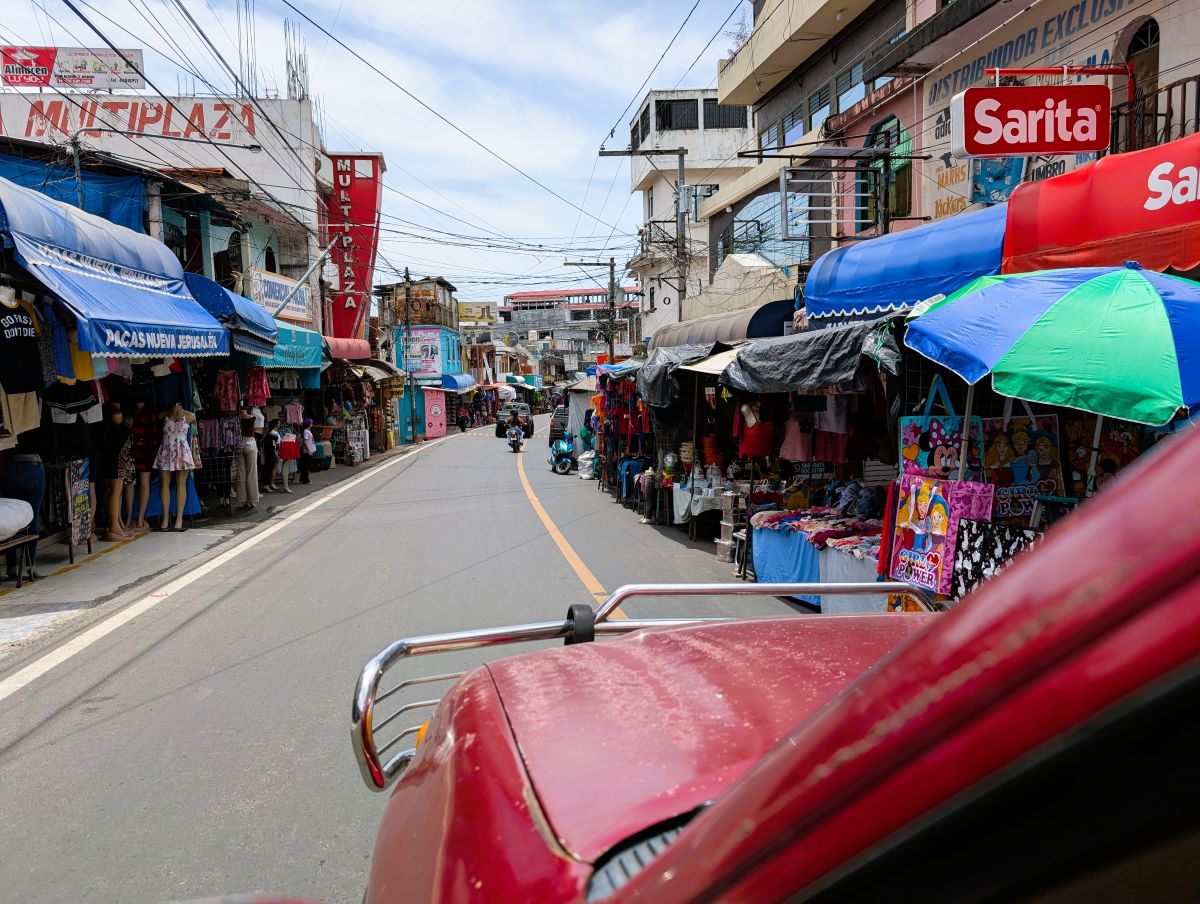
La Mesilla itself is a market town, and on market days it fills with people from towns a couple of hours away on both sides of the line. Money changers work all along the street. The ones planted right outside the immigration office — where you stamp your passport — give the worst rates on the hill; they tend to improve if you decline and walk on.
The thing I watched most closely in August 2026 was that the two directions aren’t equally bad. Turning quetzales into pesos was close to a fair rate. Turning pesos into quetzales — which is the trade you’re making if you’ve arrived from Mexico — took a much deeper cut.
What I was quoted · La Mesilla · Sunday, August 2026
| Where, and which way | Rate quoted | Vs mid-market |
|---|---|---|
| Quetzales → pesos, by the immigration office | MX$2.00 per Q1 | ~12% under |
| Quetzales → pesos, up the hill from the office | MX$2.17 per Q1The rate my partner actually changed at. | ~4% under |
| Pesos → quetzales, by the immigration office | Q35 per MX$100 | ~20% under |
| Pesos → quetzales, up the hill (likely) | around Q40 per MX$100My read of the better rate away from the office — an estimate worth the walk to test. | ~9% under |
| Mid-market reference that day | ≈MX$2.27 per Q1 (≈Q44 per MX$100) | — |
So the direction stings the wrong way for anyone arriving from Mexico: you need quetzales, and pesos-to-quetzales is exactly the trade the street treats least kindly. The Q35 per hundred offered by the office was frankly poor; I’d expect nearer Q40 a few minutes up the hill. Going the other way — quetzales back into pesos on the way home — was barely below a fair rate.
Worked example — changing quetzales to pesos
On 2 August 2026 my partner was given MX$2.17 per Q1 by a changer up the hill, away from the immigration office. At that rate, Q500 came back as MX$1,085, against about MX$1,135 at the reference rate — a difference of roughly MX$50, or 4.4%. The first offer, right beside immigration, was only MX$2.00; declining it and walking a few minutes up the hill was worth doing. This is the reassuring direction: if you’re heading home into Mexico with quetzales to spend, you lose very little changing them here.
The two ATMs on the hill
Where the cash is — nothing on the Mexican side
Guatemalan immigration → 5B ATM · Plaza Campoar, halfway up → Banco Industrial ATM · near the top → bus terminal, ~100 m on
Both machines are up the hill on the Guatemalan side: a 5B ATM about halfway up at Plaza Campoar, next to G&T Continental and Banrural, and a Banco Industrial (BI) machine near the top, roughly a hundred metres before the bus terminal.
One thing to have straight if you arrive from Mexico with no quetzales: the Banrural right beside the SAT office — where you actually pay the permit — has no cash machine of its own, and the two ATMs that do exist are both up in the town, above the border. So a machine is no help for the permit or the fumigation. Either bring some quetzales with you, or change just enough with the changers at the border (poor rate, but only to cover those first payments) and draw the rest from the BI machine once you’re up the hill.
I drew my quetzales from the BI machine on a Mastercard. It gave me Mastercard’s official exchange rate and charged one flat fee of US$6 — about Q46 — which it prompted me to accept on screen. Crucially, it never asked me to accept a currency-conversion rate of its own (the “convert this to your home currency?” prompt that quietly skims a few per cent off), so the US$6 was all there was. On a Q2,000 withdrawal that works out at just over 2% all in, which I find perfectly reasonable. Your own bank may add a foreign-transaction fee that the BI machine doesn’t; mine lets me withdraw abroad for free — so run your own numbers in the calculator below.
A worked example: getting Q500 at the border
Money changer vs the BI ATM · defaults from 2 August 2026
Adjust the assumptions
| How you get the quetzales | What it costs | You lose |
|---|---|---|
| Reference value of the quetzales | MX$1,135 | — |
| Street changer at your quote | MX$1,429 | MX$294 |
| Banco Industrial ATM + fee | MX$1,239 | MX$104 |
At the defaults above — Q500, a Q35 quote — the BI ATM comes out about MX$190 cheaper than the changer by the immigration office, and roughly level with a Q40 quote up the hill. This was my clean Mastercard withdrawal; push your card’s foreign-transaction fee above zero and the ATM can lose that edge. Treat it as the shape of the decision, not a verdict.
Break-even street quote: Q40.3 per MX$100 — above that the changer wins, below it the ATM does (before your own bank’s fee).
Reference figures are the Banco de Guatemala / Banco de México rates for the last banking day before the crossing — Banguat and Banxico — not a rate anyone offered me. They move daily; check live before you rely on them.
I'll say plainly that La Mesilla has always felt fine to me. Twenty years of crossing here, usually with my family, and it's been a busy market town getting on with its day — not somewhere I've felt I needed to watch my back. I change money on that street without thinking twice.
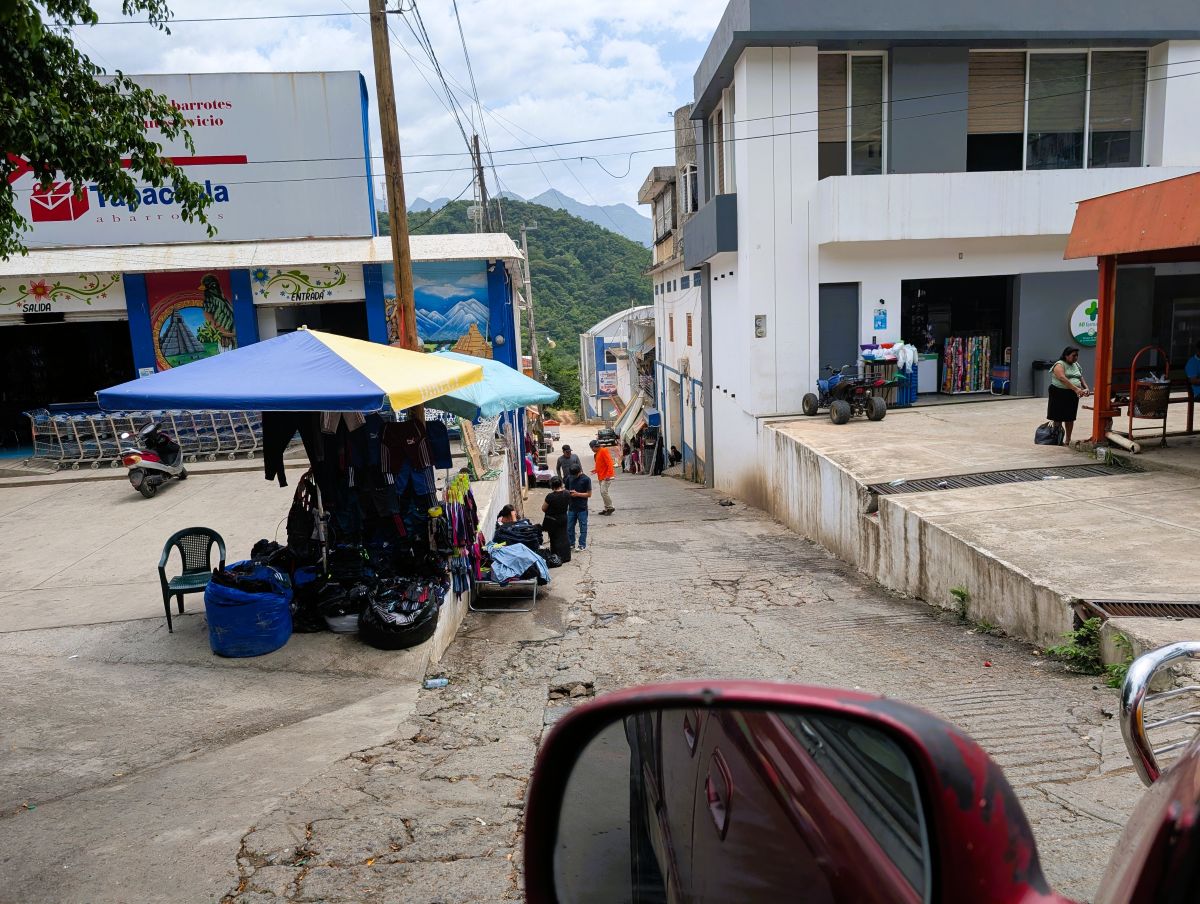
The line of shops and stalls runs for more than a kilometre up the hill, with the local bus terminal at the top if you're carrying on without a car.
On the rates above
These are what individual changers quoted me on one Sunday in August 2026, not a posted tariff — every changer sets their own rate and they move daily. Check a live rate on your phone before you commit, and treat the "up the hill" figure as my expectation rather than a promise. What's durable here isn't the exact number: it's that the changers by the immigration office give the worst rates, and that pesos-to-quetzales currently costs you more than the other way round.
09 — The road
The road, and driving it with children
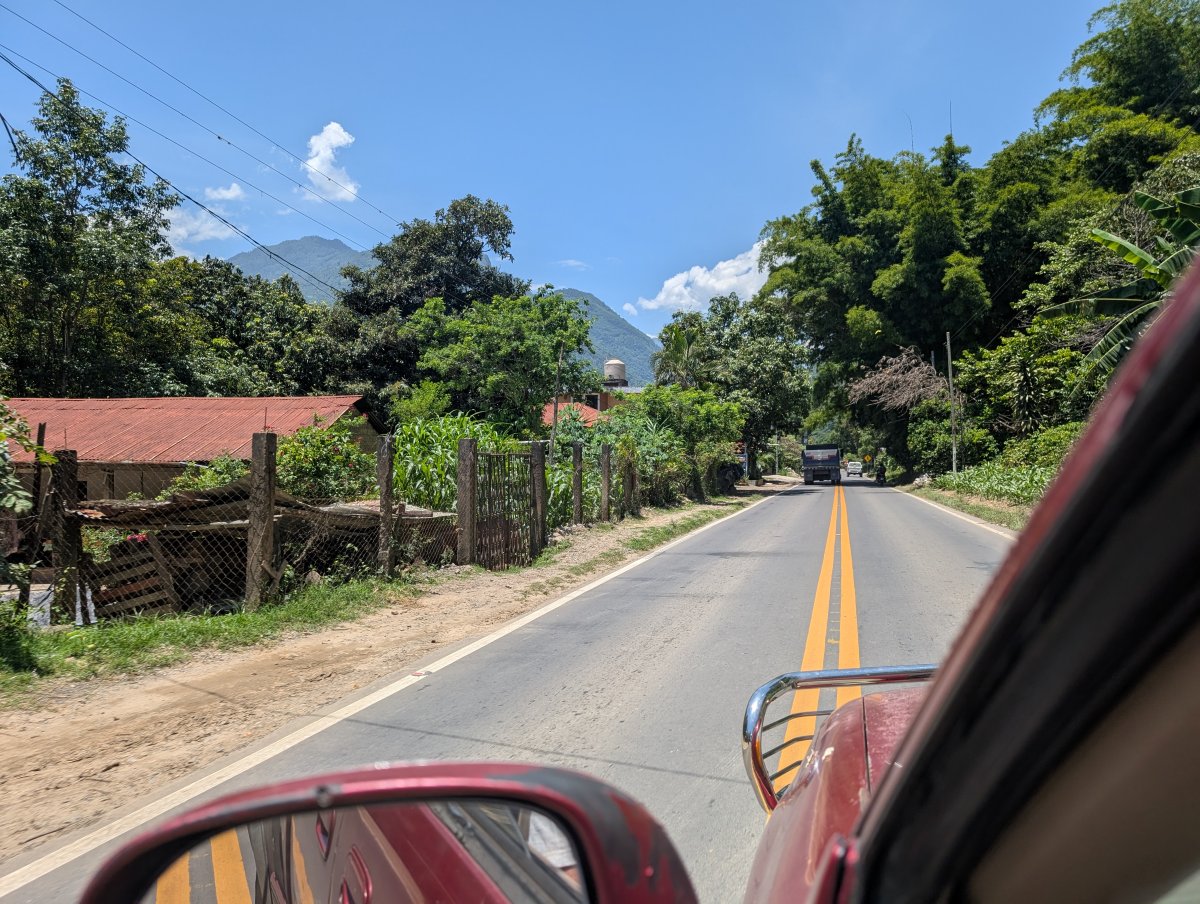
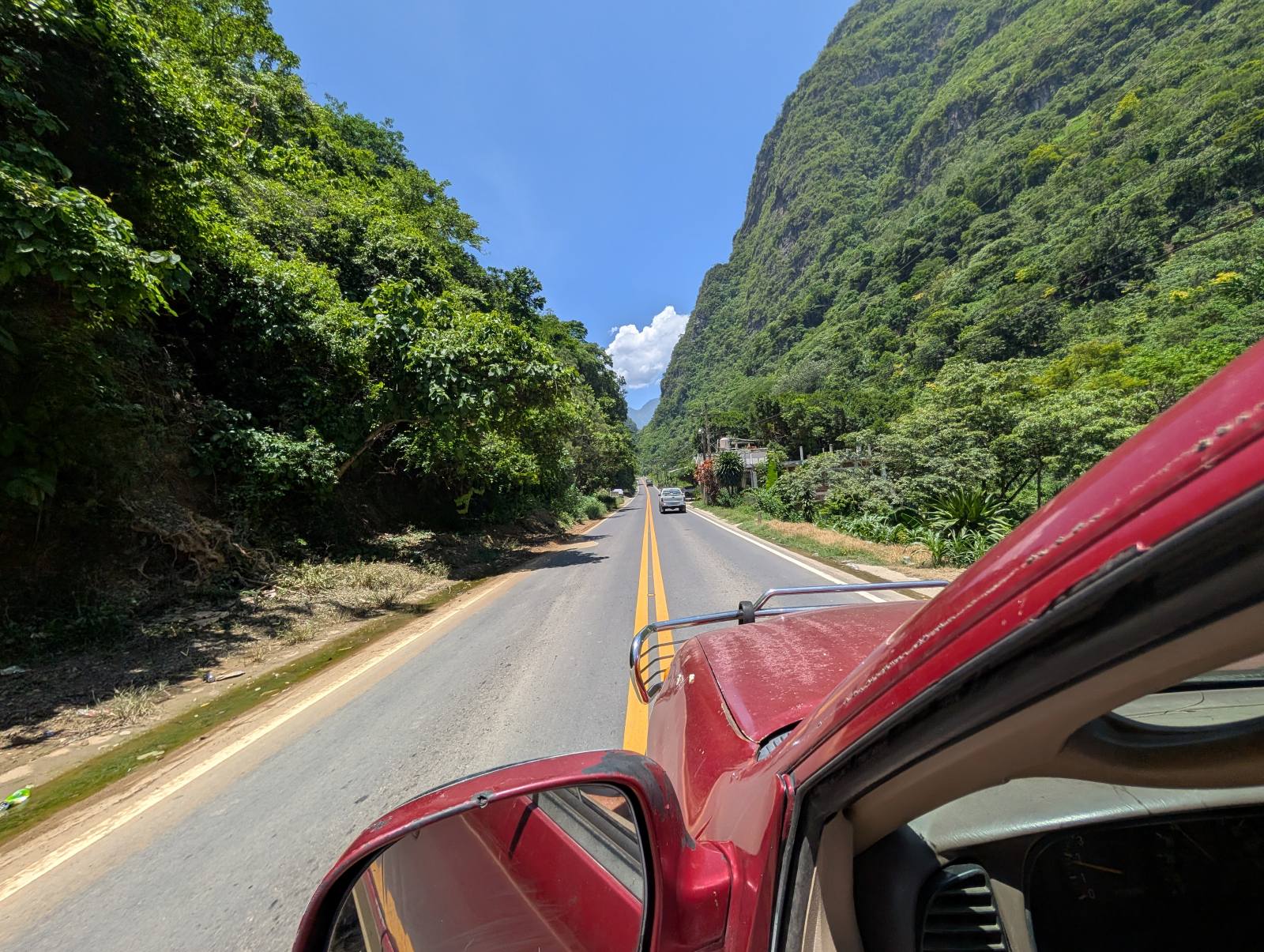
The road between Huehuetenango and La Mesilla is slow, winding and genuinely beautiful. It takes about two hours, not the ninety minutes the distance might suggest — there's slow-moving traffic much of the way, heaviest in the first half-hour climbing out of La Mesilla. It is also the stretch that made both of my children travel sick when they were small. We used to give them ginger to chew — not pleasant, but they took to it readily enough once they worked out it settled the nausea. It seemed to help. If anyone in your family suffers, take whatever you already trust.
The smoke
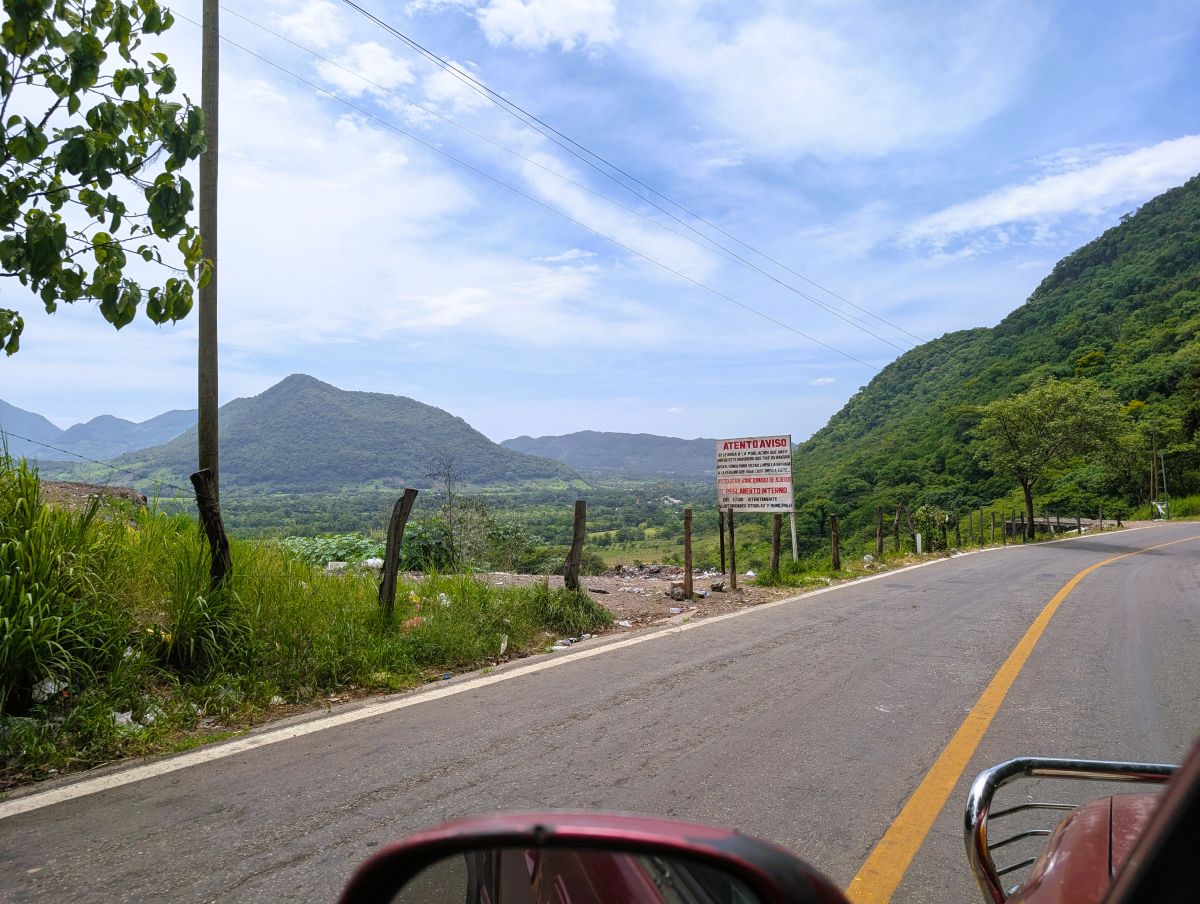
Rubbish is burned on the mountainside about halfway between Ciudad Cuauhtémoc and La Mesilla. It has been smouldering on every crossing I can remember, including days when nothing new appeared to have been lit, and a lot of what burns there is plastic. It was still going in July 2026.
I close the car windows and set the fan to recirculate before we reach it. The smoke is sometimes thick, dark and acrid, and I'd rather my children weren't breathing it. It's over in about thirty seconds. It's the one part of this drive I actively plan for.
10 — Breaking the journey
Where we stop
We break this drive in Huehuetenango, because we have family there. That's not a recommendation so much as an explanation — but it does mean I can tell you that Huehue is where the journey naturally divides, about two hours past the border — with slow traffic much of that road — and before the long stretch onward. Two other places we've used, with honest dates attached:
Piscinas Azufradas de Agua Caliente
Where Huehuetenango meets San Marcos, twenty minutes off the Panamericana. Concrete pools, volcanic hot water — you can smell the sulphur — and slides the children love. Community-managed, with entrance and parking fees going to local people. We take an afternoon there every year, most recently in 2026.
La Ceiba, Camojá
Twelve kilometres and about twenty-five minutes from the border, less than two kilometres off the Panamericana. Good Guatemalan food and an outdoor pool with shallow areas that worked well for toddlers; also a hotel if you'd rather split the drive over two days. We haven't stopped here for a few years — our route changed, not our opinion of it — so treat this as a place I used to use rather than a current report.
No arrangement with either, and I'm not printing their prices.
If you're not driving
Plenty of people do this crossing by shuttle from San Cristóbal, or by colectivo in stages via Comitán. For the border itself I can now give you the practical parts first-hand — the colectivo between the two immigration posts and its August 2026 fare, where to change money and find an ATM, and the Sunday question. What I won't invent is the onward shuttle fares and timetables from San Cristóbal; I don't ride them, so I'd trust the people who do for that leg.
11 — Questions
Questions I get asked
Can I take my Mexican-plated car into Guatemala?
That's what this page describes — I do it regularly. You import it temporarily at La Mesilla, which in July 2026 meant ✓ Q160 for the permit plus ✓ Q17 for fumigation. Requirements are set by Guatemalan customs and can change; check the current ones rather than planning on my figures.
Do I have to hand the permit back when I return to Mexico?
No — you get a choice. Driving out doesn't burn it: they stamp the exit date and the unused time is still there when you come back. I keep it if we'll return in time and hand it in if we won't, for the reasons in the permit decision above. The waiting period that drives that choice is my understanding rather than a rule I can quote, so if your dates are tight, ask at the desk.
Does the car have to be in my name?
I am asked this every time, and the officials have told me it does. Mine is registered to me, so I've never had to find out what happens otherwise — but it isn't a question you want to be answering for the first time at the vehicle desk. If you're planning to drive a car that belongs to someone else, resolve it before you travel.
What documents do I need for the vehicle?
What I hand over is the tarjeta de circulación, my driving licence and my passport. Requirements are set by Guatemalan customs and can change — check the current list before you go rather than packing to this page.
Do I need to tell anyone I'm driving?
Yes, and it's easy to miss. Tell the official who stamps your passport into Guatemala that you're travelling in your own vehicle — that's how you get the SAT customs and duty form you'll need at the vehicle desk. And you pay the permit fee at the bank beside the SAT office, not at the counter.
Is La Mesilla open on Sundays?
In my experience, yes. I have crossed here on a Sunday, in the car, in one direction or the other, every year for many years — and it has always been open, including the vehicle desk. I did the full vehicle import driving into Guatemala on a Sunday in July 2026, and drove home on a Sunday in August 2026 — both went through without a hitch, vehicle desk included. Some guides say otherwise. Published hours for this crossing conflict with each other and the different desks may not share a schedule, so I won't print a timetable — but the weekend closure I keep reading about isn't something I've run into.
How do I get between the two immigration offices, and what's the taxi fare?
By colectivo taxi, from the "Las Champas" rank at Ciudad Cuauhtémoc on the Mexican side, up the five kilometres to La Mesilla. In August 2026 the drivers quoted me MX$20 a head if you wait for the car to fill, or MX$100 for the whole taxi to yourself — ask before you get in, as it isn't posted anywhere. In your own car you just drive it; see getting between the two offices.
Where should I change pesos and quetzales, and is there an ATM?
Change on the Guatemalan side at La Mesilla — there's nowhere to do it in Ciudad Cuauhtémoc, which has no bank or ATM at all. Avoid the changers right by the immigration office; rates improve up the hill. On my August 2026 crossing the two directions weren't equal: my partner changed quetzales to pesos at MX$2.17 per Q1, only about 4% under the reference rate, while pesos to quetzales was offered at just Q35 per MX$100 by the office — roughly 20% under. For cash there are two ATMs up the hill: a 5B at Plaza Campoar and a Banco Industrial near the top, though both sit above the border payment points. Full rates, the ATM route and a cost calculator are in changing money.
Where is the unsigned turn after fumigation, driving north?
Straight after the northbound fumigation at the border, you're waved off to the left before the taxi rank — with no sign at all. Go to the first corner, turn right, and follow the road a couple of hundred metres until it rejoins the road down to Ciudad Cuauhtémoc. It's in northbound, coming home, with a photo.
Do I owe a Mexican tourist tax when I leave for Guatemala?
You might. The Derecho de No Residente (DNR) applies to foreign visitors in the visitante sin permiso para realizar actividades remuneradas category. Under the official rule, a land stay that doesn't exceed seven days is exempt; beyond seven days the fee — MX$983 in 2026 — is collected when you leave. It's card-only at the office and there's no ATM in Ciudad Cuauhtémoc, so pay it online or at a bank beforehand. If your dates are near the limit, confirm with INM how they'll count them.
How long does the crossing take?
About forty-five minutes with nobody ahead of me; around an hour and a half if a tourist or two is already importing a vehicle. Add twenty to forty minutes if you hit the shuttles between 12.30 and 1.30.
Which crossing should I use from San Cristóbal?
For the Guatemalan highlands — Huehuetenango, Xela, Atitlán, Antigua — La Mesilla is the one I drive. I've also crossed at Talismán near Tapachula on the coastal route. I've used Gracias a Dios once, in 2012, and give no directions for it. I've never used El Ceibo. See why this guide covers La Mesilla.
Can I permanently import a vehicle from Guatemala into Mexico?
I don't know — I've never done it. Everything on this page is temporary import of a Mexican-plated car and back again. Permanent import is a customs process and worth taking to a customs agent rather than a blog.
The bottom line
Stop five kilometres early, say you're driving, arrive before the shuttles — and on the way home, decide deliberately whether to pause the permit or close it.
Those three things are most of what twenty years of crossing here has actually taught me. The rest — the fees, the hours, the paperwork — is published by the authorities and changes; the links on this page go to them rather than to my version of them.
What I can give you that they can't is what the day is like: how long you'll really wait, where the money is, when the smoke comes, and where to stop so the children can get out of the car.
Crossed here recently and found something handled differently? Email me with the crossing and the date. I'll keep your report separate from what I've experienced myself — this page is only worth anything if it stays true.
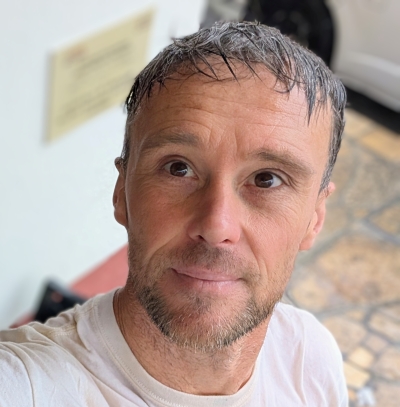
Written by Luke Burchell
I live in San Cristóbal de las Casas, Chiapas, where I self-managed the building of my own house. Before that I spent years doing rural-development work in Guatemala, including designing and building woodstoves in the highlands of Huehuetenango — the department this road runs through. I've been crossing between the two countries for about twenty years, on buses and, for a long time now, in my own car with my family.