Living on rainwater in Mexico: what daily life is like
San Cristóbal de las Casas, Chiapas · 2024–2026
On 22 March 2024, we moved into the house in San Cristóbal de las Casas, Chiapas. That first night we had water in one bathroom sink. There was no glass in the windows, and the door count was one: the front door.
The new roof’s first rain, before any pipes were fitted to carry it to the cistern.
Moving in before it was finished
We slept on three mattresses on the floor by the entrance. The one bedroom was too small for all of us and still had a rough concrete floor.
It may have looked like squatting, but it felt like an adventure.
By the second night I’d connected the kitchen sink to the roof tank. Gravity did the rest. Other taps could wait. Each day brought another chance to make the house work a little better.
I’d only just got electricity after years of building with hand tools. That felt like such a win that my worries about water had faded.
There was no mains connection, but I expected the roof to catch rain from May to November. The first time it rained on the new roof, before any pipes were fitted, we’d all stood and watched it pour to the ground. I didn’t know how regularly the 10,000-litre cistern would fill. At least there was a river in front of the house.
I had chosen flush toilets, set up to use as little water as possible, and hoped we could keep using them all year. I was prepared to build compost toilets outside if we needed them.
We moved in early because my rent had been rising faster than my earnings. After years of building, the house still wasn’t completely finished, but when my rental contract was coming to an end I didn’t want another six months in the same place.
Moving with a pickup seemed to take ten times as many trips as I’d planned. By then, the condition of the house was in an unreachable part of my brain. At least the years of bicycle trips to work on the house were over.
I’ve described the catchment, storage, filtering and wastewater arrangements in my off-grid water guide. This is how we got used to living with them.
Rain for the house, river water for the laundry
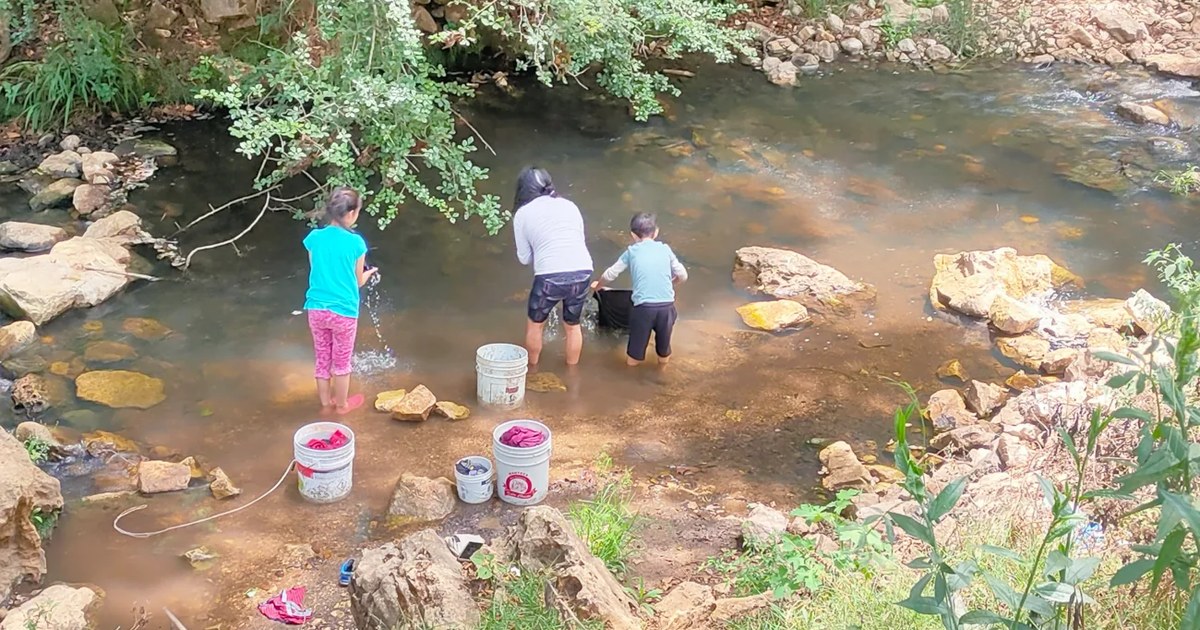
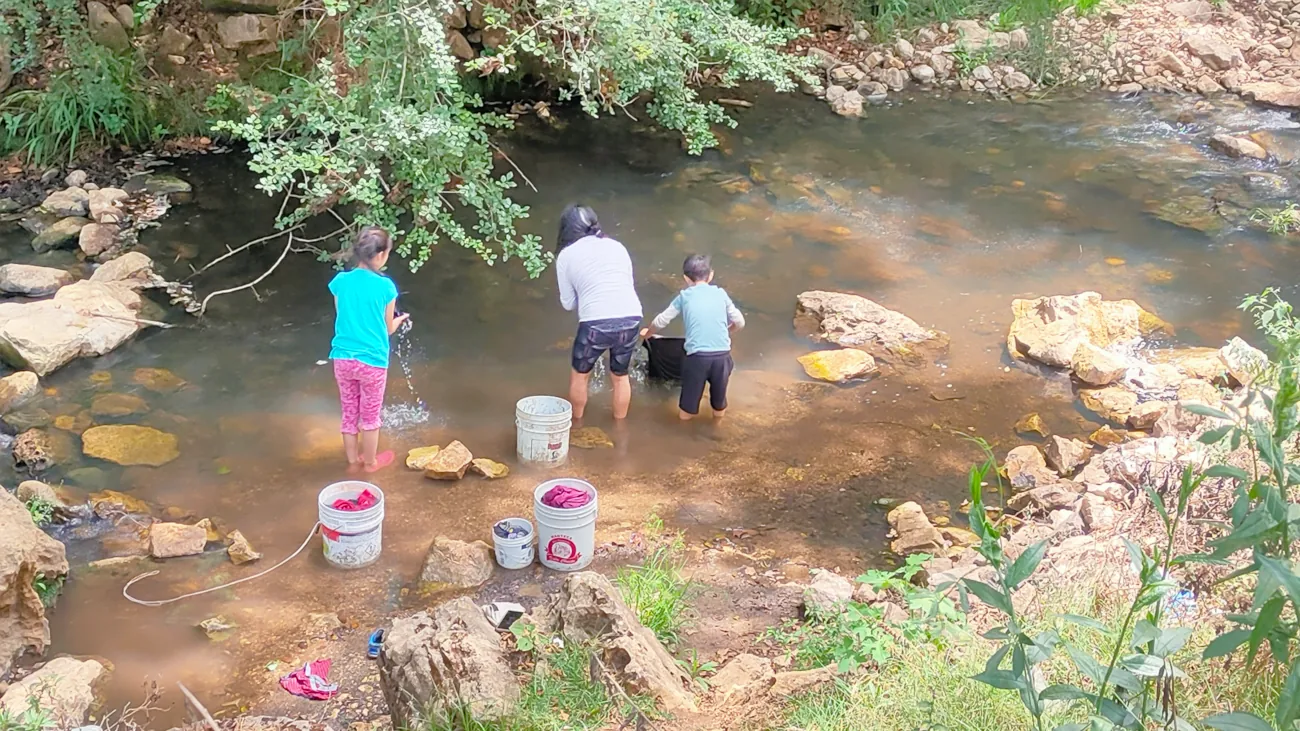
For the first few months, the children and their mother washed our clothes in the river.
Washing clothes in the river in front of the house, in our first months there, 2024.
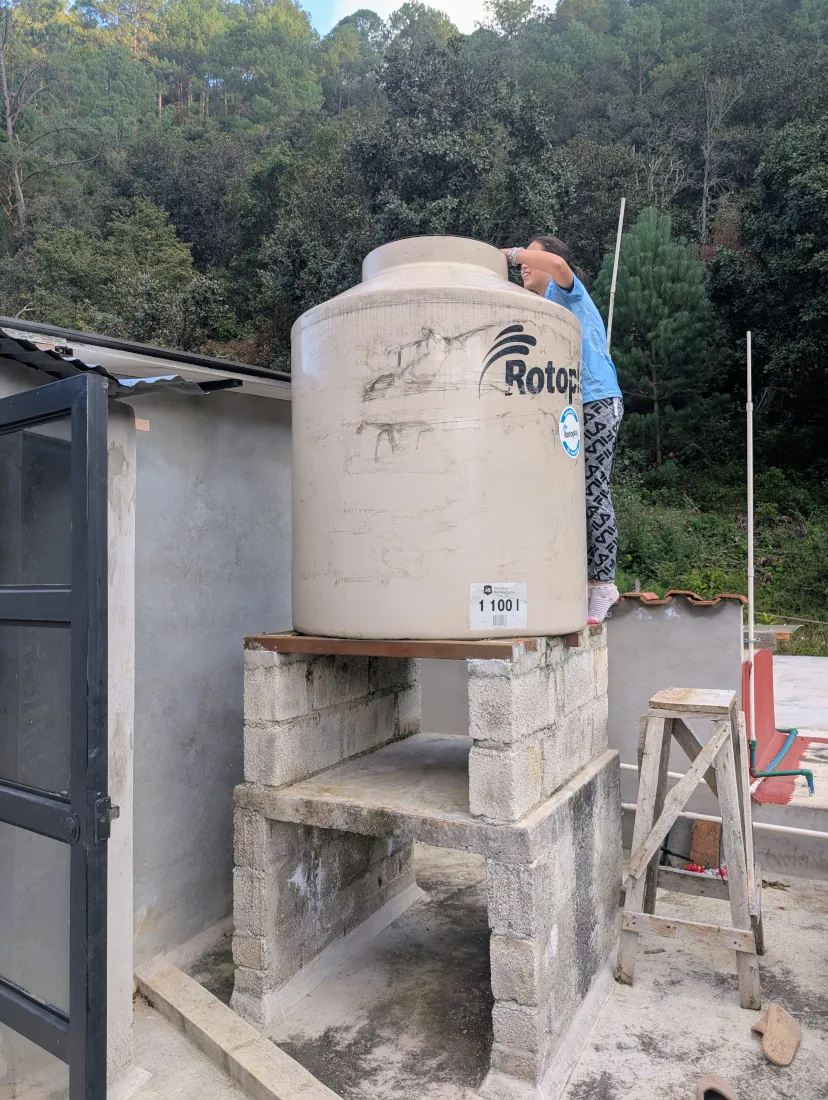
Two months after we moved in, the rains arrived. From the start, I’d used a pump to lift water from the cistern, with a long hose to fill the 1,100-litre tank on the roof. One person below switched on the pump while another climbed a ladder to hold the hose in the tank, then yelled down when it was full.
A tankful could last us a week if we used it sparingly and took quick showers. We were careful, just in case we ended up having to take our soap down to the river.
We soon learned that the roof caught more than enough water for those simple daily needs. But I didn’t want to connect the washing machine and upset the balance, particularly when we had no idea what the dry season would be like.
Instead, we carried river water up to the washing machine. The riverbank is steep, so we told ourselves we were getting a good workout for our arms and shoulders. The dirty clothes still piled up faster than we could wash them. It wasn’t just physically tough: it took time, and the buckets sloshed water over us as we climbed the bank.
By the end of the year I had installed proper piping from the cistern to the roof tank. Nobody had to pose as a fireman at the top of a ladder holding the hose anymore. We still had to check the tank and switch the pump on and off ourselves.
Getting through our first dry season
Luckily for our water supply, the dry season in San Cristóbal brings cold nights and often cold days from November through March. It can be warm in the sun and icy inside the house. Fewer hot, sweaty days meant fewer occasions when a shower felt essential, particularly for the wellbeing of anyone standing nearby.
On paper, a full cistern held about nine tankfuls: nine weeks of careful use, against a dry season of nearly six months. I checked the cistern every couple of weeks, and showers were rationed to two or three per person per week. That made the children particularly happy.
All through the dry season we saw many families coming to the river to wash clothes, and even to transport water in barrels back to their communities.
By the end of April, a few weeks before the rains usually start, the cistern was about 90% empty. Sporadic light rain had helped us get that far. Seeing it so low gave me mixed feelings. We’d made it this far through the dry season, and that was pretty impressive for a family of four. But there was a slight disappointment too: we were so close to the first rains, and perhaps not going to make it without a water truck (pipa).
Then some early rain got us over the finish line. We’d met our goal of getting through on our own supply.
More storage, and the end of river laundry
In 2025 I added a second 1,100-litre Rotoplas on the roof, so the pump now fills two tanks from the cistern. Extra tanks let me add capacity without enlarging the concrete cistern already buried in the ground.
That same year I fitted guttering to the concrete roof, then added a 1,100-litre and a 500-litre tank to catch its water for washing clothes. The runoff looks less clean than what comes off the tin roof, so I keep it for laundry.
We no longer use the river. It looks far less clean than when we moved in, so I’m particularly glad we no longer depend on it.
Learning when to save water and when to enjoy it
It took me two wet and dry seasons to become less frugal when it rains. I’m always conscious of how precious the water is, and changing habits twice a year still takes some adjustment. In the dry months I try to make every drop count. When the rains return, I can shower for ten minutes every day and enjoy having plenty.
A shower with rainwater feels wonderful. Whether it’s partly psychological or I really do glow like an angel afterwards, the jury’s out. The showerheads, toilet tanks and kettle stay free of limescale, which is a benefit I can actually see.
I use rainwater from the tap to fill my ceramic drinking-water filter, and I prefer its taste to the bottled water I used to buy. It’s what my children now take to school in their flasks. That preference isn’t a water-quality test: collected rainwater needs treatment and testing suited to how it will be used, as the CDC’s guidance on collecting rainwater explains.
I like having the seasons shape our behaviour. Moving between saving water and having plenty keeps me appreciative of it.
A song without pauses between the beats would become a wall of sound. The pauses help make it music.
The switch I’m still proud of
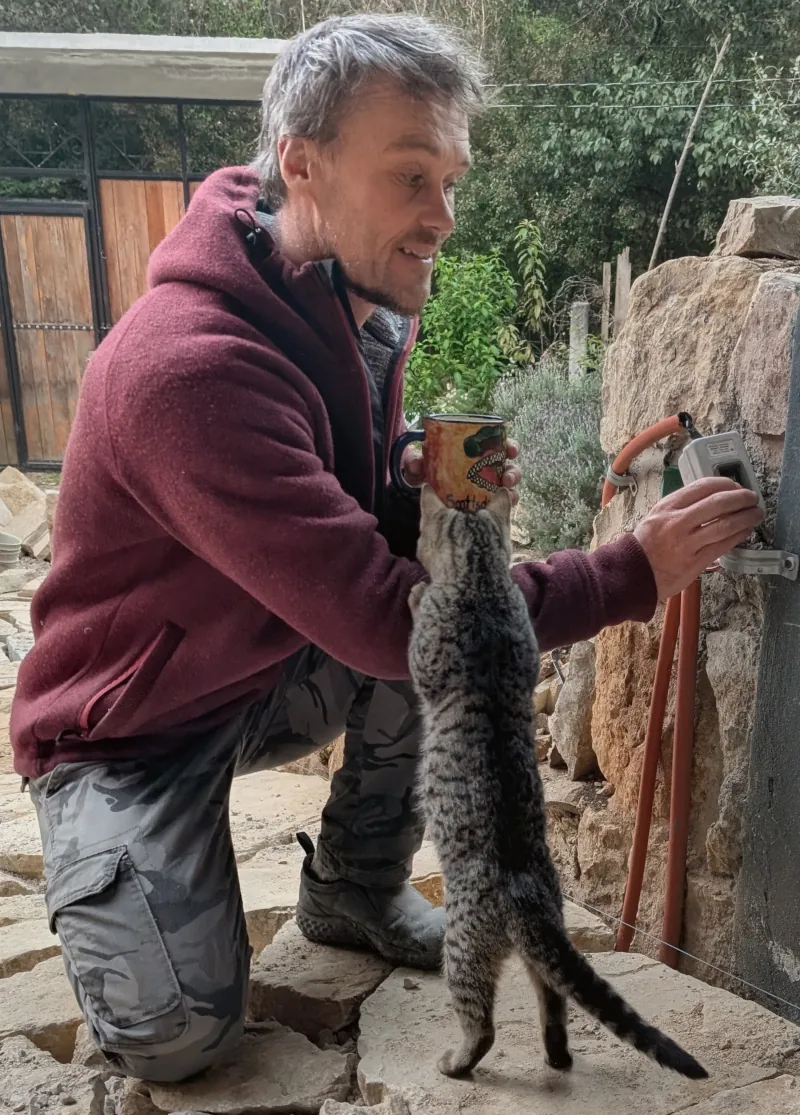
We switched the pump on and off manually for two years before I installed an electronic float switch in 2026. Now it responds to the water level in the roof tank and operates the pump for us.
The family adjusted to the convenience immediately. No more going up to the roof, climbing up to the tinaco and peering in to see how much water remained. No more checking when to switch the pump off.
Before the float switch: climbing the stand to see how much was left in the 1,100-litre roof tank.Switching the cistern pump on by hand, with company. Since 2026 the float switch does it.
After a couple of weeks, everyone was bored of hearing me boast about how nobody had to go up to the roof anymore, and how amazing it was that the tank now filled itself.
I still see the cable running down to the pump in front of my bedroom each morning, and secretly look at it with pride.
This is one household’s experience in San Cristóbal de las Casas, Chiapas, from March 2024 to 2026, written from my own notes and memory. Rainfall, roofs, storage and water use differ from site to site. How we drink our rainwater is our own choice, not a recommendation or a water-quality standard.
— Luke Burchell
About the author
Written by Luke Burchell. I self-managed the build of this house in San Cristóbal de las Casas while working full time, and fitted much of its rainwater system myself, from the pump and roof tanks to the guttering and float switch. We’ve lived on rainwater since March 2024. Read my full story →
Follow along
I email new articles as I publish them. Subscribe if you’d like to read the next one.
San Francisco Las Flores, and the beans that wouldn’t cook
Huehuetenango, Guatemala · 2013
I went to San Francisco Las Flores twice in 2013, both times to help families cook with less firewood. What I remember best is the night I couldn’t cook a pot of beans.
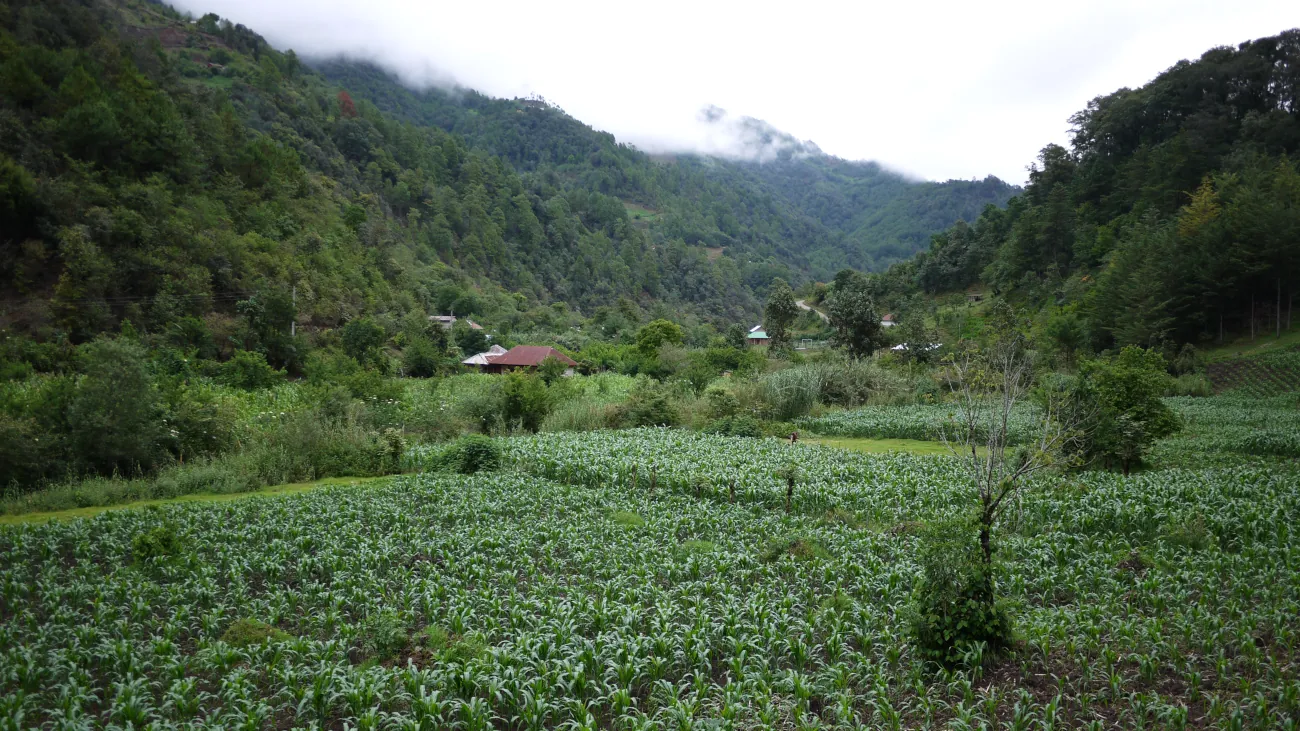
San Francisco Las Flores, 2013: young maize on the valley floor, houses at its edges, forest up the slopes.
Two trips into the Cuchumatanes
San Francisco Las Flores is a village in the municipality of Chiantla, Huehuetenango, deep in Guatemala’s Cuchumatanes mountains. It mattered to the stove project before I ever got there. The engineers at ACODIHUE, a regional development association working with smallholder farmers across Huehuetenango, came from San Francisco Las Flores, and they had chosen the cookstove I’d designed.
The first trip was in March. Juan, the young man I’d trained to install stoves, came over from Nebaj the day before, and we met in Huehuetenango at about 5.30 in the morning. We were picked up and driven up into mountains I already knew well. The road to San Francisco Las Flores leads off from San Juan Ixcoy and runs alongside a beautiful emerald-blue river.
The installing was slow, with just the two of us following a plan agreed with the leaders of each community. We worked until dark every day, and some nights we slept in the house where we’d put in the last stove of the day. Some houses in San Francisco Las Flores had no road to them, so the last stretch was by mule; I’ve told that part in the stove’s own story.
I went back in July, in the rainy season, for three days, with a colleague and three American engineering students. We were testing a second stove I’d designed, a small rocket stove for tortillas and big pots of corn, and asking families how the stoves they’d bought were working.
Three meals a day
I was leading the group, and the hardest part of the job turned out to be feeding everyone three times a day. The days were cool and wet, and by evening we were all hungry. We stayed in a wooden cabin and cooked on a gas stove, by the light of our own solar lamps, because there was no electricity.
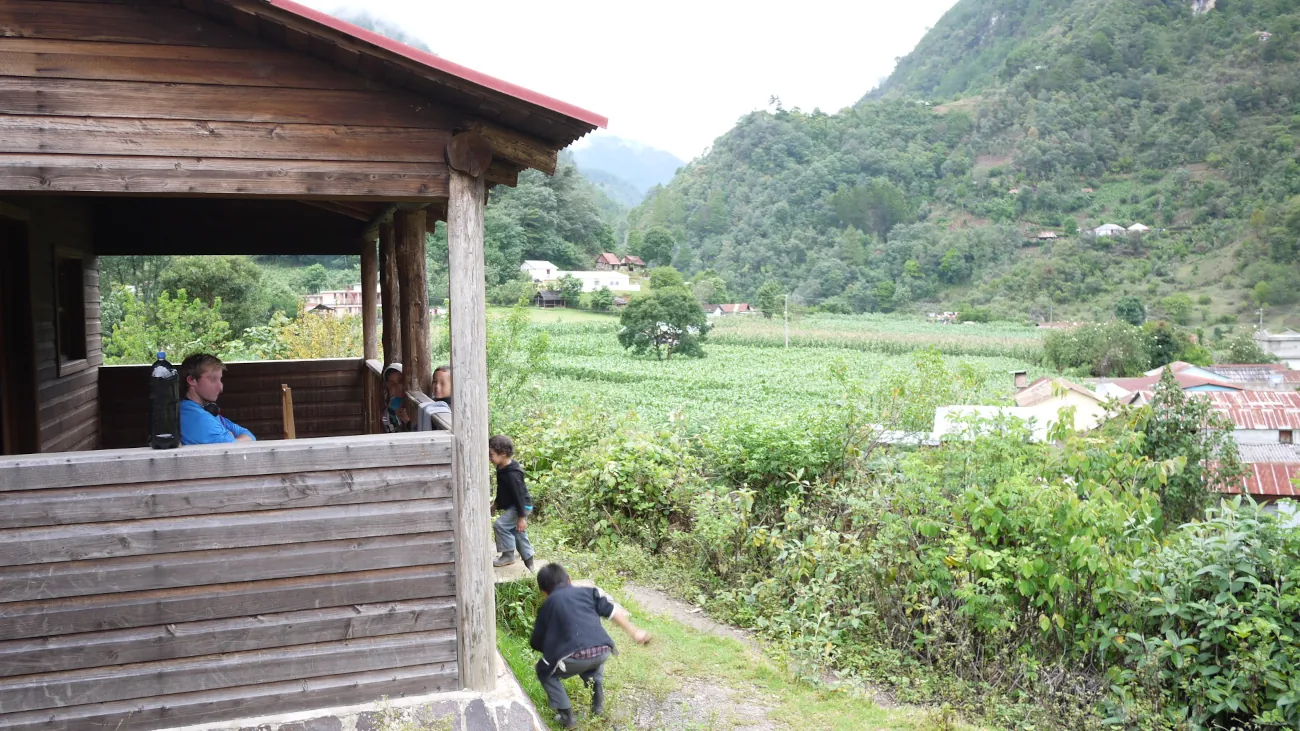
Our cabin in San Francisco Las Flores, July 2013 — a colleague on the porch, the valley behind. One child’s face has been blurred.
One night I had beans on that stove for four hours, and they were still hard. Not undercooked: inedible. It was getting late.
So we carried the pot through the dark to the nearest house. The family’s fire was still lit. The woman of the house added some cal, the lime people use to soak corn for tortillas, and cooked the beans over her fire for another hour. It was around ten at night when we finally ate.
Her stove wasn’t one of ours. I noticed how much wood was burning in it, and how open the flame was at the intake: the way the traditional concrete stoves were built, the kind the programme was there to replace.
We’d come to replace stoves like hers. That night, hers cooked our dinner.
It wasn’t a verdict on either stove. She had a fire still burning at ten at night, and knew what to put in the pot.
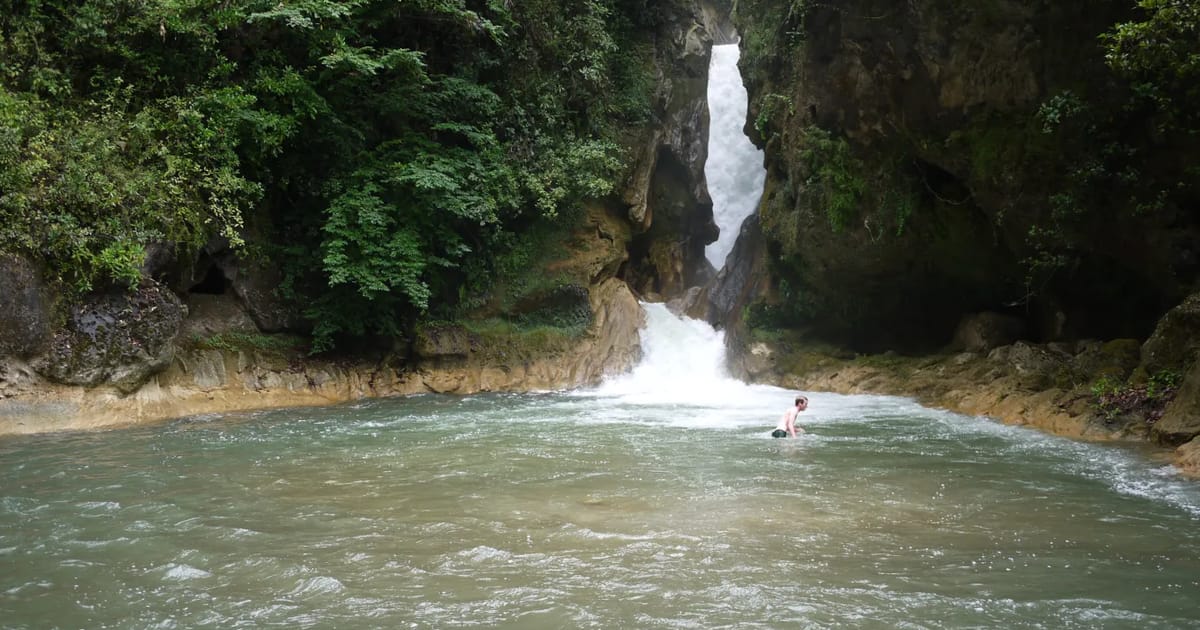
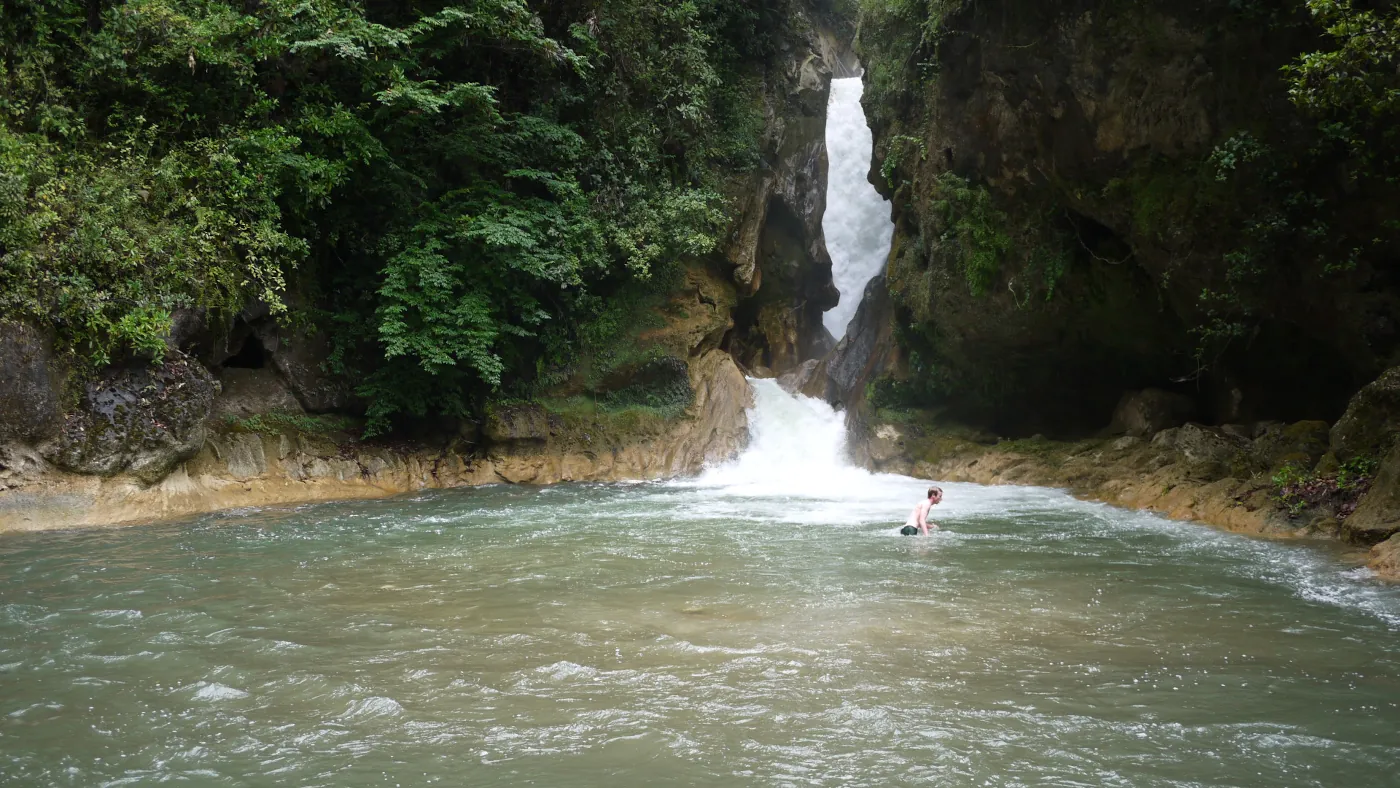
A waterfall in San Francisco Las Flores, 2013.
What I was told about the peas
The community leader told me the snap peas grown on those slopes went to the UK. I didn’t see the fields where they were grown, but it still felt strange to be in a remote corner of Guatemala and think that my family back in the UK might be buying peas from here in their local supermarket. San Francisco Las Flores was a long way from the big export plantations on the coast. As I understood it, its peas reached the UK through the networking and hard work of the village’s leaders, and I liked knowing that the same leaders had been involved in choosing the stoves going into local families’ kitchens.
Afterwards
For about three years after the stoves went in, my colleague, the regional coordinator for Huehuetenango, and I kept hearing from the community leader that they were working well, with no problems using or maintaining them. That’s second-hand, but it was the news a stove programme hopes for. In the years after, I was supporting the team in Quiché with their own local manufacturing of portable stoves.
I haven’t been back to San Francisco Las Flores since 2013. I still drive up into Huehuetenango a few times a year, across the border at La Mesilla, but I can’t tell you what the village is like now: how far the road reaches, whether there’s anywhere to stay, what grows on those slopes, or whether those stoves are still lit.
Thirteen years on, I still think it’s one of the most beautiful parts of Guatemala.
I say that after eight years living in Guatemala and working in dozens, possibly hundreds, of communities. It’s the heavily forested mountains, the areas of alpine cloud forest, the waterfalls and rivers, and almost no tourism. If you want to get well away from the tourism of Antigua and Lake Atitlán, Huehuetenango and communities like San Francisco Las Flores make a stunning adventure, with fewer comforts.
Weigh the official advice first. The US State Department tells Americans not to travel to Huehuetenango department at all, because of crime and terrorism by cartels, gangs and criminal organisations. The UK government‘s warning is narrower: a strip along the Mexican border and three towns, none of them near San Juan Ixcoy. I checked both in October 2026. My own trips there are my experience, not a safety rating.
I still have a motorcycle in Guatemala, and I plan to ride back with my son in 2027 to see the community again.
This is a personal account of two short visits in 2013, written from memory more than a decade later. Numbers are as I recall them. The peas and the later news about the stoves are what I was told, not things I saw. Nothing here describes San Francisco Las Flores today.
— Luke Burchell
About the author
Written by Luke Burchell. I spent more than a decade on community work in Guatemala, Mexico and South Africa, much of it in rural villages. I designed the cookstove this programme installed, and went to San Francisco Las Flores twice in 2013 to install and evaluate stoves. I now live in San Cristóbal de las Casas, Chiapas. Read my full story →
Follow along
I email new articles as I publish them. Subscribe if you’d like to read the next one.
Balneario Isla de María: our river escape near Tuxtla
By six in the evening, when the air cools and the little biting flies come out, the day visitors have usually gone. From then until late the next morning, the river is ours.
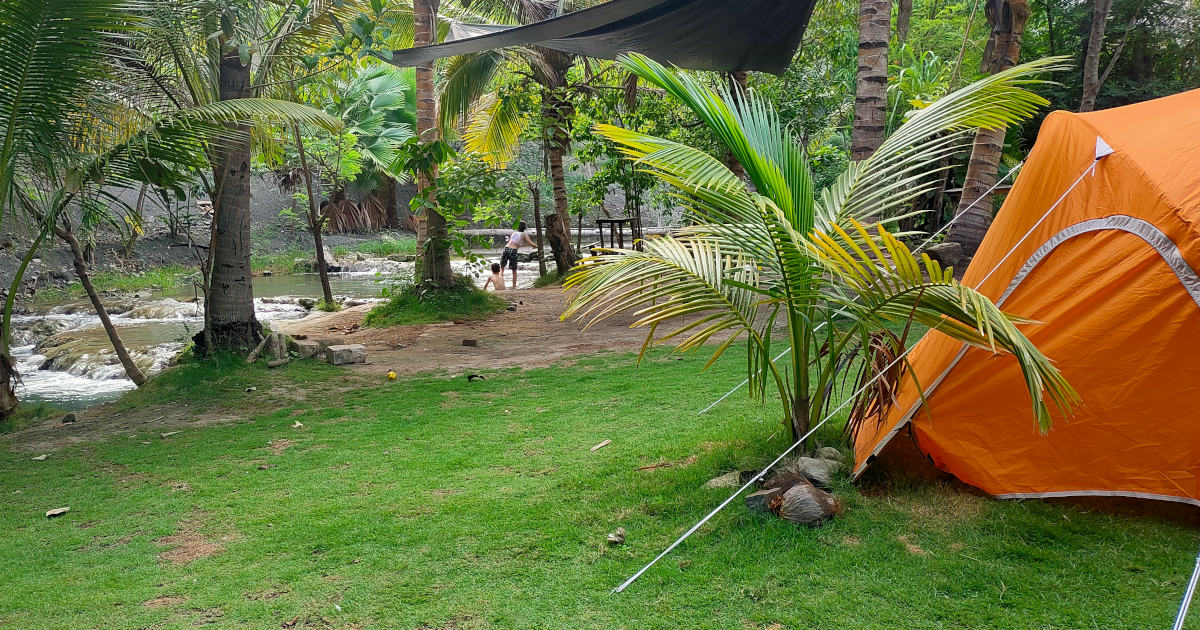
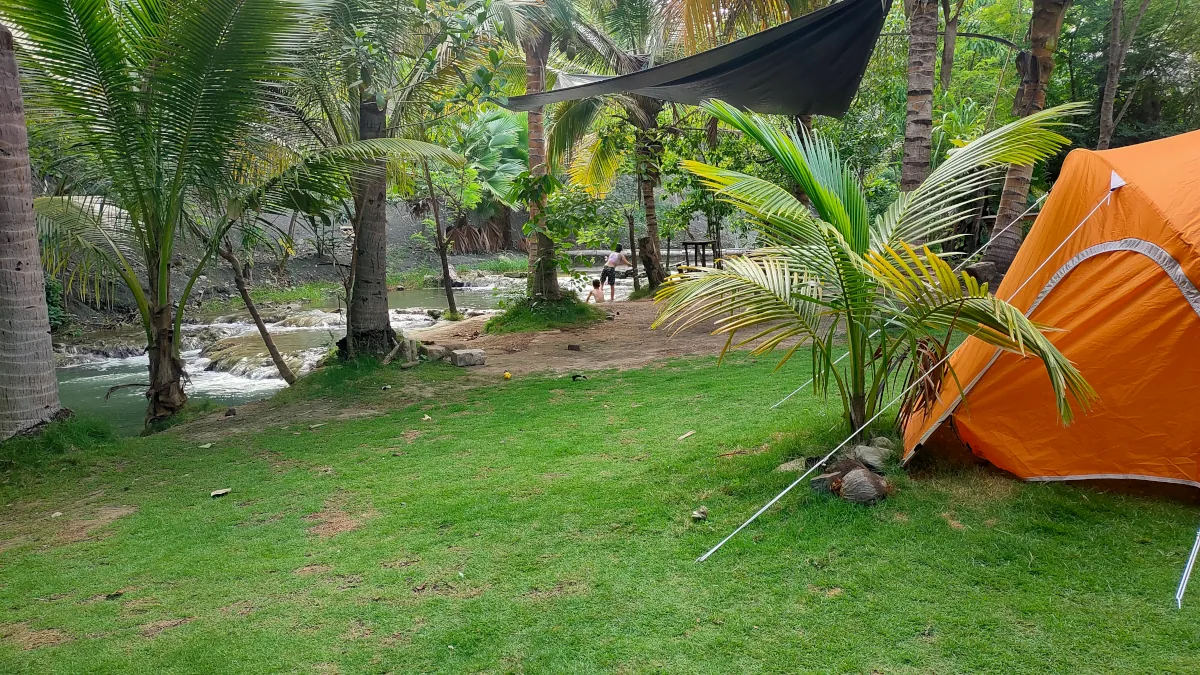
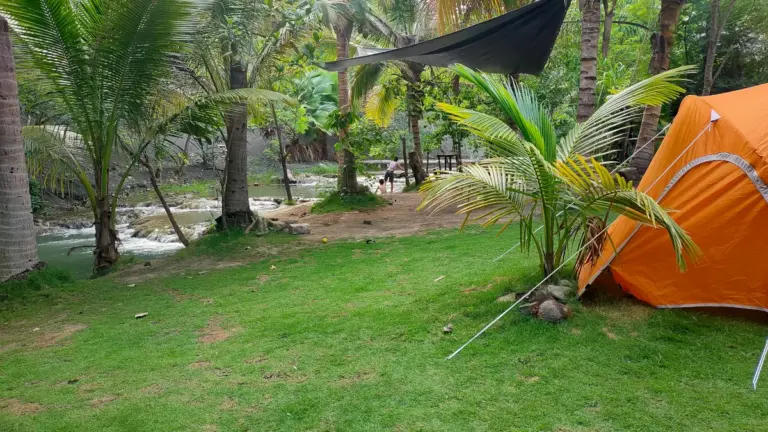
Our old tent on the lawn above the river at Isla de María.
The Alternative Lives FactorOur family’s verdict · overnight stays since 2021, latest July 2026
For five years we’ve made the hour-and-twenty-minute drive from San Cristóbal de las Casas to the same balneario by a thermal river outside Tuxtla Gutiérrez — summer holidays, and again at Christmas. We’re friends now with the family who live at and run the site. We’ve never seen it advertised by a tour agency in San Cristóbal.
There is very little here, and that’s the point: a warm and inviting river running over small limestone cascades, a lawn under the coconut palms, and a couple of picnic tables. You come for the water. This page is how a visit works, for a day or for a night, and what I’d tell a friend before they went.
The visit at a glance · 2026
Where
Balneario Isla de María, one of several balnearios around Las Islas Marías, outside Tuxtla Gutiérrez, Chiapas — an hour and twenty minutes’ drive from San Cristóbal.
Finding it
Drive slowly on the approach: the sign sits down the bank beside the road, and you only see it as you’re about to pass the entrance. The Street View link below shows the approach.
A day visit
MX$40 ✓ per person to park and use the river (2026).
Camping
MX$40 ✓ per person for the afternoon and one night; stay past 9am and you pay again (July 2026). The tent comes down before 10am, so there’s space for day visitors.
Hours
No formal opening hours: the family live there, and they’re up by about 6.30am. The gate closes around 8pm — tell them if you’ll be coming back later.
Facilities
A couple of picnic tables, toilets you flush with a bucket of water, and no showers. Bring your own food and drink, or pick it up on the way.
On the way
Roadside stalls in América Libre sell cooked chicken, corn and fresh chicharrón. A few minutes before the balnearios, a Pemex with a Circle K has what an OXXO has, plus a coffee machine.
When it’s busy
Weekend lunchtimes. The first visitors usually arrive between 10.30 and 11am on Saturdays and Sundays, and most have left by 6pm.
The gate: 16.596398, -92.963327 · Plus Code 7689H2WP+HM. Paste either into a maps app.
Our river escape from San Cristóbal
We go for the water, and for the family who run the place. The children play with the dogs and spend the evening, and most of the next day, in the warm river water under the shade of the coconut trees.
The campsite by the thermal river outside Tuxtla Gutiérrez — the same spot we’ve returned to for five years. The dogs come with the site.
When we take that trip in the first week of July, just as the schools break up, the uninhibited feeling of being away from school — no rules, long days full of adventure — comes through in their laughter and in the way they move.
Why this one, out of several
There are several other balnearios around Las Islas Marías, and I’ve visited most of them. I always choose this one:
The river is natural. Some of the other sites have reshaped the landscape into concrete pools.
The camping space is perfect: immediately alongside the river, on a small, relatively flat patch of green grass.
There’s a ton of flexibility about coming and going late in the evening or early in the morning.
A day by the river
A day here is about relaxing in the water, climbing out to eat the food you’ve brought, and getting back in. There really is little else: the river, and a couple of picnic tables to cook on or to serve the food you’ve prepared.
Around lunchtime, especially at weekends, families arrive — many of them from Tuxtla — with a few beers and bags of Sabritas, and their children head straight for the water. Beers by a river or at a picnic spot are part of Chiapaneco culture. Start talking to people and you’ll find them super friendly.
One thing I love about this place: in five years we’ve never had anyone playing music from their car or bringing a loud speaker. Picnics in Chiapas usually come with a soundtrack, and it won’t always be to your taste. Here, it’s the river.
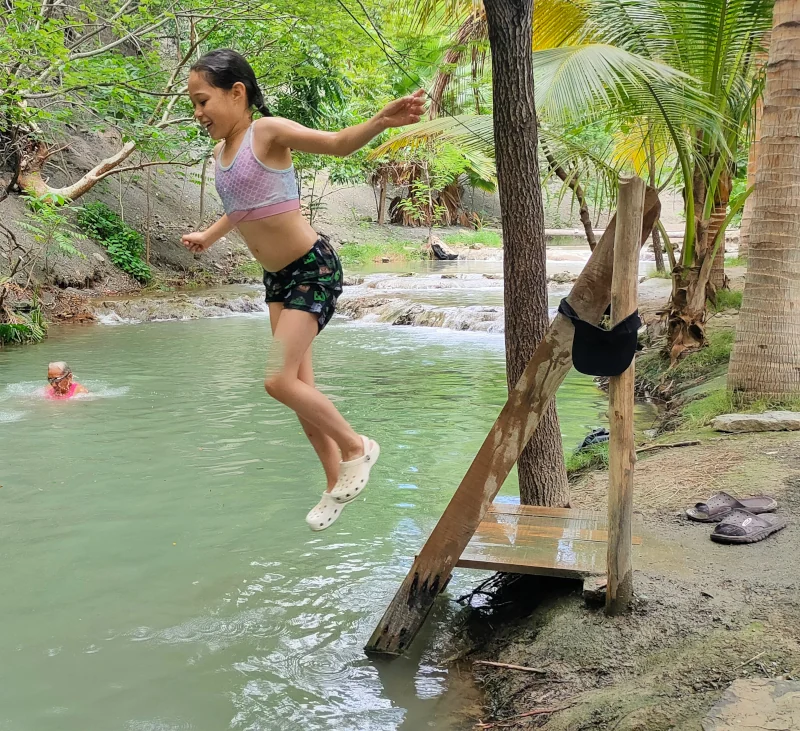
Jumping in from the ladder below the cascades, 2023.
What to bring for a day
Most of what we pack for a night works for a day too. The short version:
If you’d rather pick food up on the way, you pass through América Libre, a tiny town with a couple of hundred metres of stores along the roadside. They sell cooked chickens, corn and freshly prepared pork scratchings — chicharrón. Immediately after it, and just a few minutes before you arrive at the balnearios, there’s a Pemex with a Circle K: everything you’d find in an OXXO, and a coffee machine.
Camping is how we know the place best. Once the day visitors leave, around six, we have the river to ourselves through the evening and most of the next morning, until the first people arrive between 10.30 and 11 at weekends.
The family ask campers to take the tent down before 10am, so there’s space for visitors. They really aren’t strict about times: relax, and everything can be resolved with a conversation. The gate closes around 8pm. I’ve gone out and come back later, and that’s fine as long as you let them know.
We don’t light a fire — everything is usually damp, and the evenings are warm or still hot — though I sometimes bring a charcoal barbecue. In the morning, the coffee machine at the Circle K is a couple of minutes’ drive away.
Who it suits, and what it isn’t
It suits families with young children, and anyone happy with a simple day by warm water. The pools are shallow enough for toddlers. There’s very little current in the water, as each cascade falls into a wider or deeper section of river, and the depth of the water falls somewhere around your abdomen in the deep sections. It isn’t the place for restaurants, showers or anything organised, and the biting flies are worst at sunrise and sunset. After heavy rain the river rises, so check the rating below before you pitch.
Our rating
Our family’s rating — overnight stays since 2021, most recently July 2026, with our children aged 10 and 12.
How the Alternative Lives Factor works
The Alternative Lives Factor is our family’s overall judgement, not an objective score: how much of what we value about living outside the usual routes a place gave us — discovery, the children free and absorbed, connection with the people who live there, and time to slow down. 5 means this is why we do it; 1, not for us. It isn’t an average of Family fun and Comfort, which are simply what we found on the day.
Balneario Isla de María, near Tuxtla Gutiérrez
The Alternative Lives FactorOutside the usual routes
4/5Our kind of experience
Our visits · overnight stays, summers and Christmases since 2021 · latest July 2026 · children aged 10 and 12
The children in the warm river from the evening we arrive until we leave, and five years of friendship with the family who run it — something a first visit won’t give you.
With children: shallow pools that suit toddlers, and even the deepest part of the river is below adult chest height; we’ve never found a strong current. After heavy rain the river rises and can overflow, then drops back quickly — one rainy season we pitched a little up the hill, and we’d do that again.
Family fun5/5Swimming and bathing for the whole family: the children spend the evening and most of the next day in the water, and the rest with the dogs.
Comfort2/5Biting flies, worst at sunrise and sunset and fewer around Christmas; rudimentary tables to cook on; toilets you flush with a bucket of water, and no showers — we bathe in the river.
Access and restrictions: a public balneario, an hour and twenty minutes’ drive from San Cristóbal. Drive slowly on the approach: the sign sits down the bank beside the road, and you only see it as you’re about to pass the entrance. We don’t light a fire — everything is usually damp, and the evenings are warm or still hot — though I sometimes bring a charcoal barbecue (July 2026).
What we paid: MX$40 ✓ per person for the afternoon and one night; stay past 9am and you pay again (July 2026).
Been recently and found the prices, the hours or the river changed? Email me with what you found and the date you went.
This is one family’s experience of one place: overnight stays and the days around them since 2021, most recently July 2026. Prices marked ✓ are what I actually paid, in the year stated — they will move. The times and arrangements are what we’ve seen and what the family have told us; ask them on the day. Judge the river for yourself: shallow and gentle on the days we went says nothing about the river after heavy rain, and this isn’t safety advice. The World Health Organization’s drowning fact sheet notes that the risk rises when children are in water without active adult supervision.
— Luke Burchell
About the author
Written by Luke Burchell. I live in San Cristóbal de las Casas, Chiapas, where I built my own house and am raising two children. The visits on this page are ours, summers and Christmases since 2021. Read my full story →
Follow along
I email new articles as I publish them. Subscribe if you’d like to read the next one.
Cenotes in Chiapas with children: Chukumaltik and Las Peñitas, near Montebello
Comitán and the Lagos de Montebello, Chiapas · May and August 2026
I had lived in Chiapas for years before I found out it has cenotes.
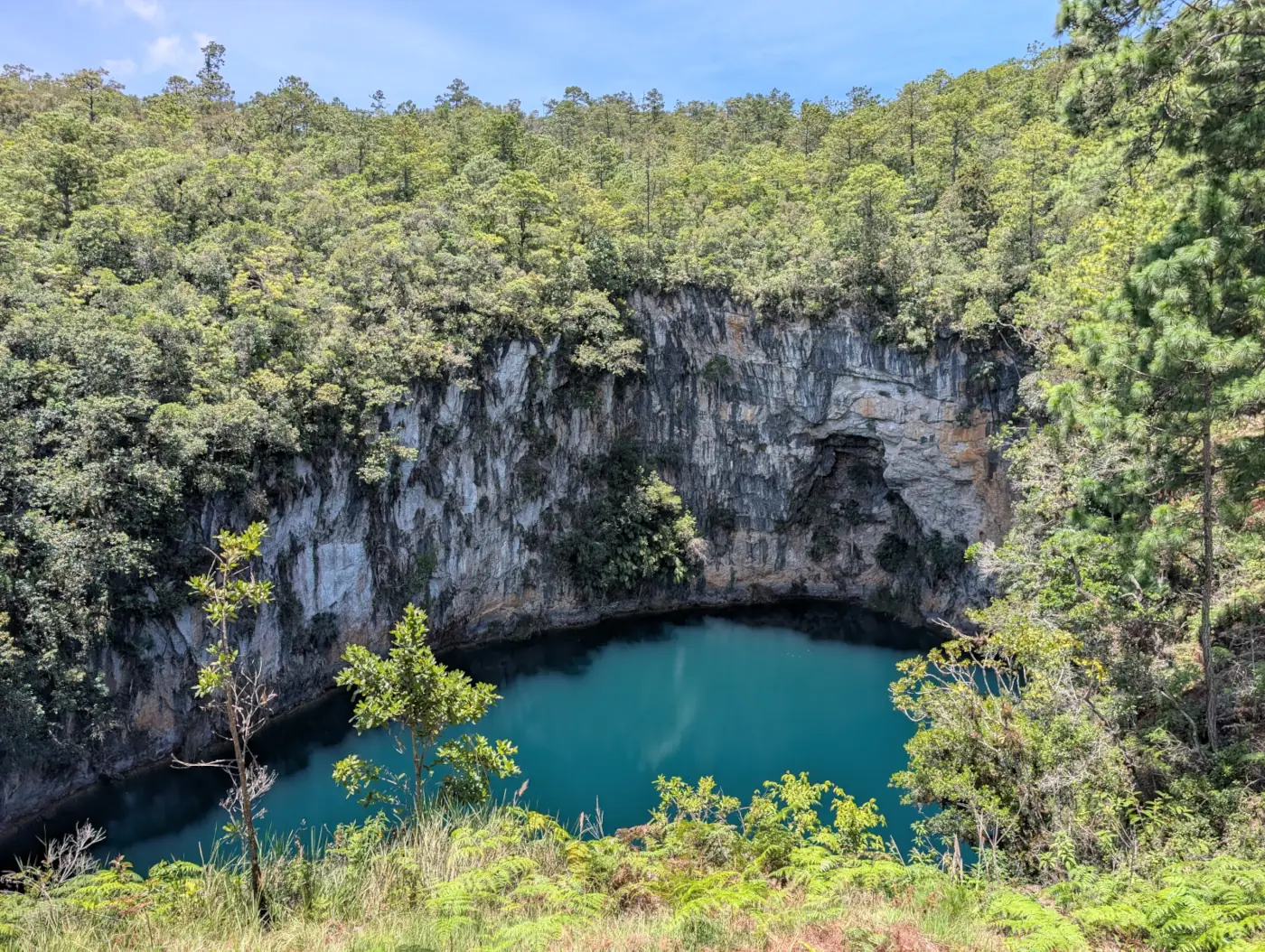
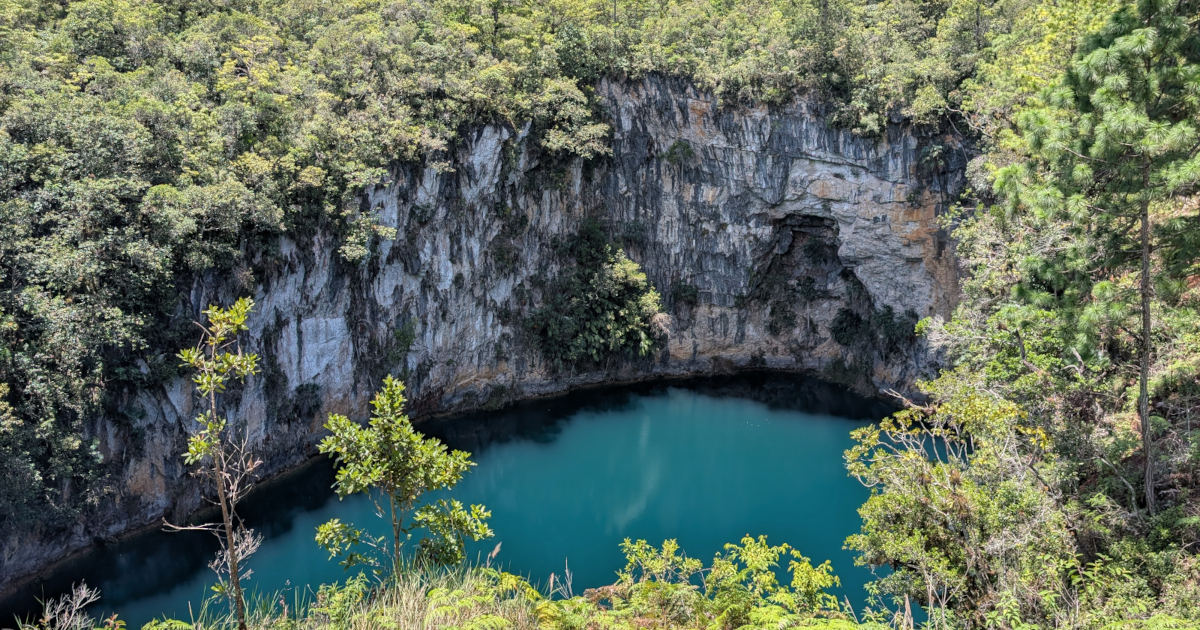
La Peineta, one of the three cenotes at Las Peñitas — a few steps from the track. We were told swimming here isn’t allowed.
Two outings with my children, aged 10 and 12: a day at Chukumaltik near Comitán in May 2026, and a night at Las Peñitas near Montebello in August. Here are the differences that would shape our next visit.
Four cenotes at a glance · our visits, May and August 2026
I had always thought cenotes belonged to Yucatán, Quintana Roo and Campeche — the east side of the bottom of Mexico — and that everywhere else you visit towns, lakes, rivers, mountains and jungle, but not spectacular sinkholes. It turns out there are several within about an hour of Comitán, and the ones we went to cost next to nothing: MX$40 a person at one, MX$120 a car at the other (2026). There were no crowds of tourists at any of them.
What a cenote is
Cenotes… what are they? I used to think of underground water networks linked to deep wells of turquoise water — the photos I saw as a teenager in National Geographic. The word comes from Yucatec Maya: ts’ono’ot, a word for any place you can reach groundwater. The ones we saw in Chiapas are open cenotes: caves whose roofs collapsed over thousands of years, leaving craters ringed by sheer cliffs and, often, lush forest. What strikes me now is that local communities, often on that land for hundreds of years, still look after them — the three at Las Peñitas are on community land, run by the community.
The first one I visited with the children was Chukumaltik, in May 2026. It’s only about twenty minutes from Comitán, but the roads through the rural lowlands are very quiet, and it feels isolated when you arrive at the sandy entrance by the roadside. At a dilapidated concrete building, as you drive into a sandy expanse of cactuses, a woman collects the entrance fee — MX$40 a person when we went. The desert-like landscape made me feel I was in another state.
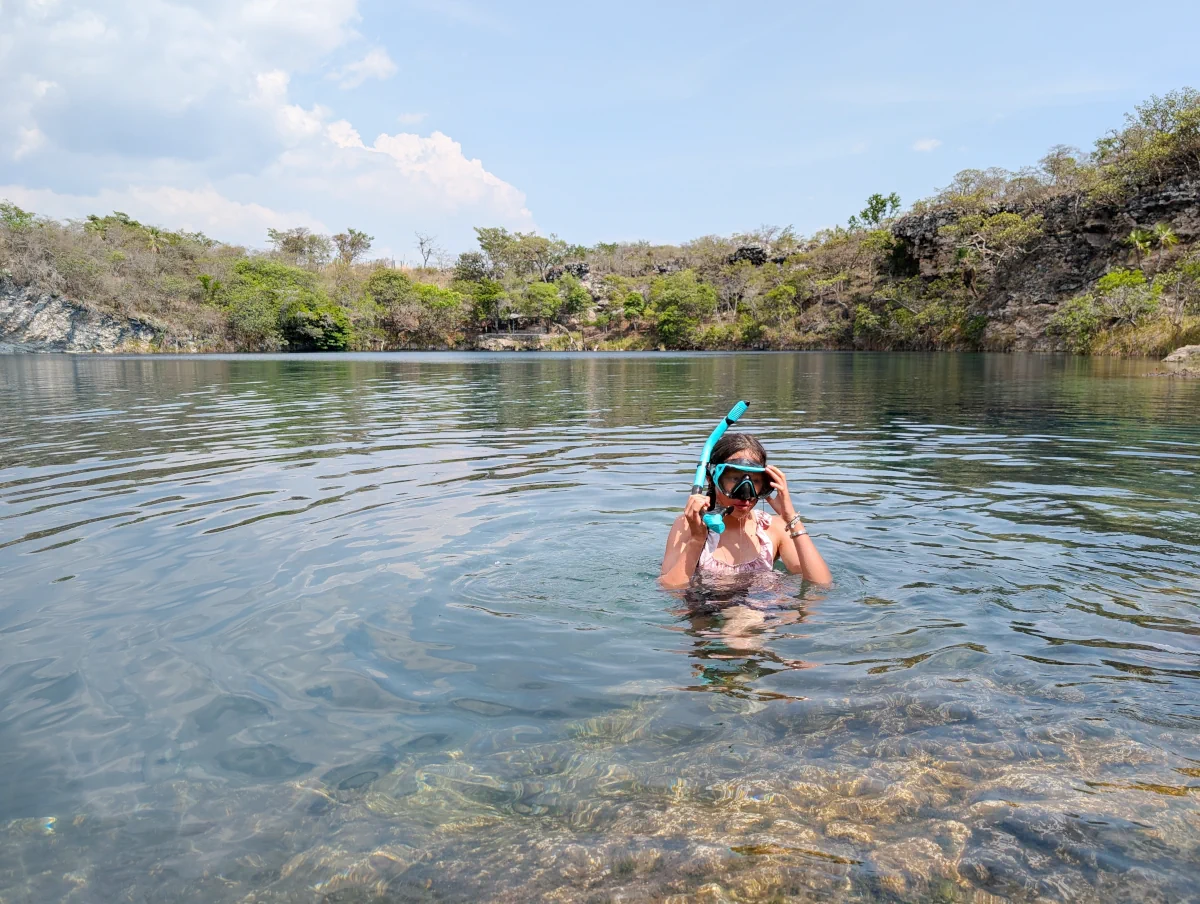
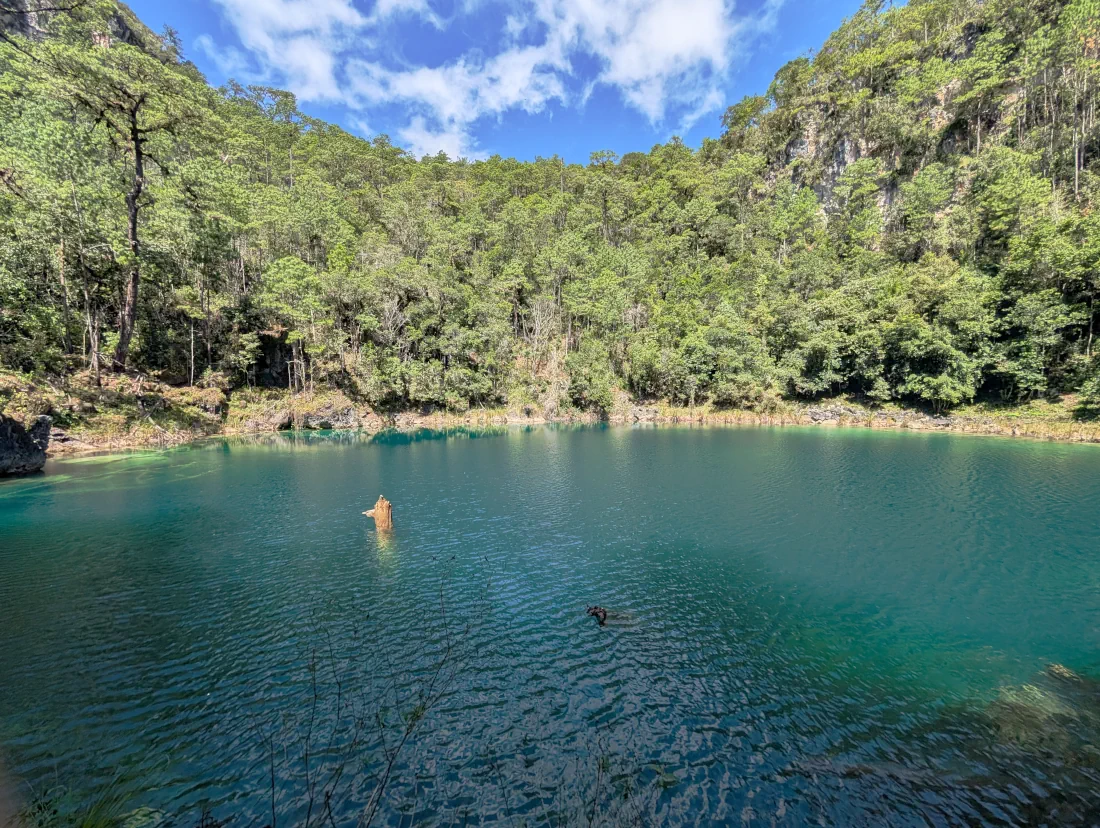
According to México Desconocido, it’s almost 70 metres deep, with visibility of up to 40 metres — and its name means “the hidden beauty”. In the water, it isn’t so much the depth as the clarity that gets you: swimming out, you can see the sides drop away beneath you, and that can be quite scary. I swam across. The children, who are still gaining confidence snorkelling, tried it — but the water gets deep quickly, and they found that disconcerting, so they stayed close to the edge.
Clear enough to watch the bottom drop away beneath you.
Chukumaltik, May 2026 — shallow right at the edge, then deep, quickly.
Despite feeling far from anywhere touristy, they rent out life vests and even a canoe — we didn’t use either — and there are a couple of picnic tables where you can prepare food and eat while watching the spiny-tailed iguanas on the rocks. That is all the facilities there are, so come prepared. In May it was very hot in the middle of the day, the edge is rocky, there are mosquitoes, and there aren’t many places to sit.
As we left, we were told you can camp beside a small hut whose tin roof extends over a concrete patio, a two-minute walk from the cenote. There’s a rudimentary bathroom and no other facilities. We weren’t prepared to camp that day — and we would soon be camping near other cenotes, at Montebello.
Las Peñitas: three cenotes on community land
At the end of August 2026 we went to three cenotes near the Lagos de Montebello. They’re just outside the national park — officially the Parque Nacional Lagunas de Montebello — on ejido (community-owned) land, where the local community has set up the Centro Ecoturístico Las Peñitas. It was simple to drive to: about 5 km, ten minutes, from the signposted Lagos de Colores.
Before you go: the UK government advises against all but essential travel within 40 km of the Guatemalan border in this part of Chiapas, and its own map puts the Montebello lakes inside that area. Chukumaltik, nearer Comitán, is about 40 km from the border, close to the edge of that zone. Travelling against that advice could invalidate your travel insurance. We’ve lived in Chiapas for years and drive through this zone often to visit family across the border. In 2026 the tour agencies were running Montebello trips again, and on one drive through I saw many Mexican families out exploring the lakes. That’s what I’ve seen, not a safety rating — read the current UK advice for Chiapas, or your own government’s, before you go.
The three are within a four-minute drive of each other, and with children they could hardly be more different. When I looked in September 2026, El Camarón was even marked as a lake on Google Maps.
Cenote Bartolo: a scramble down, and very deep water
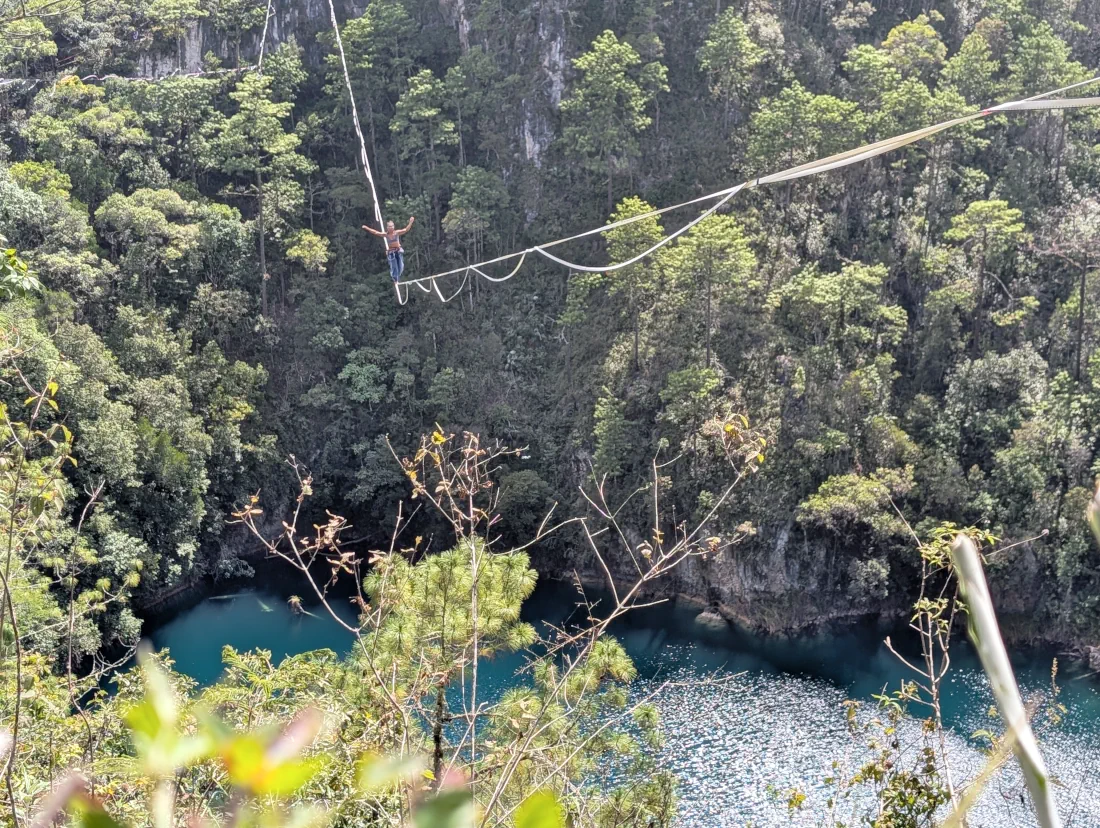
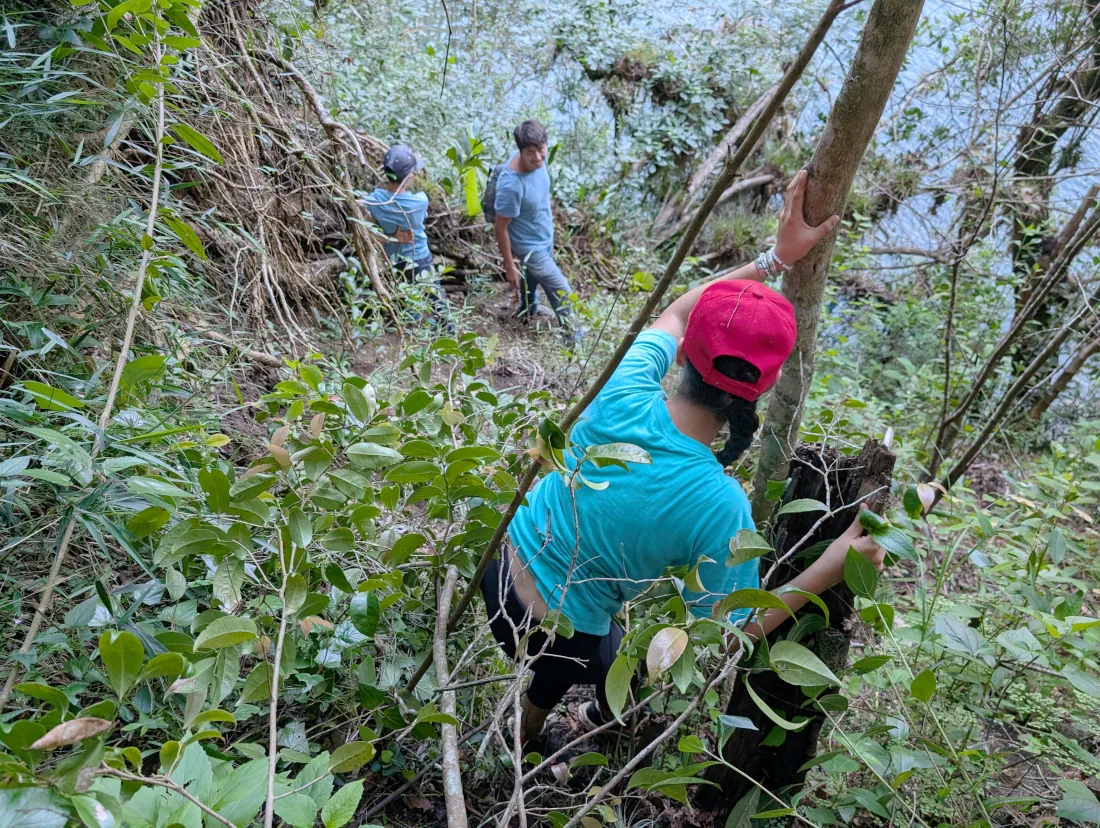
The first we visited was Bartolo, and it’s a serious drop from the ridge to the water, with no trail down. We followed steep, narrow, snaking trails that locals had made extracting timber until we were close to the water; from there my friends and I held on to trees and vegetation and slid down. I managed to help my children manoeuvre close to the water, but it was precarious, and I wouldn’t recommend taking young children down.
Cenote Bartolo · from the ridge, and the way down
From the top — we arrived as a group of slackliners was finishing a multi-day event above the cenote.The way down: timber-cutters’ trails, then holding on to whatever grows.
There was no flat ground at all at the water’s edge, which made getting changed and getting in difficult — in rain it would have been close to impossible. Only the adults went in, and it was dangerous. The dip was short and cold.
Hard to get in and out of, and immediately extremely deep.
There was the thrill of reaching something few people ever see — but for families, I’d recommend viewing the water from the ridge above.
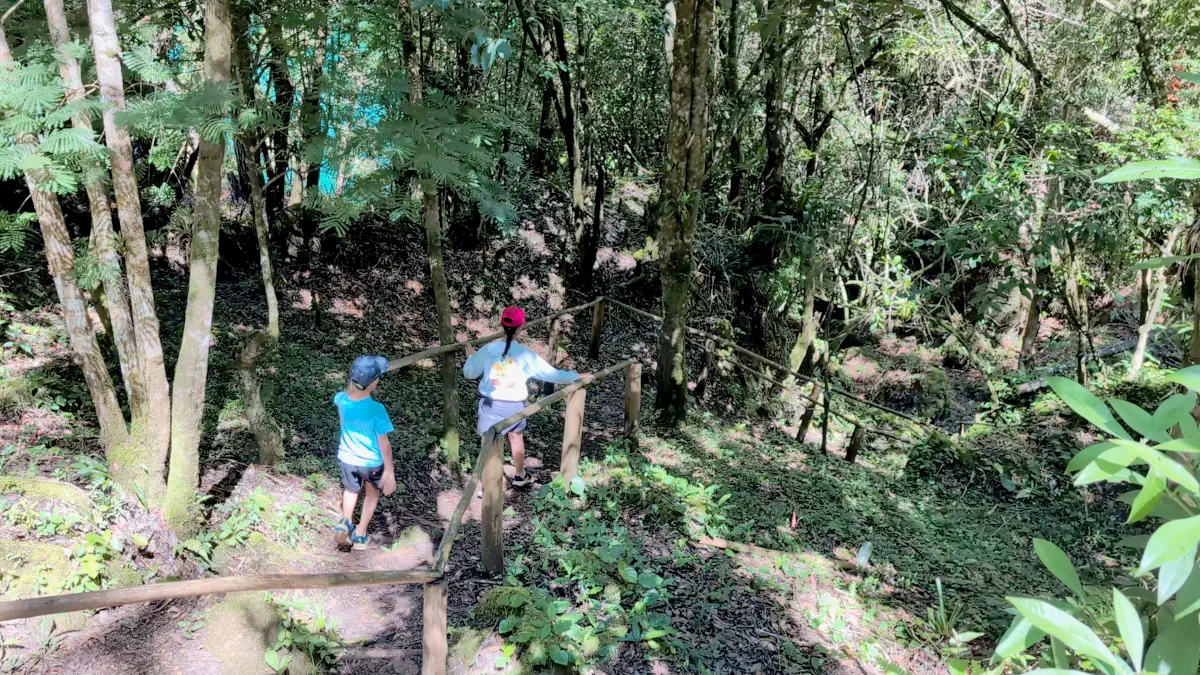
The next cenote was a five-minute, 1.5 km drive along an unmarked track. It isn’t signposted; we found a rustic access area between two fields and parked there — a low car might not have the clearance and would have to be left on the main track. We followed a trail between the fields, and it turned out to be a well-defined path with handrails, leading down to El Camarón: an easy, short walk, descending through the trees to the water’s edge.
El Camarón · the path down, and the water
The path down to El Camarón — handrails, and trees all the way.El Camarón, August 2026 — marked as a lake on Google Maps when I looked.
We arrived at an infrequently visited cenote, a secluded paradise: cold water, easy to get into for swimming and snorkelling, and places to relax around the edge. The children swam close to the edge, supervised. The water isn’t as clear as Chukumaltik’s — I swam across and looked down through my mask — but it was still incredible. There were huge fallen trees in the water, 10 to 15 metres from the bank. I don’t know how deep it is, but swimming across, the centre felt as if it could be very deep.
La Peineta: look, but don’t swim
The last cenote is a one-minute drive further along the track from El Camarón. There’s a spectacular view of La Peineta a few seconds’ walk from the track — the photo at the top of this page — with rock-face cliffs on the far side. Locals told us swimming there is forbidden. We could also see an installation that local farmers use to pump water out for their crops. It detracted a little from the view, but it was still impressive.
To explore the three cenotes, we camped beside a small lake that locals fish in and that you can swim in. It’s a picturesque spot, especially at dusk, with the lake in front and a seemingly endless expanse of cornfields running to a hilly horizon. Facilities were a couple of bathrooms where you flush with a bucket of water, and some large, well-built picnic tables with a roof. The ridge above Cenote Bartolo is a ten-minute walk away; with children, look from the top — there’s no trail down, and the water is immediately extremely deep.
They charge by vehicle, per day, and camping isn’t charged separately: MX$120 for our car. The second day’s fee was collected at 7:30 the next morning, so our night cost MX$240 (August 2026). There are no shops close by, so bring what you need.
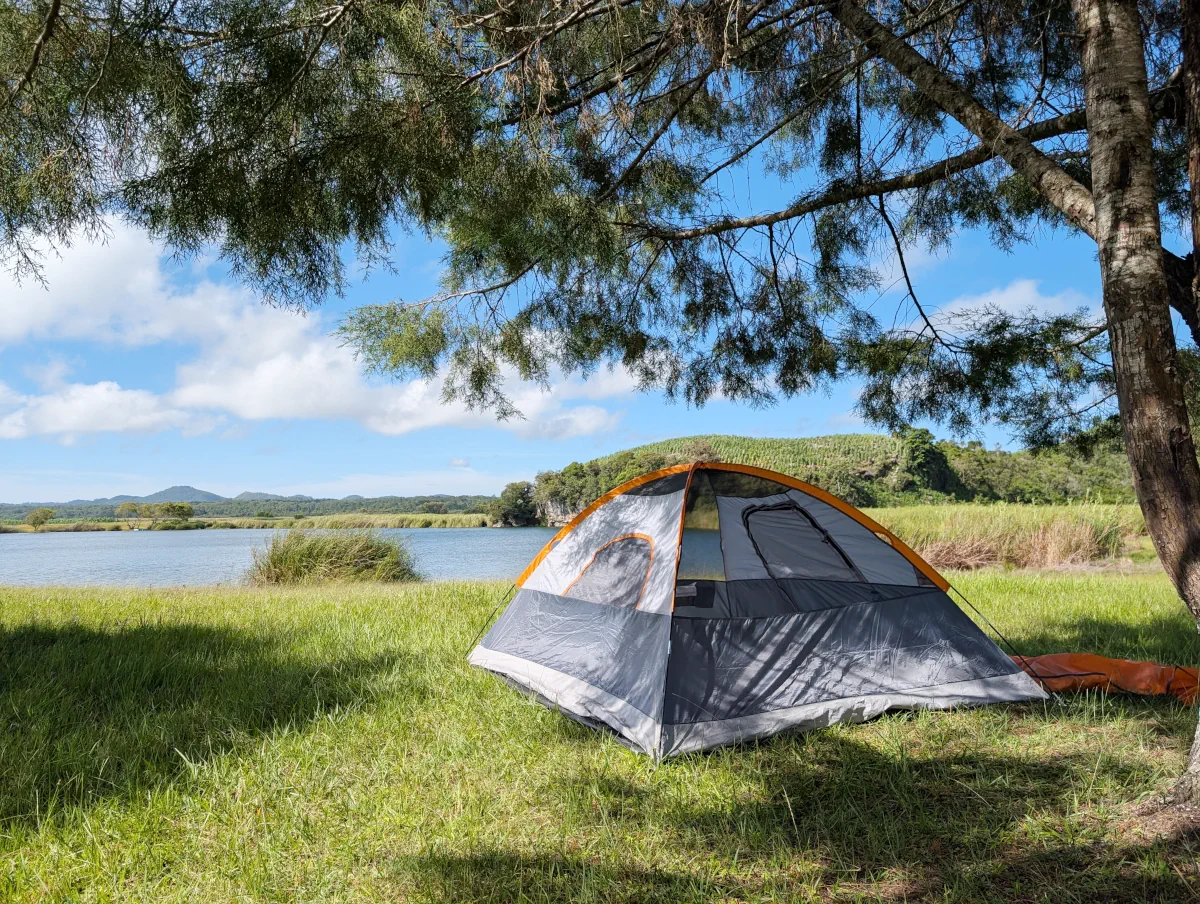
Our pitch by the lake at Las Peñitas. The trees and the ridge behind didn’t stop the wind.
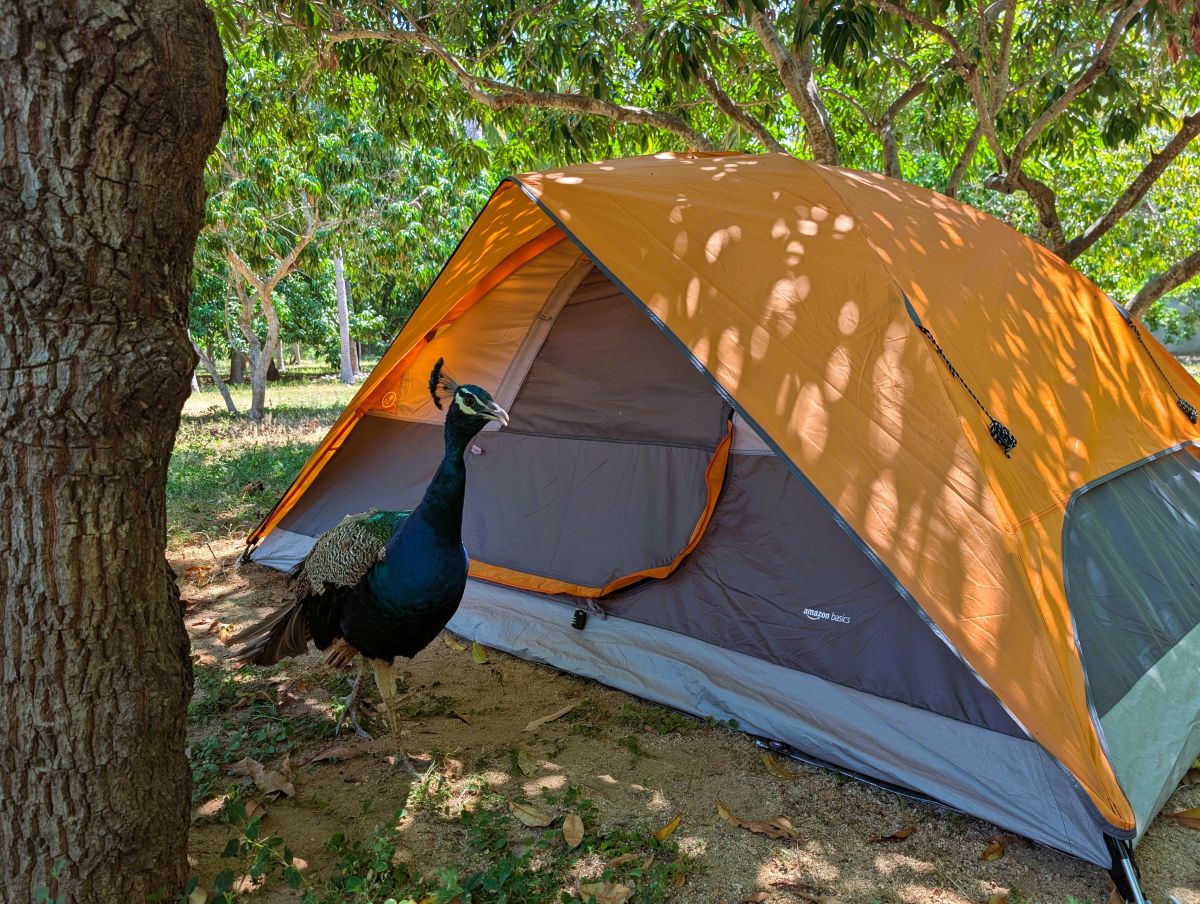
Be ready for wind and rain. We could hear the wind roar in the night. We were camped in a hollow, below the treeline behind us and the looming ridge that forms Cenote Bartolo, and it was still strong — I was a little concerned my Amazon Basics tent might not hold up and we would end up in the lake. The wind brought rain, even though Comitán and San Cristóbal were in the middle of a very dry few weeks.
Tie down the guy lines.
I was also glad I’d brought the lona I use as a groundsheet: the ground was very damp. My friends camped without one and were laughing about having wet backs over breakfast. The kit we always camp with is on its own page: camping in Mexico with two children.
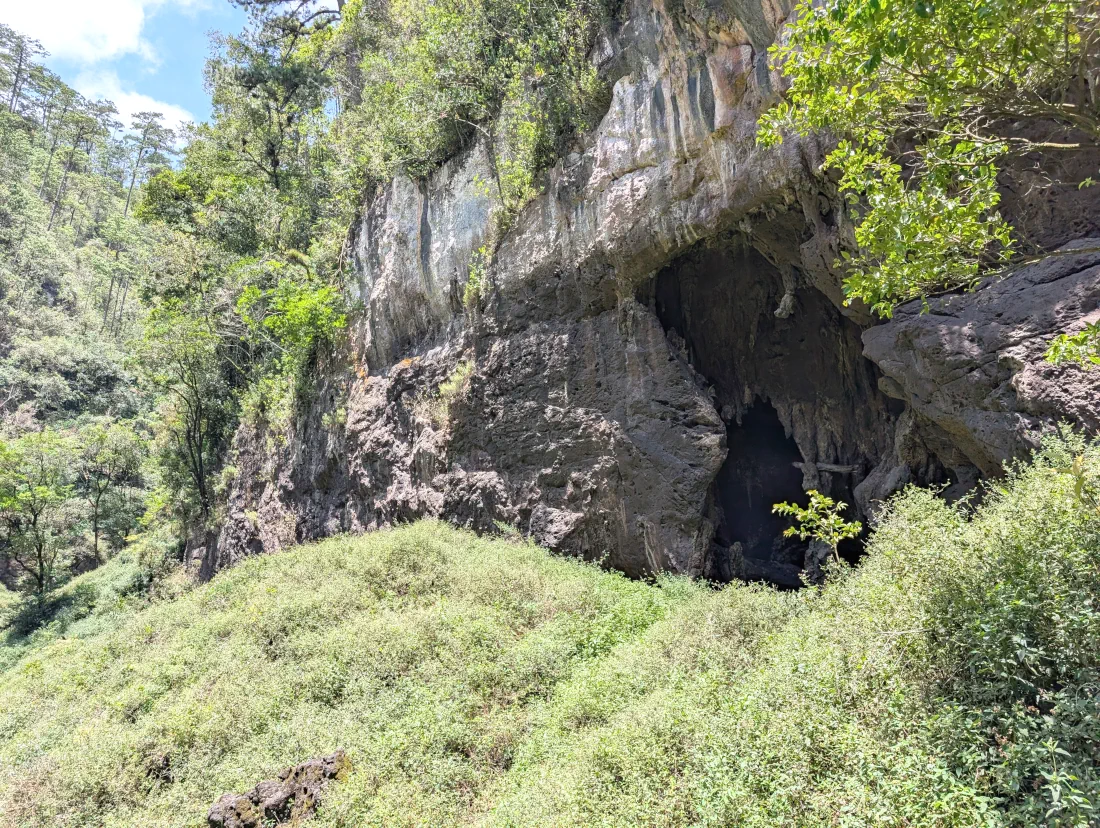
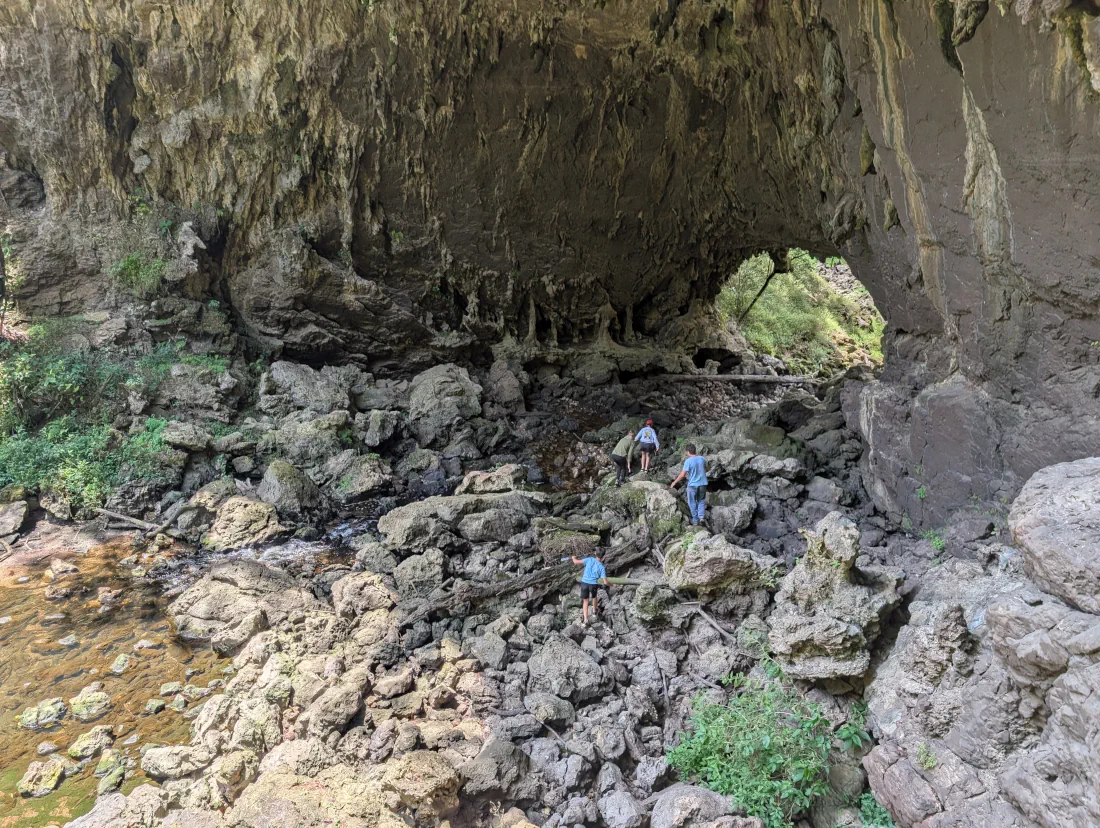
A local man told us there was a cave and a stone arch a short walk from the road, close to the cenotes — a few minutes’ drive on from La Peineta. The ten-minute walk in from the road was beautiful, through a forest of tall, quite epic pine trees. At one point the path splits: one way to the arch, the other to the cave directly behind it.
If you have never seen a place where people hold ceremonies in a cave, this is one. In my years in Chiapas I have learnt that people light coloured candles, sold in glass jars, to ask for almost anything — love, luck, a safe journey to the USA, even a curse on someone; the list is endless. What anyone asked for here, I can’t know; we saw only what they left. Fires had been burnt all around the front of the cave and inside it, and candles from recent ceremonies were still burning. It feels a bit spooky, with the candles, the glass and the burnt wood everywhere.
The cave itself is large but quickly becomes steep and slippery, and there isn’t a great deal to explore inside. The children explored around the river under the arch.
The cave and the stone arch · near Las Peñitas
Looking out from inside.From the path, among the pines.
Leaving Las Peñitas, we drove past two lakes beside the road and stopped to take in the views. We didn’t explore them, and there are many more we could have visited with more time.
What we’d repeat, and what we’d do differently
Repeat: Chukumaltik, for the water — if you snorkel, I’d recommend it 1000%. El Camarón, for the easy path down and a swim the children could share. And a night by the lake at Las Peñitas, with three cenotes minutes away.
Differently: at Bartolo, I’d keep the children on the ridge and look at the water from above. At Chukumaltik, take everything your family needs to be relaxed and comfortable in the heat — there are picnic tables and not much else — and if your children aren’t strong swimmers, it may be worth hiring the life vests or the canoe. And at Las Peñitas, tie the tent down and bring a groundsheet.
If you can only do one: I’d still go to both — they’re about an hour apart, and they’re different experiences. Chukumaltik is an incredible day trip, close to the amenities of Comitán. The Montebello area has so many options — lakes, cenotes, camping, cabins — that I’d give it at least two days and visit as many lakes as you can. Together they’d make one long weekend, with Chukumaltik on the way; we did them as two separate trips, so that part is a suggestion rather than something we’ve tested.
Our ratings
Our family’s ratings — one visit each, May and August 2026, with our children aged 10 and 12.
How the Alternative Lives Factor works
The Alternative Lives Factor is our personal verdict on how rewarding we found an experience and what made it worthwhile. 5 means this is why we do it; 1 means it was not for us. The appeal, trade-offs and practical details help you judge what suits you. Each verdict reflects the dated visit described here.
Las Peñitas is inside a UK travel-advice zone, and Chukumaltik close to its edge — see Before you go.
Chukumaltik
The Alternative Lives FactorOutside the usual routes
5/5This is why we do it
Our visit · May 2026 · day trip · children aged 10 and 12
Water so clear you can watch the bottom drop away.
Who might enjoy it: Snorkellers who want to look down into very deep, clear water, with a short walk from the car.
The trade-off: It gets deep quickly at the rocky edge; mosquitoes, considerable midday heat and few places to sit.
With children: ours tried snorkelling but found the sudden depth disconcerting and stayed near the edge. Life vests and a canoe were for hire; we didn’t use them.
Access and restrictions: sandy roadside entrance, a short walk to the water; a couple of picnic tables, and no other facilities (May 2026).
What we paid: MX$40 a person, entrance (May 2026).
El Camarón
The Alternative Lives FactorOutside the usual routes
5/5This is why we do it
Our visit · August 2026 · from our camp at Las Peñitas · children aged 10 and 12
A secluded paradise down an unmarked track, and the children in the water.
Who might enjoy it: Swimmers looking for a secluded forest cenote with a short, handrailed path down to the water.
The trade-off: The approach is unmarked, and facilities are minimal.
With children: the one I’d bring them back to — a short path with handrails, and they swam close to the edge, supervised, while I swam across with my mask.
Access and restrictions: unmarked track, 1.5 km on from Bartolo; park between two fields (a low car may need to stay on the main track), then a well-defined path with handrails (August 2026).
What we paid: covered by the Las Peñitas day fee.
Camping at Las Peñitas, with the walk to Bartolo’s ridge
The Alternative Lives FactorOutside the usual routes
4/5Our kind of experience
Our visit · August 2026 · one night · children aged 10 and 12
The lake at dusk, cornfields running to a hilly horizon — and a ten-minute walk to look down into Bartolo.
Who might enjoy it: Campers who want a simple base for exploring the cenotes.
The trade-off: Wind, rain and damp ground on our visit; bucket-flush bathrooms and no shops nearby.
With children: the ridge is the way to see Bartolo with them. We scrambled down once — precarious, and the water is immediately extremely deep; only the adults swam. Pitch for the wind, too: it came up in the night.
Access and restrictions: drive in and pitch your tent anywhere around the small lake. Bartolo’s ridge is a ten-minute walk; there’s no trail down to the water — only timber-cutters’ paths, then holding on to trees (August 2026).
What we paid: MX$120 per vehicle per day, camping included; the second day was collected at 7:30am — MX$240 for our car, one night (August 2026).
The cave and the stone arch
The Alternative Lives FactorOutside the usual routes
3/5Glad we went
Our visit · August 2026 · a short walk from the road · children aged 10 and 12
A local man’s tip took us through tall pines to a cave where people still hold ceremonies.
Who might enjoy it: Walkers interested in tall pines, the cave and the stone arch.
The trade-off: The cave becomes steep and slippery; boulders can be awkward for small children.
With children: good for the walk and the river under the arch; the cave gets steep and slippery quickly.
Access and restrictions: about ten minutes’ walk from the road through tall pines; the path splits for the arch and the cave behind it (August 2026).
What we paid: nothing.
Been recently and found the access, the fees or the swimming rules changed? Email me with what you found and the date you went.
This is one family’s two outings, in May and August 2026, written from memory soon afterwards — not a guide to the region’s cenotes. Prices are what we paid, with their dates; they will move. Access, and the rules on where you can swim, are what we found and were told at the time. Judge any water for yourself: that our children swam close to the edge at two cenotes says nothing about your children, or another day, and nothing here is safety advice. The World Health Organization’s drowning fact sheet notes that the risk rises when children are in water without active adult supervision.
— Luke Burchell
About the author
Written by Luke Burchell. I live in San Cristóbal de las Casas, Chiapas, where I built my own house and am raising two children. These were our family’s two cenote trips in 2026 — a day at Chukumaltik in May and a night at Las Peñitas in August. Read my full story →
Follow along
I email new articles as I publish them. Subscribe if you’d like to read the next one.
San Cristóbal de las Casas → Mazunte, Oaxaca · August 2026
Driving ten hours to sleep in a tent in lowland heat with two children does not sound like a rest. It turned out to be the most relaxed I have been in years.
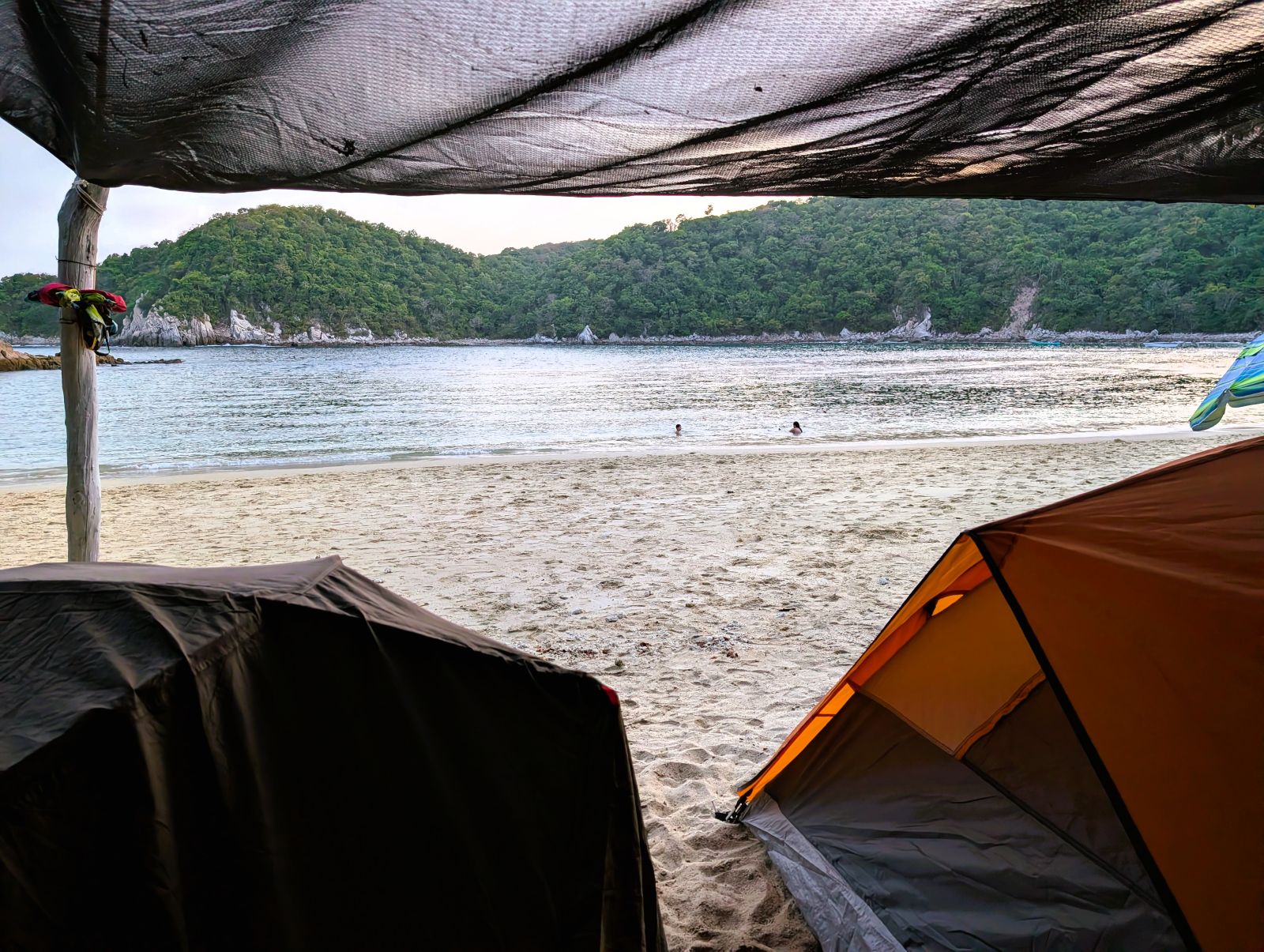
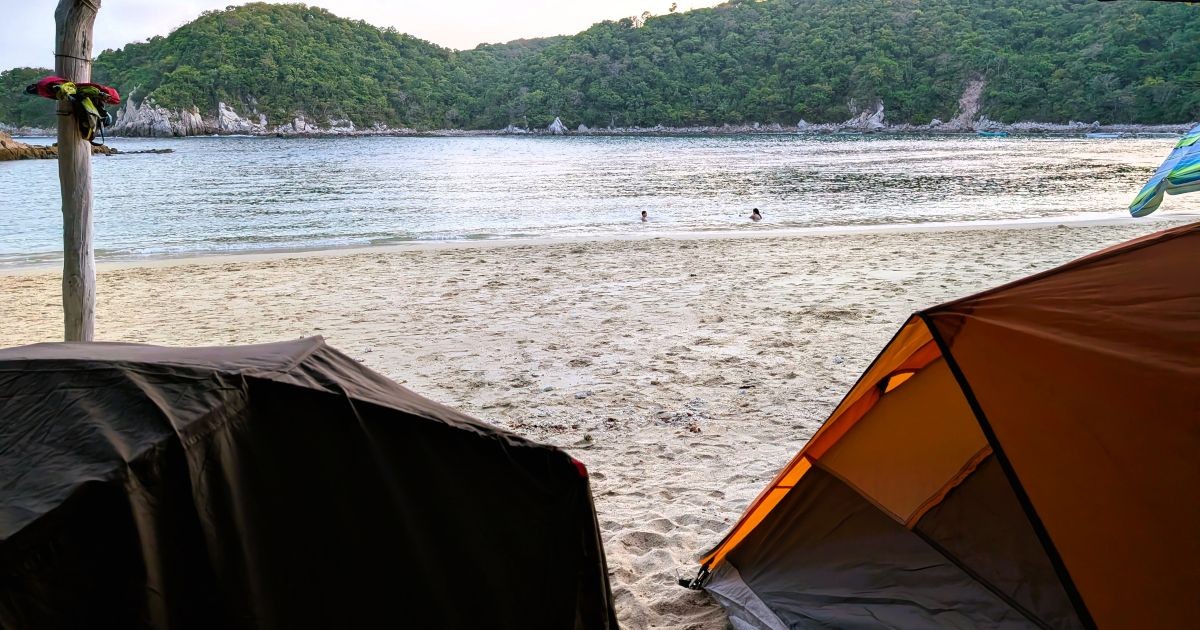
Playa Riscalillo, from under the shade at the end of the beach — our first night on the coast, and what the ten hours were for.
The Alternative Lives FactorOur family’s verdict · August 2026
In August 2026 I drove with my two children and two friends to Mazunte, on the Oaxaca coast, looking for golden-sand beaches and bays calm enough to snorkel. Counting breaks, it was a ten-hour drive — and that was leaving early on a Sunday morning to stay ahead of the city traffic.
If you live in, or are visiting, a non-coastal town, most of Mexico is a long way from a beach — even from Oaxaca City to an Oaxacan beach you are probably driving more than three hours. In our case the nearest coastline is the Chiapas coast, a little over three hours away, and it is not the answer it looks like on the map: black sand, and heavy, turbulent open-Pacific water. With two children who are not strong swimmers, I don’t treat it as swimming water. The calm golden bays start further up, in Oaxaca — and that is what the ten hours buys.
The drive: San Cristóbal to Mazunte
I must admit I find long-distance drives in Mexico somewhat intimidating. I don’t drive long distances often, and some of the route runs through fairly isolated, remote country, even though long stretches of it are toll road. My main concern is a mechanical problem leaving us stranded somewhere unfamiliar at best, and possibly unsafe. Travelling with friends helps more than anything — safety in numbers is real, and so is knowing there are more minds in the car to figure out a solution if one is needed.
I also got mentally prepared by thinking about a friend who regularly drives auctioned cars down from the USA to Guatemala. My 600 km would be covered before he had cracked open the first Red Bull of one of his 3,000 km trips. And I drive a Toyota — twenty-five years old but gold. Not in colour; ostentatious is not me. Mechanically, it has not let me down yet.
Grabbing a roadside breakfast en route is not normally something worth writing down, but in Mexico it can be. Outside an Oxxo there was a typical roadside food stand — a small table, an umbrella against the sun, four or five plastic stools. Two hours down from the mountains San Cristóbal sits in, it was our first taste of lowland heat in a long while, and the first time I had ever come across tamales with prawns. They cost MX$15 each (August 2026) and were delicious. Even early on a Sunday morning, there had been no need to plan for food.
A taste of the sea, eight hours before the beach.
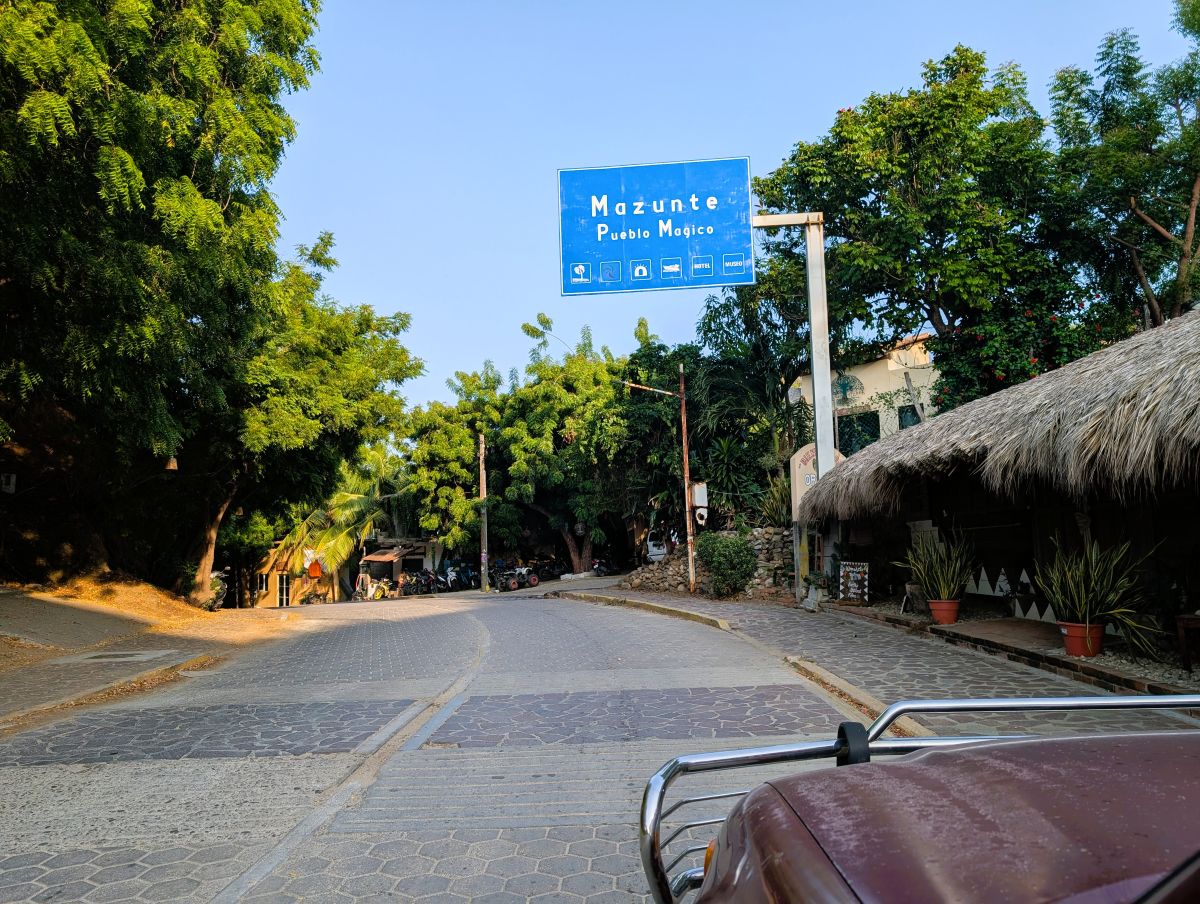
Mazunte — the town the ten-hour drive was aimed at, through the car window.
The first night: Playa Riscalillo
The first night we camped extemporaneously in a small bay called Playa Riscalillo. It was paradise: crystal-clear water, golden sand, and in the evening and early morning, nobody else there at all.
We paid the owner of the small piece of land at the end of the beach, and of the small café where I parked, MX$200 per adult to camp under the shade of the dense forest growth — the children weren’t charged (August 2026). He told us the tide would come to within fifty centimetres of the tents, which seemed like an overly precise calculation, but we went with it. The tide came in to where he said it would, and no further.
The bay is a coral reef, with manta rays, schools of fish and turtles. We loved every moment: the snorkelling, and then sitting on the sand in front of the tent at night with the gentle ebb and flow of the water and the Milky Way overhead. As the sun set, the beach filled with hermit crabs, every one carrying a different shell. It was the perfect evening.
Was it too hot in the tent? Being so close to the sea seemed to make the difference — by morning it was almost cool. It seemed to help with the mosquitoes too; there really were not many. One night’s evidence, so take it as that — but it was certainly a relief compared with an earlier trip, when we camped a couple of hundred metres back from the sea, near standing water, and had a much worse time of both.
Why we moved: an orchard campsite in Zipolite
The orchard site at Zipolite — fruit trees, shade, and fifteen metres to the nearest neighbour.
The next day we moved to the orchard camping-and-caravan site in the grounds of Rancho Los Mangos, a hotel in Zipolite. I had found it on Google Maps and contacted the owners beforehand — and, like every site I vetted, they told me there was space and no need to reserve. I chose it mainly because it has a swimming pool, because I knew there would be four or five hours in the middle of each day too hot for the children to be out in. It turned out to be one of the better decisions of the trip.
We were surrounded by fruit trees, with plenty of space, shade, and an electricity outlet close to the tent. Our nearest neighbour was a good fifteen metres away, and I really appreciated that — privacy, and a noise buffer at night. Along the beachfront at Zipolite itself, people were camping with their tents pitched back to back. That is not something I would enjoy.
The orchard charged MX$150 per adult and MX$100 per child under twelve (August 2026).
Which brings me to the other thing worth knowing about money on this coast: no two sites work the price out the same way. Riscalillo charged by the adult and didn’t count the children. The orchard counted all of us. Friends camping over in Mazunte paid by the tent, regardless of how many people were inside it. Same family, same coast, same week — anywhere between MX$200 and MX$400 a night, depending entirely on whose arithmetic we were on.
You can definitely save a couple of hundred pesos a day by choosing on price. For me the extra was usually worth it — a pool for the hours we couldn’t be on the beach, and space between us and the next tent.
Managing the heat with two children
I had been apprehensive about camping in the heat, especially for the children. What we settled into was a rhythm: the beach in the early morning and the evening, and the middle of the day — roughly eleven until three, which in August was too hot for us to be out on the sand — in the shade and the pool. The children spent the worst hours of the day in shaded water.
The nights sorted themselves out. The first night had already taught us that a tent close to the sea sleeps cooler, and at the orchard the shade did the same work.
Twenty-eight degrees at 7am was the new norm.
Food and drink on the coast
Beer and coconut water are far more ubiquitous on the coast than in other parts of Mexico. Away from the beach itself, which is more touristy, the comedores are full of local people eating quesadillas and working arduously to finish a beer before it goes warm. The builders working on our campsite had beer on a plastic table every day after work.
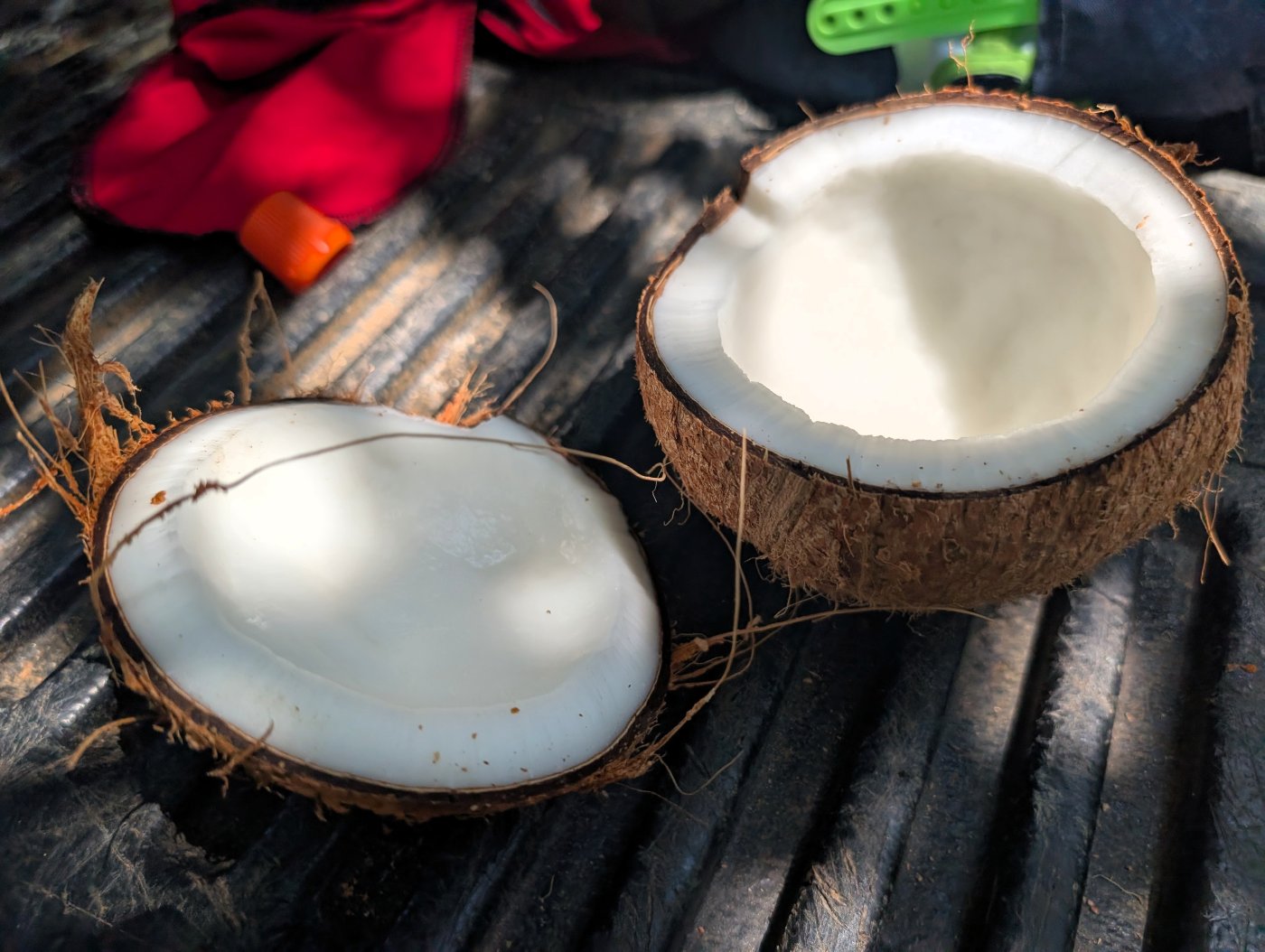
Anyone who lives by the side of a road with a coconut tree in the yard is selling coconuts — MX$50, or MX$60 if you want one that has been chilled in the fridge (August 2026). Make sure you have a machete or a small axe with you, and you can open the coconut up after drinking the water. Since we were camped surrounded by coconut palms, I spent at least twenty minutes a day refining my dexterity with the machete.
Twenty minutes a day of machete practice — the campsite’s coconuts, split open after we’d drunk the water.
Tortillas. In San Cristóbal we eat handmade corn tortillas with almost every meal, and camping is where they prove themselves: the perfect carbohydrate. They last a couple of days even in the heat, they need no cooking, and you can scoop food straight out of the pan into a large reheated tortilla.
Even NASA flies them: the Mexican astronaut Rodolfo Neri Vela asked for tortillas on a shuttle mission in 1985, his crewmates noticed they made no crumbs in weightlessness, and they have been standard fare in orbit ever since.
The one surprise in Oaxaca was that corn tortillas took more work to get hold of: we had to walk to a comedor and ask — most will sell you a stack — instead of the handmade tortillerías that sit on every few corners at home.
I also didn’t eat any seafood all week, which seems like madness on this coast. You can buy straight from the fishermen in Puerto Ángel, or eat fish in dozens of nearby restaurants. But honestly, I was content not putting effort into cooked food. The effort went into snorkelling, walking up to the lookout points for the sunsets, and having a very different routine from the one I have at home.
Five days without screens. The only work was cooking — and opening coconuts with a machete.
Five days in
I woke on the Friday morning after five nights of camping. Five days with barely a glance at my phone, no monitors, no TV, no work.
The previous evening I had been invited to drink a couple of ice-box-cold beers with a Mexican family travelling in a Mercedes Sprinter, who we had become friends with. The friendship began over food: the abuela had witnessed me cooking an unusually poor meal — my gas canister was running out, so the eggs and beans stayed mushy in the pan — while she cooked quesadillas ten metres away. She came over, sympathetically, with piping-hot ones on a plate, to make sure my children would have food that looked fit for a human. The next morning I shared a papaya with them.
At seven that morning I walked over to the carambola tree with my daughter and we quenched our thirst straight from the branch, with a perfectly ripe star fruit. I was no longer micro-managing the ants that walked into my sandals and occasionally made me feel I was in an acupuncture session; somewhere in the week I had developed a nonchalant reflex for swiping them off. Twenty-eight degrees at 7am, a star fruit in hand — living in God’s kitchen with a broken thermostat had become completely tolerable, even rewarding. I was completely relaxed.
The carambola tree · Zipolite
Breakfast hanging within reach — the carambola (star fruit) tree beside our tent at the orchard site.
One of the fruits I pulled from the tree had a small brown patch along one edge — normal, as a fruit passes from ripe towards overripe. This time I picked at the brown with a fingernail and found a small worm. The disgust hit, then subsided.
Instead of throwing the fruit down, I thought of the workmen on the campsite. All week I had watched them pick up fallen mangoes already substantially eaten by wasps, flies and the roaming chickens — roll the fruit over in one hand, find the undamaged side, peel the skin back with their teeth and eat the intact half cleanly before dropping the rest, like vampires homing in on the one good jugular. None of them had missed a day sick; it was always the same four men working.
My star fruit had never even touched the ground. I took off the area around the worm hole, forced the image out of my head, ate the fruit, and didn’t get sick. The new, more relaxed me.
By the last days, fruit was doing a lot of our daytime hydration — partly for the taste, and partly because the 20-litre garrafón we bought every three or four days was always warm, and I don’t love drinking warm water out of a plastic bottle. The children still drank plenty of water; but eating fruit, which I eat very little of at home, had become a feel-good routine of its own.
I had purposely not filled the days with trips and excursions. Space to relax was the point — and relaxing, it turns out, is something I needed to practise.
What I’d do again
Take an ice box. Buying ice at the beer deposits and the Oxxo kept our milk and cheese cold for more than 24 hours at a time.
Choose the site for shade, water and space. A shaded pool carried us through the four or five unusable midday hours, and fifteen metres to the nearest neighbour changes the night. The caravan-and-camping parks tended to offer far more space than the small beachfront sites.
Camp close to the sea if you can. One trip’s evidence, but our night by the water was cooler and had fewer mosquitoes than an earlier site further back near standing water. I’d pitch by the sea again.
Move between the quieter bays. Shifting camp is how we ended up snorkelling a reef with nobody else on the beach — the serene settings are there if you keep moving.
Don’t over-plan the booking. Every site I contacted in August 2026 had space and told me not to bother reserving. I stopped worrying about it. Your month may differ.
Bring home mezcal and cheese. The queso on the coast was far creamier than anything we get in San Cristóbal.
A small luggage lock for the tent zip. A tent is fabric, so it stops nobody determined — but I never felt at risk of being robbed, and the lock bought real peace of mind whenever we walked down to the water.
Our family’s ratings — one stay each, August 2026, with our children aged 10 and 12.
How the Alternative Lives Factor works
The Alternative Lives Factor is our personal verdict on how rewarding we found an experience and what made it worthwhile. 5 means this is why we do it; 1 means it was not for us. The appeal, trade-offs and practical details help you judge what suits you. Each verdict reflects the dated visit described here.
Playa Riscalillo
The Alternative Lives FactorOutside the usual routes
5/5This is why we do it
Our visit · August 2026 · one night · children aged 10 and 12
A reef with turtles at the end of a beach with nobody on it in the evening — then the Milky Way over the tent.
Who might enjoy it: Snorkellers who want a reef in the bay, and campers happy with a simple pitch in the shade at the end of the beach.
The trade-off: Simple camping on the café owner’s land; rain would have made things complicated.
With children: a calm, protected bay the week we were there — the kind of calm, clear water we drove ten hours to find. A short stay here, since we needed a little more of a town as a real base.
Access and restrictions: park at the small café at the end of the beach and pay its owner, who also owns the land you camp on; pitch in the shade of the trees. He said the tide would come to within fifty centimetres of the tents — it did, and no further (August 2026).
What we paid: MX$200 per adult; the children weren’t charged (August 2026).
The orchard campsite, Zipolite
The Alternative Lives FactorOutside the usual routes
5/5This is why we do it
Our visit · August 2026 · four nights · children aged 10 and 12
Slow days under fruit trees, star fruit and mangoes straight from the tree, and meeting great people — including the abuela who made hot quesadillas for us.
Who might enjoy it: Families who want shade, space between tents and a pool for the hottest hours.
The trade-off: Hot even at dawn — 28°C (82°F) at 7am — with warm drinking water and ants that bite toes and ankles.
With children: chosen for the pool — the children spent two or three of the hottest hours of each day in the shaded water. Fifteen metres to the nearest tent kept the nights quiet.
Access and restrictions: camping in the orchard grounds of Rancho Los Mangos, a hotel — see it on Google Maps. The owners said there was space and no need to reserve (August 2026).
What we paid: MX$150 per adult and MX$100 per child under twelve, per night (August 2026).
Camped at either recently and found the prices or the set-up changed? Email me with what you found and the date you went.
Was it worth the drive?
Ten hours each way is a real price, and I won’t pretend otherwise — the return leg is where I learnt what the 088 number is for, even if I never had to use it. But against that: five nights under trees, a reef with turtles at the end of a beach with nobody on it, new friends with an ice box of cold beer — and the most relaxed I have been in years. We will be going back.
This is one family’s five nights on the Oaxaca coast in August 2026, written from memory soon afterwards — not a guide to the region. Prices are what I actually paid at the time, stated with their date; they will move. And judge any swimming spot for yourself: what was calm for us in one protected bay in one week says nothing about the open coast, and nothing here is safety advice.
— Luke Burchell
About the author
Written by Luke Burchell. I live in San Cristóbal de las Casas, Chiapas, where I built my own house and am raising two children. This was our family’s August 2026 trip — the same kit we always camp with, driven ten hours further than usual. Read my full story →
Follow along
I email new articles as I publish them. Subscribe if you’d like to read the next one.
When I was 21, on a multi-day solo trek in British Columbia — carrying my tent, sleeping bag, cold-weather gear and food — I learnt that I needed more than peanut butter, a heavy loaf of bread and bananas to feel excited about the next meal. After three days of hiking, the first thing I did on returning to civilisation was buy my first liquid-fuel backpacking stove.
Breakfast on the butane stove at the river site outside Tuxtla Gutiérrez — eggs first, coffee next.
Now, with two children, school and work, I value the human centripetal force of homemade food more than ever. The WhisperLite has been replaced by a rather less compact butane stove.
This page is our family’s packing list: the ten things we always carry on a camping trip in Mexico, and a few things that come along without ever making a list.
Living and working in Guatemalan, South African and Mexican rural communities, I found food bringing people together not just in the home but in the street: chicken dust — spiced chicken grilled over charcoal — in the South African townships, tacos and consomé in Mexico, enchiladas and atol in Guatemala. Mexican natural parks and campsites are no exception — eating is never just a necessity to get through. That’s why four of the ten things on our list are connected to food or cooking.
Where we camp
Our camping is Chiapas camping. For five years we’ve been going back to the same site, Balneario Isla de María, by a thermal river outside Tuxtla Gutiérrez; we’ve camped in the pine forest at Rancho Nuevo, above San Cristóbal de las Casas, where we live; and sometimes we drive down to the coast — in August 2026 as far as Oaxaca, five nights that became their own note: camping on the Oaxaca coast. The list below is one family’s kit from those trips, refined mostly by forgetting things. Prices are marked ✓ — what I actually paid, with the year and place.
1 · A butane stove
They sell them on Amazon and in well-stocked ferreterías. Mine boils water faster than my electric kettle at home, and you can buy the butane cartridges (butano) in almost any ferretería, because the same cans fit blowtorch heads. It’s not a backpack item, but it earns its place in the car. I use it mostly for breakfast — eggs and beans — and for tea and coffee. A cartridge gives me at least an hour of cooking, and since I cook quick meals, I generally get three camping trips from one can. I only use it outside — never in the tent.
2 · Long sleeves — and, for me, quercetin
I don’t use insect repellent, but I do cover up anywhere with mosquitoes, and I carry quercetin. I swell more than most people after insect bites and I suffer from allergies; I’ve found it reduces my own itching and swelling, so I start taking it a few days before we leave, and I take it with vitamin C.
That is my personal routine, not advice for anyone else — and my choice not to use repellent shouldn’t be read as advice to avoid it, particularly where mosquito-borne illnesses are present. The WHO’s dengue guidance recommends a suitable repellent as well as covering exposed skin.
3 · Salt, oil and coriander
Living in Mexico, I can think of few dishes that don’t take coriander (cilantro). Corn, meat, salad, a plain avocado — it livens all of them.
Four of the ten things we carry are connected to food or cooking. That isn’t an accident.
4 · A ground sheet
I’ve never bought a footprint — the plastic sheet cut to your tent’s exact dimensions. For MX$150 ✓ (San Cristóbal, 2026) a generic tarp protects the underside from sharp stones and general wear, and adds a second waterproof barrier. Mine is a Pretul, folded so it sits under the tent base without protruding — you don’t want rain running over the tarp and pooling under the tent. Just about every ferretería I’ve been into sells them, and with a little rope or cord you can also sling one between three or four trees for shade or a roof.
5 · A yoga mat
For stretching, sitting and sleeping on. Mine is thick enough that I use it under my sleeping bag instead of an inflatable mat — and it’s added incentive to do a little yoga or meditation while on holiday. That’s for the warmer places, though; a cold night in the pine forest at Rancho Nuevo needs more insulation from the ground than a yoga mat gives you.
6 · Sleeping-bag liners
With the children I use liners far more than actual sleeping bags, because we mostly camp in the warm zones — near beaches and lowland rivers. Sleeping bags are a pain to wash and dry properly; a liner goes straight into the washing machine between trips and takes up very little space.
The liners have their limits, and we learnt them the honest way: one winter at Rancho Nuevo we went up without proper sleeping bags, and the tent froze over. Waking to an icy white pine forest was beautiful. Making the morning fire with trembling hands was not — it was a painfully cold start to the day. For the high, cold sites, take real sleeping bags.
7 · Refried beans and totopos
Ultra-convenient, versatile, and easy to find in tiendas and OXXOs across Mexico — and despite the salt, far healthier than most of what you’ll find in a petrol-station shop. The beans come in a bag, so they’re easy to carry and leave only a small amount of litter, easy to stash until you’re home if there are no bins. Before we leave I add two purchases from the market: eggs and avocado. Together with the beans and totopos they make a one-pan dish that’s ready in ten minutes and feeds the family. The only caveat: your kids may not like avocado.
The ten-minute one-pan dish — refried beans, eggs, totopos and avocado — at the river site, July 2026.
And take mangoes. Our favourite fruit for camping — they peel easily, don’t get crushed, and don’t ripen too quickly, unlike bananas, which can go over in a single hot day. To the unripened, still-hard ones you can add lime, salt and chilli, if you want to feel a little more Mexican.
8 · Shoes for the water
Every time I take the children to a river and forget our slip-on water shoes, I am deeply repentant. With them on, you can happily walk across a stony riverbed all day without wincing once.
Below the cascades at the river site outside Tuxtla Gutiérrez — a stony bed under warm water. This is where the water shoes earn their keep.
9 · Ocote — resinous pine
In the rural communities where I’ve lived in Mexico and Guatemala, families cooking over wood commonly use ocote as a natural firelighter — the resin takes a match directly. Rather than felling a whole tree, I’ve watched people slowly hack smaller resinous sticks from living ones. It also self-seeds remarkably quickly in my garden. I buy it ready-cut into small sticks for MX$20 ✓ at the market in San Cristóbal (2026) — I see it in the local markets and sold on the street. It burns with thick black smoke, so light it in the open, never inside the tent or under a closed shelter.
One more use for it: at the coast, if we can salvage some old coconuts, we use ocote to get the husks smouldering, and the smoke seems to reduce the mosquitoes around us. Do it where fires are allowed, and keep the smouldering husks well away from the tent and the children. The last time we camped at the coast, the coconuts were donated by the owner of the campsite.
10 · Toilet paper and baby wipes
Many camping areas have very simple bathroom facilities and no guarantee of paper. I always carry a roll, along with baby wipes for grubby hands and for cleaning muddy feet before they come into the tent. The used wipes get bagged with the rest of our rubbish and come home with us — never flushed, never left at the site.
The other thing in my pickup
Like many people in rural Mexico, I usually have a machete in the back of my pickup. I use it sometimes to dehusk coconuts — much harder work than you might imagine — and for cutting small branches and preparing wood for a campfire. And although I have never felt unsafe camping in Mexico, I do find it reassuring to have it nearby at night when we’re somewhere remote.
The tent I downgraded
Until recently I had a mid-range tent, highly wind-resistant and waterproof. When the second pole broke after years of use, instead of repairing it I replaced it with a budget Amazon-brand tent, similar to the Coleman Sundome. It feels substantially less robust — but the mesh sides, with a really simple tarp fitted over the top, make it far more comfortable in hot weather. I’m probably not going back to a more expensive tent.
The budget dome under the palms at the river site — barbecue lit, children already in the water.
We are not camping to save money.
Why we keep going back
Camping in Mexico isn’t automatically the cheap option. At Rancho Nuevo we paid MX$300 ✓ for the tent — four of us, one night — back in 2021, when that was about the price of a very cheap room; the price will have moved since. At the river site outside Tuxtla it was MX$40 ✓ per person (July 2026). So it’s worth planning the trip; but the money was never really the point.
For five years now we’ve made the hour-and-twenty-minute drive to the same site by the thermal river outside Tuxtla — summer holidays, and again at Christmas. When we take that trip in the first week of July, just as the schools break up, the uninhibited feeling of being away from school — no rules, long days full of adventure — comes through in their laughter and in the way they move. That’s what we’re carrying all this kit for.
This is our family’s packing list, drawn from our own trips in Chiapas. Prices marked ✓ are what I actually paid, in the year and place stated — they will move. Judge any river for yourself: shallow and gentle on the days we went says nothing about the river after heavy rain, and this isn’t safety advice. The World Health Organization’s drowning fact sheet notes that the risk rises when children are in water without active adult supervision. And nothing here is medical advice: the quercetin is my personal routine, and the WHO dengue link above is the place to read about mosquito-borne illness, not this page.
— Luke Burchell
About the author
Written by Luke Burchell. I live in San Cristóbal de las Casas, Chiapas, where I built my own house and am raising two children — the camping trips on this page are ours, from the past five years in the highlands, the lowland rivers and the coast. Read my full story →
Follow along
I email new articles as I publish them. Subscribe if you’d like to read the next one.
Every organisation building cookstoves in the Guatemalan highlands seemed to be chasing the same thing: efficiency. The less firewood a stove burned, the better the design was meant to be. I understood the logic — families spent too much time and money gathering wood, and the smoke from open fires was bad for their health, so a tighter, more efficient stove genuinely helped with both.
A typical concrete stove of the kind we were replacing — not far from an open fire with a cooking surface around it. The wood burns fast and the smoke goes where it wants.
But in the cold villages of the Cuchumatanes I kept noticing what the efficiency argument left out. A stove there isn’t only for cooking. It’s where the whole family gathers each evening — eating, sharing atol, talking through the day until bedtime — and in a single-room house it’s the only warmth there is. I knew those hours first-hand, from years of living alongside families in Todos Santos and other Guatemalan villages.
So I built a stove that leaks some heat on purpose. The goal was never warmth instead of efficiency — the stove still had to move heat into the cooking surface better, and burn less wood, than the stoves it replaced. It was a balance: improve the cooking, but don’t design away the warmth those evenings depended on.
What efficiency alone missed
I’m not an engineer. What I had instead were years of eating in highland kitchens, sitting beside fires at night, and sleeping in single-room homes where the cooking fire was also the only heat in the house.
Cookstoves had become a serious subject in Guatemala around then. Carbon credits and clean-cooking money had brought real attention into the sector — I went to a conference in Antigua, funded as I remember it by the Gates Foundation — and organisations were setting up workshops in the touristy towns, Xela and Antigua. I visited some of them. The stoves were well made and genuinely efficient, and I admired them. But I kept seeing the same two gaps.
The first was the firewood intake, usually built small, for thin sticks. The families I knew didn’t cut their wood that way — they burned larger pieces, because splitting wood small with an axe costs time and energy nobody has spare. The second was warmth. A stove that captures every last bit of heat and sends the smoke cleanly up the flue makes sense on a test sheet. In a cold mountain house it can be the wrong kind of efficient: it cooks the food and leaves the room cold.
Designing for the room
So I designed around the life I’d actually seen. The stove needed an intake big enough for real pieces of firewood, not just sticks. It needed a cooking surface big enough for a family. It needed to give some heat back to the room, because in the colder villages that warmth was part of the day. And it needed a small shelf, because when people gathered around the fire at night with their atol, the cups and plates needed somewhere to go.
None of that came from engineering. It came from having been in the room. The mistake outsiders make is to treat the stove as a device. In those houses it was part of how the home worked.
The sector was designing the heat out. I was designing some of it back in.
The problem that kept me awake
The hardest question wasn’t how to make a stove burn wood well. It was how to make a large, heavy cookstove portable.
Most projects solved that one of two ways, and I didn’t like either. You could make the stove small — easier to carry, sell and install, but not what I’d want if I were cooking in a highland house every day. Or you could build it in place from cement and blocks, which works but needs masons, materials and time, and turns a family’s home into a building site. I wanted something a family could actually buy, carry and assemble: large enough to be useful, heavy enough to hold heat, and still movable enough to reach a house with no road to it. For months that problem woke me up at night.
Brick, heat and weight
The answer I kept returning to was brick. Brick has good thermal mass — it soaks up heat while you cook and releases it slowly afterwards — exactly what a cold house needs. It’s also far lighter than a solid cement-and-block stove.
I already knew the man who owned a local brick kiln, so large paver-style bricks could be made cheaply. The idea was a metal frame with a free-standing internal brick structure inside it, thermally isolated with pómez, the volcanic stone Guatemalans build with. It wasn’t an obvious design — a free-standing internal combustion structure sounds like something that should collapse — and working out how to keep it stable took months and several prototypes. But if it held, the stove could travel in pieces: frame, bricks, pómez, cooking surface. Still heavy, but movable. In the mountains, movable was everything.
Testing an early prototype in my patio — the metal frame around a free-standing internal brick structure, before the design ever went up into the mountains.
Don Fredy’s workshop
The first real versions took shape in Nebaj. Don Fredy had a welding workshop at his house, and for months he let me in almost every evening. I’d arrive with a new idea or a problem from the last prototype, and we’d stand there working out what to change — the frame, the intake, the combustion chamber, how the bricks sat inside, how the heat moved. I was taking an evening course in welding cars at the same time, which gave me just enough understanding to ask better questions about metal and heat.
We built several prototypes. One lived in my own house, where I could cook on it, dislike parts of it, change them and test again. I made smaller rocket stoves for corn and tortillas in that period too, but the big family stove was the one that took over my mind; I kept waking up with the next change I wanted to try.
None of the wider project would have happened without Greg Van Kirk, co-founder of Social Entrepreneur Corps and Soluciones Comunitarias — the local social business that could turn a good stove into actual jobs by distributing it. He backed it more than I can easily put into words.
When local engineers chose it
In 2013, engineers from ACODIHUE — a regional development association working with smallholder farmers across Huehuetenango — chose the model I’d been developing with the local fabricators, after testing a range of cookstoves. As far as I knew, I was the only person designing for that kind of adoption who wasn’t an engineer; what I had instead were the years in the kitchens.
What I respected most was who was choosing. ACODIHUE’s engineers come from San Francisco Las Flores, a village deep in the Cuchumatanes — local engineers deciding from inside the region, not outsiders guessing from a distance. And the families weren’t being given the stoves; they were putting their own savings into them. That raised the bar. The stove didn’t just have to be clever. A family had to want it enough to pay for it.
Leaky, but tested
“Leaks heat” makes it sound casual, so let me be precise. The stove was tested the way the sector tested everything: boiling measured amounts of water, weighing the firewood before and after, comparing fuel consumption run after run. Against the concrete stoves families in Guatemala typically built when they had the income for one, it came out — as I remember the results — substantially more efficient: measurably less wood for the same cooking. The warmth it gave the room was on top of that, not instead of it.
That arithmetic carried the economics too. Families paid for their stoves in monthly instalments they’d agreed to, and as I remember it, the firewood a family saved each month lined up with the payment. Owning the stove wasn’t a hardship; in effect, it paid for itself as it went.
Shipping day — the first 89 stoves leaving for five communities deep in the Cuchumatanes, travelling the only way the design allowed: as frames, bricks and sacks of pómez.
The night in Chichim
Juan, a young man I’d trained — seventeen, wiry, a big grin under his baseball cap, and already married with a full-time job — and I were taken up into the mountains to install them, to high villages like Chichim, one of the highest I know of in Guatemala. We worked from first light to dark and slept in whichever house we’d reached by nightfall.
The stove drop · Chichim
The drop at the top of the Cuchumatanes, just outside Chichim — as far as the truck could go.Chichim — frames, bricks and cooking plates arriving in pieces, ready to assemble house by house.
That’s how I ended up in a single-room house, sharing a bed with Juan while the family slept a few metres away — two adults and two children in the other bed, the room serving as kitchen, living room and bedroom at once. It was bitterly cold. We had three heavy blankets over us, the kind that press on your chest until breathing takes effort, and even in all my clothes I couldn’t get warm.
Twice in the night I went outside to urinate in the dark. The third time I got up it was around five in the morning and the stars were still out — but I wasn’t the only one under them. The village was already awake, the men gathering for the microbus down to town. Transport from a place like that might leave once a day, very early; miss it and you don’t simply catch the next one.
That morning explained the stove better than any drawing could have. The fire, the cold, the one daily bus, the single room — they were all the same problem, and the stove had to fit inside it.
A single-room highland home in the Cuchumatanes — the cooking fire is also the only heat in the house, corn drying in the roof-space above. This is the room the stove had to fit inside.
Moving stoves by mule
In San Francisco Las Flores some houses had no road to them, so the villagers helped us carry the stove parts by mule. I remember the mule trotting ahead loaded with bricks, pómez and the metal skeleton of a stove — the moment all those months spent on portability paid for themselves. The stove was still heavy. But it moved, and because it moved it could reach homes a fixed cement stove never would. I went back to the village that July, and what I remember best from that trip is the night our beans wouldn’t cook.
Loading the stove frame for the last stretch in San Francisco Las Flores — no road reaches every house.
I was told the snap peas grown on those slopes were destined for the UK. There was something quietly strange in the exchange: a British man arriving in the mountains with wood-burning stoves while the local peas travelled back across the Atlantic to Britain.
One morning we set off at five for a village spread across the side of a valley so steep and undeveloped it appeared to be nothing but mountains and waterfalls; ACODIHUE got us in by small off-road vehicle. The houses weren’t grouped along a lane the way they are in some places near the Mexican border around Las Huistas — they were scattered almost invisibly across the mountainside, some separated by deep gorges and tough thirty-minute treks.
Even after years living and working in the region it was one of the most beautiful places I’d seen, and one of the poorest. The people met us with the same patience and broad smiles I found everywhere in Guatemala, even where we couldn’t share a word — the older generations spoke only Q’anjob’al, one of Huehuetenango’s nine indigenous languages, and we had no translator.
Installing the stoves · Cuchumatanes highlands
Installing the finished stoves in highland homes — the last-mile work the whole design was for.
After the prototypes
After about a year of designing, testing and selling the first stoves, manufacturing was set up in Nebaj by Soluciones Comunitarias. The programme grew through their network of women entrepreneurs, who were already carrying practical things into rural communities — eye exams, water-filtration buckets — across the western highlands.
Exhibiting the stove in Nebaj’s central park after manufacturing moved there — on the stand beside it, the water-filtration buckets the women entrepreneurs already carried into rural communities.
That mattered to me, because the stove was never only the object. The point was whether something could be made, moved, installed and explained locally, by people who understood the communities it was going into. A stove that depends forever on the foreigner who designed it isn’t a good stove. It always had to leave my hands. And it did: the stove went on under the name La Estrella, and in 2014 MIT D-Lab field-tested it in Guatemala with the SolCom team — an independent record of a stove that no longer needed me.
What the stove taught me
I think of that stove whenever someone talks about optimisation as if it were the same thing as wisdom. The engineered stoves were better than mine by some measures — they burned more cleanly and efficiently, and would have looked better than mine on most test sheets. But mine was shaped by different questions. What firewood do people actually use? How cold is the house at night? Where do they put their cups? Can it reach a home without a road? Will a family want it in the room where they cook, eat and sleep?
Those questions changed the design. The stove leaked heat because warmth was useful. It took big firewood because that’s what people burned. It held heat because the room needed to stay warm after cooking. It came apart because the road didn’t always reach the door. Good design didn’t start with the cleverest solution; it started with paying enough attention to understand the real problem.
It worked because I’d been cold in the houses it was built for.
Why this one’s here
This wasn’t a house-building project, it wasn’t in Mexico, and it happened years before I built my own home in Chiapas. I still drive up into those highlands a few times a year, across the border at La Mesilla. But it’s where I learned the thing the rest of this site runs on. Years later, when our own house in Chiapas had to run on rainwater, it was the same lesson: start from what a household actually uses, not from the ideal system.
You can take a great deal from experts, plans and diagrams, and sometimes you need them. Yet if you haven’t sat in the room, watched the firewood being cut, followed the road until it ended and slept under the same blankets as the people you’re designing for, you’re still missing part of the truth. That’s what Alternative Lives is for — not to romanticise hard places, but to show what becomes visible when you stay long enough for the details to change your mind.
This is a personal account, written from memory a decade on. Dates, names and numbers are as I recall them — the figures here are recollections, not records I kept at the time. Where it matters, I’ve said so rather than round a memory up into a fact.
— Luke Burchell
Follow along
I email new articles as I publish them. Subscribe if you’d like to read the next one.