Field notes · outside the usual routes
Living on rainwater in Mexico: what daily life is like
San Cristóbal de las Casas, Chiapas · 2024–2026
On 22 March 2024, we moved into the house in San Cristóbal de las Casas, Chiapas. That first night we had water in one bathroom sink. There was no glass in the windows, and the door count was one: the front door.
The new roof’s first rain, before any pipes were fitted to carry it to the cistern.
Moving in before it was finished
We slept on three mattresses on the floor by the entrance. The one bedroom was too small for all of us and still had a rough concrete floor.
It may have looked like squatting, but it felt like an adventure.
By the second night I’d connected the kitchen sink to the roof tank. Gravity did the rest. Other taps could wait. Each day brought another chance to make the house work a little better.
I’d only just got electricity after years of building with hand tools. That felt like such a win that my worries about water had faded.
There was no mains connection, but I expected the roof to catch rain from May to November. The first time it rained on the new roof, before any pipes were fitted, we’d all stood and watched it pour to the ground. I didn’t know how regularly the 10,000-litre cistern would fill. At least there was a river in front of the house.
I had chosen flush toilets, set up to use as little water as possible, and hoped we could keep using them all year. I was prepared to build compost toilets outside if we needed them.
We moved in early because my rent had been rising faster than my earnings. After years of building, the house still wasn’t completely finished, but when my rental contract was coming to an end I didn’t want another six months in the same place.
Moving with a pickup seemed to take ten times as many trips as I’d planned. By then, the condition of the house was in an unreachable part of my brain. At least the years of bicycle trips to work on the house were over.
I’ve described the catchment, storage, filtering and wastewater arrangements in my off-grid water guide. This is how we got used to living with them.
Rain for the house, river water for the laundry
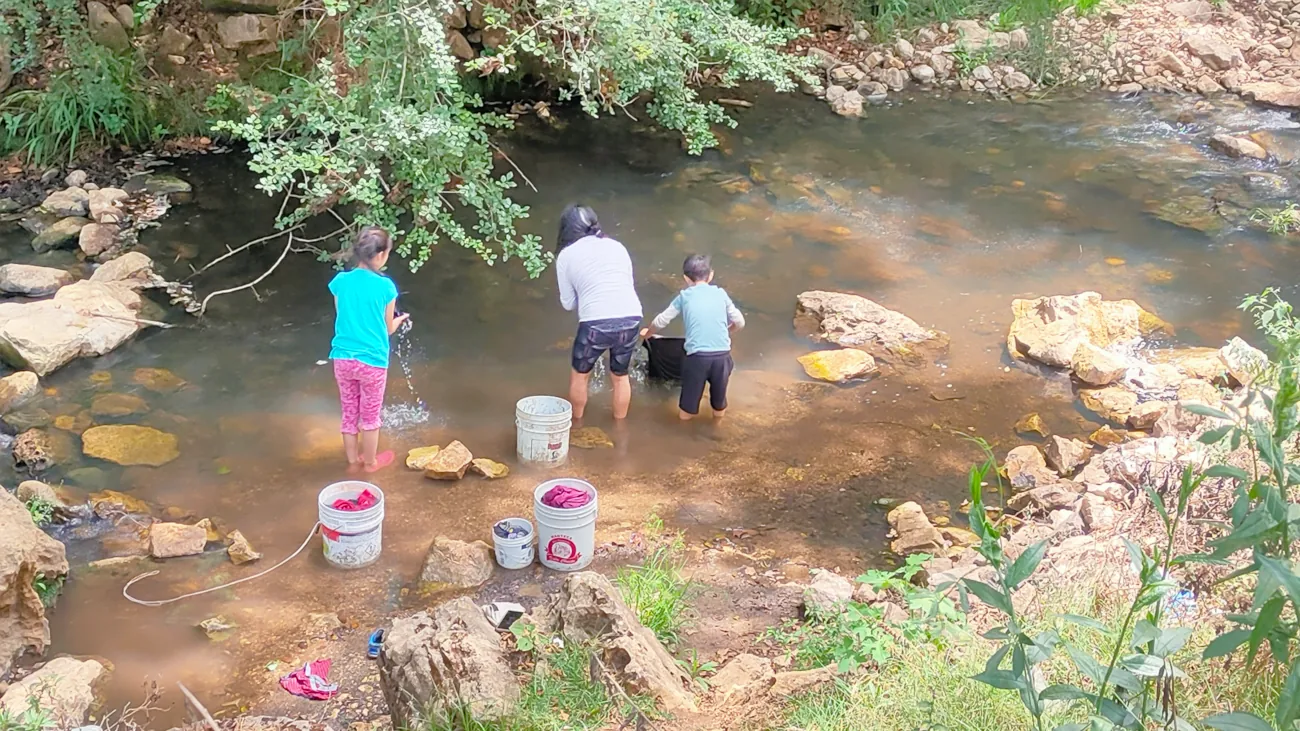
For the first few months, the children and their mother washed our clothes in the river.
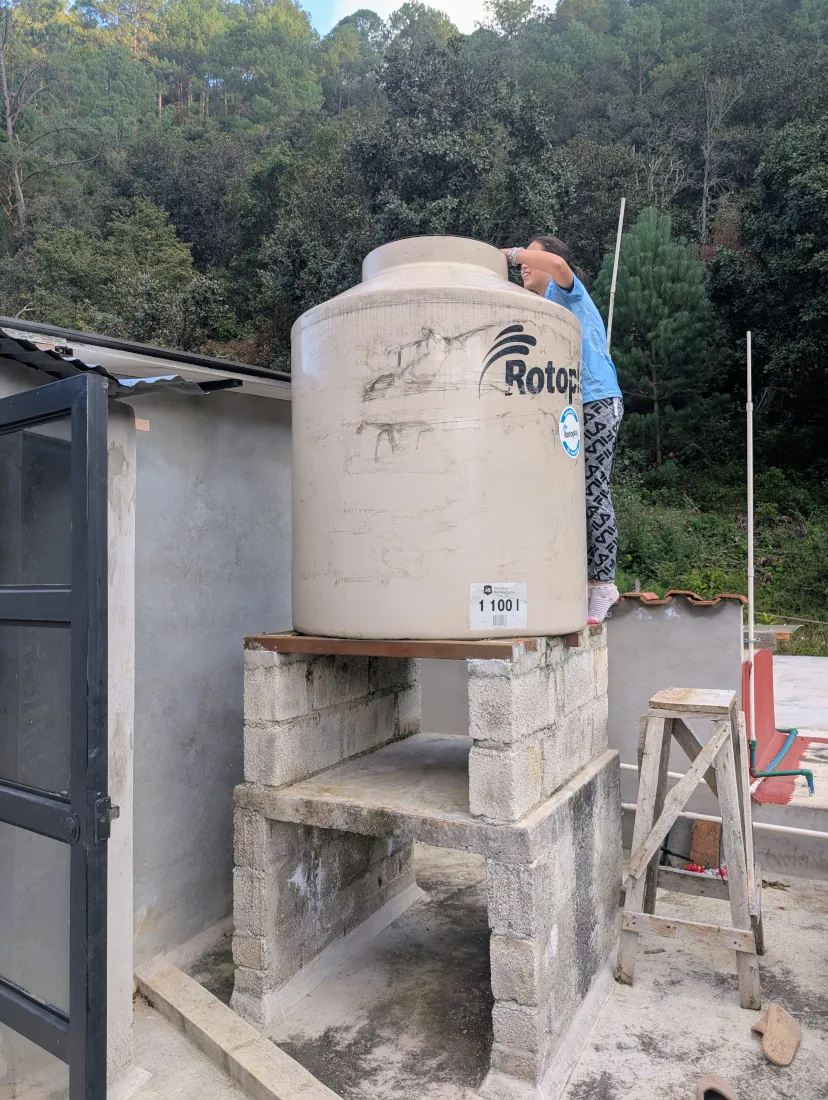
Two months after we moved in, the rains arrived. From the start, I’d used a pump to lift water from the cistern, with a long hose to fill the 1,100-litre tank on the roof. One person below switched on the pump while another climbed a ladder to hold the hose in the tank, then yelled down when it was full.
A tankful could last us a week if we used it sparingly and took quick showers. We were careful, just in case we ended up having to take our soap down to the river.
We soon learned that the roof caught more than enough water for those simple daily needs. But I didn’t want to connect the washing machine and upset the balance, particularly when we had no idea what the dry season would be like.
Instead, we carried river water up to the washing machine. The riverbank is steep, so we told ourselves we were getting a good workout for our arms and shoulders. The dirty clothes still piled up faster than we could wash them. It wasn’t just physically tough: it took time, and the buckets sloshed water over us as we climbed the bank.
By the end of the year I had installed proper piping from the cistern to the roof tank. Nobody had to pose as a fireman at the top of a ladder holding the hose anymore. We still had to check the tank and switch the pump on and off ourselves.
Getting through our first dry season
Luckily for our water supply, the dry season in San Cristóbal brings cold nights and often cold days from November through March. It can be warm in the sun and icy inside the house. Fewer hot, sweaty days meant fewer occasions when a shower felt essential, particularly for the wellbeing of anyone standing nearby.
On paper, a full cistern held about nine tankfuls: nine weeks of careful use, against a dry season of nearly six months. I checked the cistern every couple of weeks, and showers were rationed to two or three per person per week. That made the children particularly happy.
All through the dry season we saw many families coming to the river to wash clothes, and even to transport water in barrels back to their communities.
By the end of April, a few weeks before the rains usually start, the cistern was about 90% empty. Sporadic light rain had helped us get that far. Seeing it so low gave me mixed feelings. We’d made it this far through the dry season, and that was pretty impressive for a family of four. But there was a slight disappointment too: we were so close to the first rains, and perhaps not going to make it without a water truck (pipa).
Then some early rain got us over the finish line. We’d met our goal of getting through on our own supply.
More storage, and the end of river laundry
In 2025 I added a second 1,100-litre Rotoplas on the roof, so the pump now fills two tanks from the cistern. Extra tanks let me add capacity without enlarging the concrete cistern already buried in the ground.
That same year I fitted guttering to the concrete roof, then added a 1,100-litre and a 500-litre tank to catch its water for washing clothes. The runoff looks less clean than what comes off the tin roof, so I keep it for laundry.
We no longer use the river. It looks far less clean than when we moved in, so I’m particularly glad we no longer depend on it.
Learning when to save water and when to enjoy it
It took me two wet and dry seasons to become less frugal when it rains. I’m always conscious of how precious the water is, and changing habits twice a year still takes some adjustment. In the dry months I try to make every drop count. When the rains return, I can shower for ten minutes every day and enjoy having plenty.
A shower with rainwater feels wonderful. Whether it’s partly psychological or I really do glow like an angel afterwards, the jury’s out. The showerheads, toilet tanks and kettle stay free of limescale, which is a benefit I can actually see.
I use rainwater from the tap to fill my ceramic drinking-water filter, and I prefer its taste to the bottled water I used to buy. It’s what my children now take to school in their flasks. That preference isn’t a water-quality test: collected rainwater needs treatment and testing suited to how it will be used, as the CDC’s guidance on collecting rainwater explains.
I like having the seasons shape our behaviour. Moving between saving water and having plenty keeps me appreciative of it.
A song without pauses between the beats would become a wall of sound. The pauses help make it music.
The switch I’m still proud of
We switched the pump on and off manually for two years before I installed an electronic float switch in 2026. Now it responds to the water level in the roof tank and operates the pump for us.
The family adjusted to the convenience immediately. No more going up to the roof, climbing up to the tinaco and peering in to see how much water remained. No more checking when to switch the pump off.
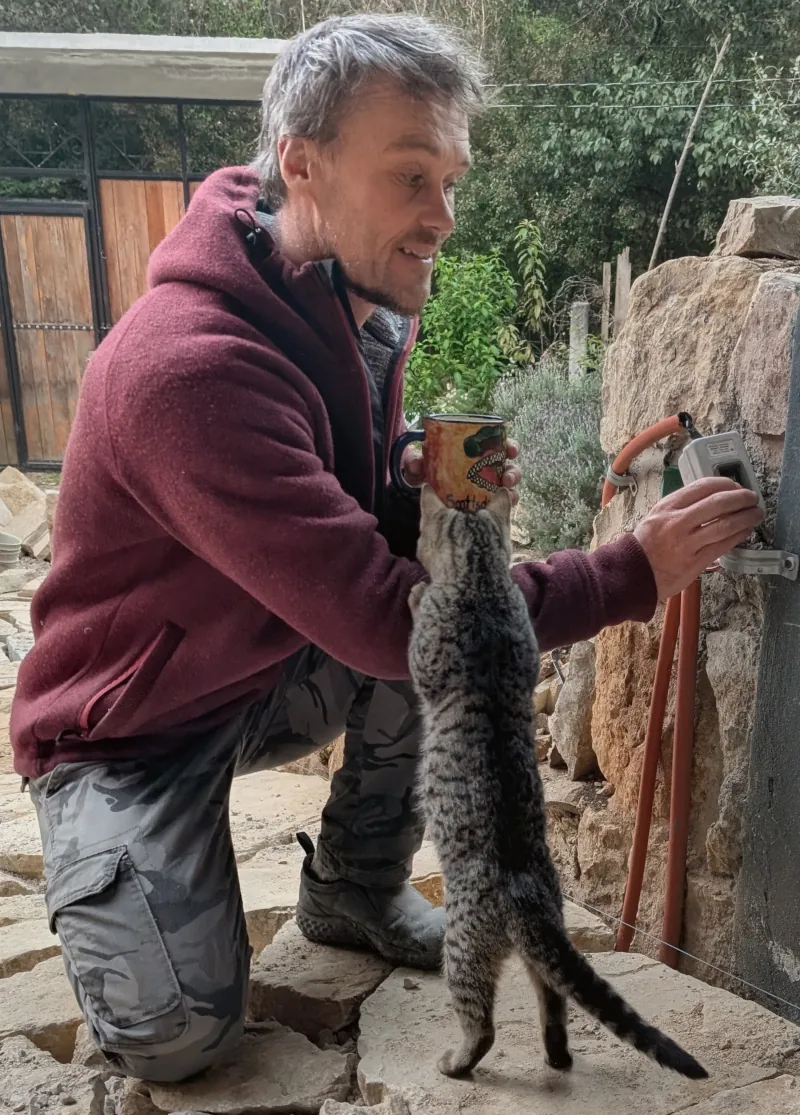
After a couple of weeks, everyone was bored of hearing me boast about how nobody had to go up to the roof anymore, and how amazing it was that the tank now filled itself.
I still see the cable running down to the pump in front of my bedroom each morning, and secretly look at it with pride.
— Luke Burchell
Follow along
I email new articles as I publish them. Subscribe if you’d like to read the next one.