First-hand · one self-managed build
Architect, maestro de obra or self-manage: who should run your house build in Mexico?
There are three ways to run a build here, and the real difference isn’t only cost — it’s who notices the problems, who makes the decisions, and who pays for the mistakes. I built my own house in San Cristóbal de las Casas, Chiapas: I self-managed it and worked with masons directly, I had plans drawn up by an architect, I’ve contracted maestros de obra, and I watched neighbours build with architects. So I’ll be clear throughout about what’s first-hand and what I observed.
The short version — which risk are you choosing?
Choosing who runs your build is a bit like choosing where to jump from. Every route charges you somewhere: the architect in money, the maestro in attention, doing it yourself in time and stress.
Architect-led
The springboard
The most structure and support, the least exposure. Makes most sense for a complex design, a difficult or hillside site, a tighter timeline, or if you can’t be on site often enough to catch problems yourself.
Maestro-led
The high board
A working lead builder, but more riding on the person. The middle road if you can visit the site, but not every day — and worth vetting carefully.
Self-managedMy route
The cliff dive
The most control and the most exposure. Masons paid as you go: the most savings, and the most learning — but also the most time, stress and responsibility.
Whichever route you choose, confirm who’s responsible for the structural design — not just who’s drawing the plans.
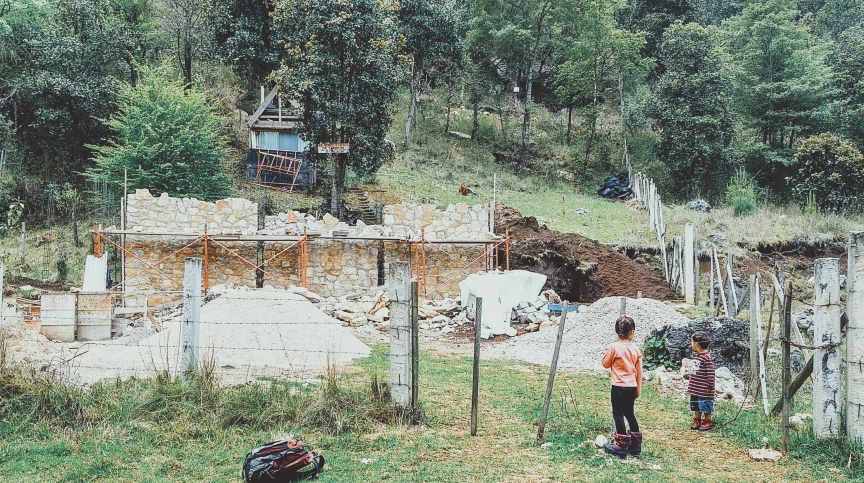
From the actual build
Terms used on this page
- Arquitecto
- Architect — may draw, permit, supervise or manage, depending on the agreement.
- Maestro de obra
- Lead builder / site foreman, usually from a mason background, who runs the crew. On site you’ll almost always hear it pronounced “maistro” — that’s the word to listen for.
- Albañil
- The mason doing the physical building work.
- Castillo
- A reinforced-concrete column; here, one with a rebar cage tied by hand on site.
- Armex
- Factory-made electro-welded reinforcement, lighter than a hand-tied castillo.
At a glance
The three routes, side by side
The cost figures are planning multipliers off a self-managed baseline, drawn from my own build and the same figures behind my cost estimator — not universal facts. Treat them as a starting point and adjust for your design, site and the person you hire.
Architect
Springboard
Maestro de obra
High board
Self-manage
Cliff dive
The fuller comparison
| Route | Cost | Control | Speed | Where it bites you | Best for |
|---|---|---|---|---|---|
| Architect Springboard |
~+25% | Lowest — you delegate | Can be fast | Savings can come from places you don’t see, including the structural spec; you still need to understand what’s specified | Complex or ambitious design, difficult/hillside site, tight timeline, limited site visits |
| Maestro de obra High board |
~+20% | Shared | Depends on how you pay | Quality rides heavily on the individual; design changes cost extra | A clear design, when you can visit but not daily, and can vet the person properly |
| Self-manage Cliff dive |
Baseline | Highest — it’s all yours | Often the slowest | Every detail and every mistake is yours to catch; time and stress | Living nearby, enough Spanish to push decisions, cost mattering more than convenience |
“Architect-led” vs paying for plans
When I say architect-led here, I mean more than paying for drawings: a route where the architect or their team plays a real role in designing, coordinating or supervising the build. You can also hire an architect for the plans and still self-manage the work yourself — which is partly what I did. They’re different decisions, and the cost and control change with each.
These percentages are why my build cost estimator has a “who manages the work” setting — self-managing is the baseline, a maestro adds roughly a fifth, an architect-led route a little more. The money you save self-managing is real, but you pay it back in your own time and attention.
The decision aid
How I’d choose now
No single route is right for everyone — it depends on how much of your own time and attention you can put in, and how much risk you want to carry yourself. The rest of this page is the experience behind these cards.
Architect
Choose if…
- The design is complex or ambitious
- The site is difficult or on a slope
- You cannot be on site regularly
- You want permits and plans handled
- You’d rather delegate than oversee
Maestro de obra
Choose if…
- You want a practical lead builder
- You can visit sometimes, not daily
- You have a clear design already
- You can vet the person properly
- You want speed over hands-on control
Self-manage
Choose if…
- You live near the site
- You speak enough Spanish to push decisions
- You can visit often
- Saving money beats convenience
- You’re willing to carry the stress
The hidden core
The looser the agreement, the more the risk falls back on you
Underneath the labels, the real question on every build is the same: who owns each job? The more loosely that’s agreed, the more of it lands on you by default — whether you meant to take it on or not.
Who carries each responsibility
| Responsibility | Architect-led | Maestro de obra | Self-managed |
|---|---|---|---|
| Buying materials | Their team | Usually the maestro | You (and your own supplier contacts) |
| Coordinating workers | Architect | Maestro | You |
| Catching mistakes & rework | Shared — you still oversee | Maestro, but you must spot it | You |
| Details: lighting, plumbing routes, finish | Only if specified | Hit or miss | You |
| Structural decisions | Confirm an engineer owns it | Builder convention | You coordinate it — get engineering advice where needed |
| Schedule & delays | Architect | Depends on payment model | You |
| Price changes & overruns | May absorb — then economise | Often passed to you for changes | You |
Read the right-hand column and you can see why self-managing is cheaper: you’re personally absorbing every row. Read across and you can see what you’re actually buying when you pay more — not just labour, but someone to own the columns you’d otherwise carry alone.
Route 01 · the springboard
Hiring an architect to build a house in Mexico
An architect gives you a professional route — but it doesn’t automatically remove structural risk, and the budget pressure can land where you’d least want it.
The appeal is obvious: pay more, hand it to a professional, get drawings and someone to run it. For a complex design, a difficult or hillside site, a tight timeline, or if you can’t be on site often, that’s often the right call. But an architect operating on competitive margins has to find savings somewhere when an unforeseen cost appears — and savings can come from places you don’t see, including the structural spec.
What happened on my own plans — the armex story
When my architect drew up the plans, he suggested one way to bring the budget down: use armex — a thin, factory-made electro-welded reinforcement — in some intermediate columns, instead of having the builders tie rebar cages, or castillos, by hand on site.
I was told this was a recognised and reliable method, and at the time I did not really understand the difference. In the end, I used armex only in the intermediate columns of one external wall. What gave me second thoughts later was not whether armex is allowed, but how thin it looked and felt next to a hand-tied castillo.
I am not saying armex is unsafe, or that every architect specifies it. But in an earthquake zone, knowing what I know now, I would ask very direct questions about what is going into the columns and beams. The structural spec is one of the few parts of the build you cannot easily revisit later.
And a plan is not supervision. A drawing on paper doesn’t build itself or check itself. Someone still has to confirm that what’s going up matches the drawing — and that the details the drawing doesn’t show have been thought through at all. That gap between “designed” and “supervised” is exactly where the next two routes live.
An architect is not always a structural engineer
It’s easy to assume “architect” means “the person responsible for the structure.” Often it doesn’t. Depending on the project and location, an architect may design, draw, permit, supervise or coordinate — while the structural calculations and structural responsibility sit with a separate engineer, or with builder convention.
For anything structural — foundations, slabs, beams, columns, retaining walls, hillside builds, extensions — ask plainly: who is responsible for the structural design, and has an engineer reviewed it?
Best for: a complex or ambitious design, a difficult or sloped site, a tight timeline, handling permits and plans, or anyone who can’t be on site often enough to catch problems themselves.
Route 02 · the high board
Working with a maestro de obra in Mexico
A maestro de obra is the natural middle option — and the one where the result rides most heavily on the individual.
Many masons who have the temperament to lead others, and to step back from doing the work themselves, become maestros de obra: they run the day-to-day site and coordinate the crew without you employing an architect. In my experience they’ll make you feel like you’ve chosen exactly the right person — and then, once work starts, the attention to detail and the quality of their workers can be hit or miss. They bring their own masons and skilled people at the right moments, which is the real value, but you still have to keep an eye on the work and nip problems in the bud.
How you pay changes their behaviour. Pay by the week and things advance slowly. Negotiate a price for the whole job and they’ll put more masons on it, often working longer hours with fewer breaks to finish. And if you ask them to change the design, or fix something that wasn’t as you’d discussed, expect to pay extra — it wasn’t in the deal.
Vet the person, not the phone
Don’t choose on the strength of nice photos on a phone. Ask to visit the actual houses, and get a reference from a previous client you can reach. Even that isn’t a guarantee — I once contracted a maestro with stunning photos and a good reference, and he still didn’t work out — but it filters out a lot.
Red flags when hiring a maestro de obra
- Asks for a large advance to start
- Can’t show recent work, or only photos — no houses you can actually visit
- Previous clients are vague or hard to contact
- The quote doesn’t say what’s included
- Refuses a weekly / pay-as-you-go structure
- Gets evasive when you ask about materials or methods
A good sign, by contrast: a maestro who offers options and ideas and is clearly thinking about the details of your project — not one who just answers “no hay problema” to everything.
Pay as you go
There’s no need to hand over more than about a month’s worth of the agreed price at a time. A small advance to start the work is normal practice — keep it to a small percentage of the total, not a big lump up front.
Best for: a clear design, when you can visit the site regularly but not daily, and when you can vet the person properly.
Route 03 · the cliff dive
Building without an architect: self-managing with masons
Self-managing saves the most and gives the most control — and hands you every detail nobody else will plan.
You draw up plans, with an architect or on the back of a napkin, and then run the project yourself. The saving is real, but so is the load: if you’re short on time or unwilling to learn as you go, expect more grey hair than you started with. The crucial thing to understand is that nobody plans the details but you. Don’t expect anything beyond the bare shell to be thought through — masons address plumbing and lighting after the main structure, and routinely miss planning for the best result.
On my own build, the masons left me with a single main wiring route up the second floor instead of two. There were no design considerations for kitchen lighting sitting the right distance off the wall, or for plumbing following basic best practice — the kind of misses that later show up as bad smells, or as everyone over four feet tall casting a shadow straight across the kitchen counter while they cook. One of my favourite memories, now that I can laugh at it, was the argument to move a half-built wall a few inches so the back of the toilet would actually align with the bathroom plumbing. Don’t expect masons to follow architectural plans unless you’ve gone over every detail with them — and then reminded them.
The cross-cutting decision
Pay weekly, or for the whole job?
This sits underneath the maestro and self-manage routes, and it’s a management decision as much as a cost one. Neither is simply cheaper — they suit different amounts of your own time and attention.
| Weekly / day rate | Whole-job fixed price | |
|---|---|---|
| Speed | Slower — a couple of years isn’t unusual | Faster — built in months if scope is clear |
| Flexibility | High — change the design as you go, “let’s add a window here” | Low — changes cost extra and break the price |
| Quality control | Easy to halt the work before it’s too late | Builder may rush or hide compromises if the margin gets tight |
| Learning | A year of conversations and you’ll understand the whole build | Less hands-on involvement |
| Bringing your own trades | Builders paid by the day will wait for your plumber/electrician | Builders paid for the job won’t wait around for anyone |
| The risk | Drifts if you’re not actively managing it | Incentive to finish — and to economise where you can’t see |
The honest trade-off: paying weekly buys flexibility, learning and control but rewards slow progress; a fixed whole-job price buys speed but won’t pause for the electrician or plumber you bring in yourself. I go into the numbers behind both in the cost to build a house in Mexico breakdown.
Why oversight matters
Some mistakes become invisible — someone has to catch them in time
Whichever route you choose, this is the work you’re really paying for (or taking on): being there at the moments a mistake gets sealed in and can’t be fixed without tearing something out.
- Rebar — before the concrete is poured
- Plumbing runs and slope — before render and floors go on
- Electrical routes — before the walls are rendered
- Slope & drainage — before the floors are finished
- Roof joins — before waterproofing
If you self-manage, these are your inspection moments. If you hire a maestro or an architect, this is exactly the oversight you’re paying them to own — so make sure someone genuinely does. The detail of how to check them is in the self-manage guide.
The honest part
The stress nobody quotes you
Ask anyone who’s been through it and most will tell you building was taxing. Living five miles from my site and working full time while managing it, I put over 6,000 miles on my bicycle in the first year alone. The stress has two real sources.
The accountability gap. Everyone does their part, but nobody owns the whole house unless you pay someone to own it — or you own it yourself. When the standard falls short and you don’t have the knowledge or the time to spot it and fix it, that gap is where the stress lives.
Imported expectations. Many “simple” expectations are really tacit agreements that hold in Europe or the US and may not here. If the lighting and the plumbing routes were never explicitly discussed — because you assumed the mason would raise them — those conversations simply don’t happen, and the misses follow.
The mason-changeover ritual
If you change masons during the build — and I did, many times — be ready for it: every new mason has a moment where he looks at the previous one’s work and disapproves of it. Some of that is real and worth hearing; some of it is theatre. As the owner, part of the job is learning which is which.
One practical note that saves money and stress: if you’re not paying someone to manage the job, suspend work when the rainy season pushes persistent rain across the country. Workers will happily turn up and spend half the day sheltering — pleasant for them, expensive for you, and concrete still has to be mixed outside.
Don’t misread this page
Permits, plans and structural responsibility
Choosing to self-manage, or to hire a maestro instead of an architect, is a decision about who manages the work day to day. It is not a recommendation to skip professional involvement where it’s required. Even self-managing, you may still need plans, permits, signatures or an engineer’s input depending on your municipio, your land status and the type of work — and structural and legal decisions should always be confirmed with someone qualified for your own site.
Questions
Common questions
Do I need an architect to build a house in Mexico?
No — most homes in Chiapas are built without one, either with a maestro de obra or by self-managing with masons directly. An architect makes most sense for a complex design, a difficult site, a tight timeline, or if you can’t be on site regularly. One caution: an architect isn’t automatically the person responsible for the structural design — ask who is.
What is a maestro de obra?
An experienced lead builder — usually a mason who’s stepped back from the physical work to run the day-to-day site and coordinate the crew, for a fee. It’s the middle route between hiring an architect and self-managing, and the quality depends heavily on the individual, so vetting matters.
Is a maestro de obra cheaper than an architect?
Usually. As a rough planning guide off my self-managed baseline, a maestro adds around 20% and an architect-led route around 25% — not fixed rules, and they move with the person, design and site. Self-managing is the cheapest because you absorb the management yourself, in time and attention.
Can I build a house in Mexico without an architect?
Yes — many people do. What you can’t safely skip is the structural and legal side: depending on your municipality and land status you may still need plans, permits or an engineer’s involvement. “No architect” is a choice about who runs the build, not a licence to skip what’s legally or structurally required.
Is it cheaper to pay builders weekly or for the whole job?
Weekly pay gives flexibility and time to learn, but rewards slow progress — a build can stretch to a couple of years. A fixed whole-job price is faster, but builders won’t wait for trades you bring in, and a tight margin can tempt them to economise where you can’t see. Neither is simply cheaper.
What’s the safest structural choice in an earthquake zone?
I’m not an engineer, so treat this as a homeowner’s experience, not advice. What I’d do now is ask direct questions about what’s going into the columns and beams — hand-tied castillos versus thinner factory-made armex, for example — and confirm a qualified engineer owns the structural design, especially on a slope or for an extension. A cheaper structural spec is one of the few things you can’t easily change later.

Written by Luke Burchell
I built and managed my own house in San Cristóbal de las Casas, Chiapas — self-managing it with masons directly, after having plans drawn up by an architect and contracting maestros de obra along the way. This is what I learned about who should run a build, from self-managing, building from an architect’s plans, and working with maestros myself.