Real costs · paid figures & local estimates
What it actually costs to build a house in Mexico
This isn’t a national average or a builder’s quote. It’s a breakdown from my own self-managed build in San Cristóbal de las Casas, Chiapas.
I’ve marked each line so you can see what I actually paid, what I’ve estimated, and what you should check locally before relying on it.
Use it as a real-world example, not a universal price list.
¿Más cómodo en español? Usa la calculadora en español →
The bottom line
Before construction
Per finished room
Water system
There’s no single honest number — it moves with room count, bathrooms, slope, finish level and who manages the build.
Rough budget: land & legal + rooms × per-room cost + water system + contingency.
From the actual build
Field note
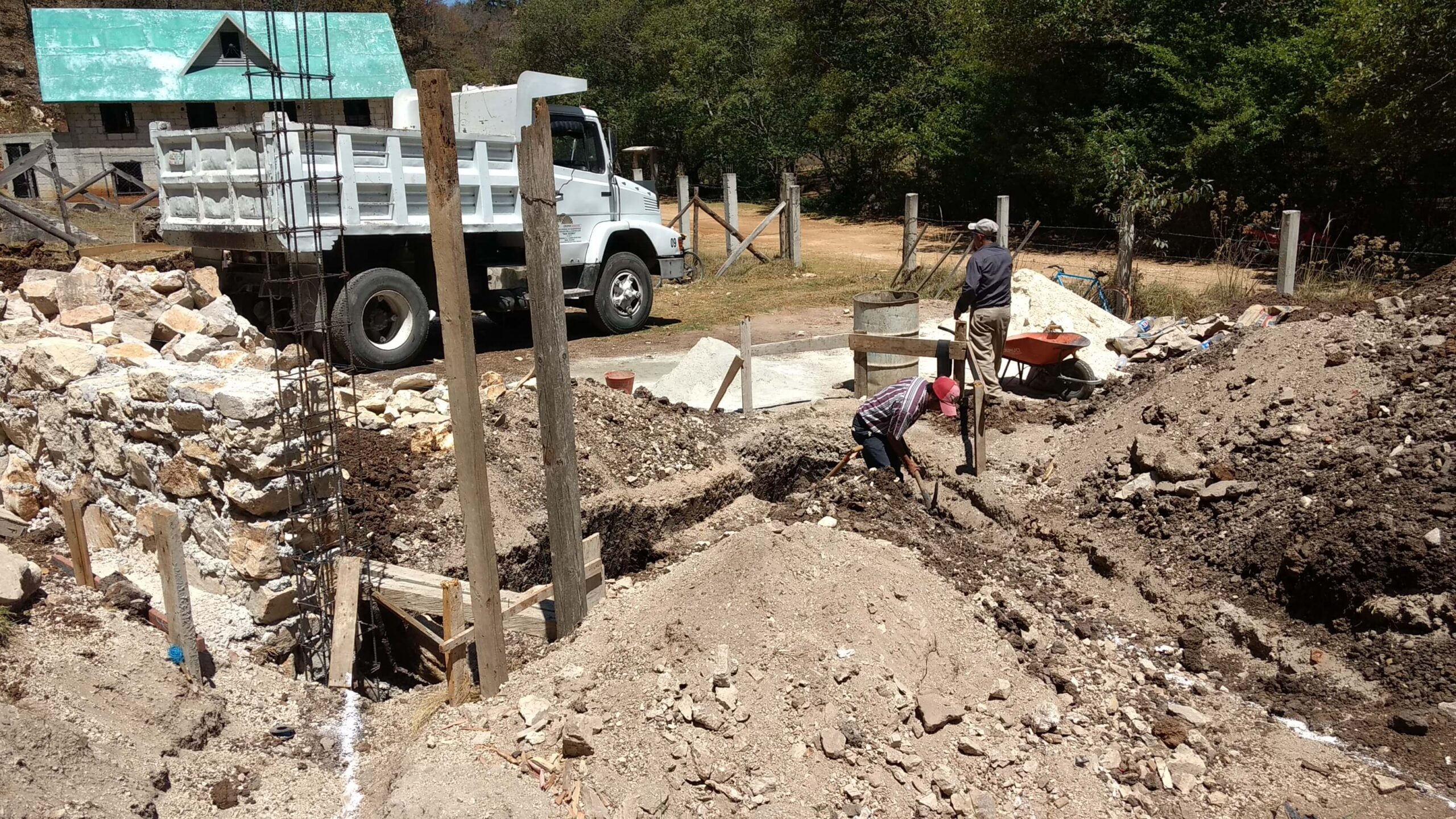
I managed this build myself while working full time and living five miles from the site. In the first year I put more than 6,000 miles on my bicycle going back and forth before and after work. That matters because these costs aren’t abstract quotes — they come from being on site often enough to see where money was spent, where it was wasted, and where I could have made better decisions.
A worked example
A modest 2-bed, 2-bath self-managed build
Assembled from the figures below for a two-storey home of roughly six rooms. This is an illustration using my numbers — your total will move with size, room count and finish level. It excludes the land purchase itself.
The move-in lines come to about MX$960,000; adding floor tiling and doors brings it to roughly MX$1.11M, and the practical budget leaves room for the overruns, price changes and surprises that come up on most builds.
Move-in vs fully finished. Floor tiling and doors — about MX$142,000 here — are things you add later, room by room, as the budget allows. I’m living in my house now with poured-concrete floors in some rooms and others still without doors, which is why I show a move-in number and a finished number rather than one figure. There’s a full tiling breakdown in the finishes section below.
Flat site assumed. This total is for a level, easily accessible plot. A hillside adds roughly 50% in my estimate — that’s not a formal quote, it reflects the extra levelling, retaining, access difficulty, slower manual work and drainage I dealt with or would now budget for.
Plan your own build
Estimate your build cost and timeline
The figures above are one real build. This estimator lets you shape them to your own plan — choose your rooms, bathrooms and finish level, then either see a full cost range or, starting from what you can spend each month, roughly how long each stage would take. It’s a planning estimate from one self-managed Chiapas build, not a quote.
All figures are in Mexican pesos (MXN) — roughly MX$17.5 to the US dollar in mid-2026, but check the current rate. Everything assumes you self-manage the build, the baseline these numbers come from.
Start with what you can invest each month and see when you could move in.
How much can you set aside each month for materials and labour?
Count each space (bedroom, living room, kitchen…) as one room of about 4×4 m.
More settings
This changes the cost a lot: self-managing can save money, but it takes time and daily attention on site.
A 3 m block wall, rendered on one face, and a simple swing gate (including the structure that holds it) — these are estimates, not figures from a wall or gate I built myself.
About — per m² built · — m²
See the breakdown
A mix of paid figures and practical estimates. Adjust to your own build; this isn’t a quote.
There’s a Spanish version of this tool: la calculadora en español.
Before the costs
The land you buy can change everything
Before permits, blocks, labour and finishes, it’s worth saying plainly: the plot itself can move the whole cost of the build. I didn’t understand at the start how much the land would control everything that came after it.
The thing I underestimated most wasn’t one dramatic cost. It was how many small decisions turned expensive once the work had already moved past them.
Nothing beats spending time in the place before you buy. I’d meet people already living in the area, ask about different parts of town, and write down my non-negotiables before falling for a plot. I knew I didn’t want to commute downtown by bicycle every day, and I wanted cleaner air than the centre of town — I keep an air-quality sensor that reads PM2.5, and it’s much lower a couple of miles out. What I didn’t expect was the trade-off: out here the air is cleaner, but rainy-season indoor humidity runs higher than in town, which matters for comfort, mould, materials and whether you end up needing a dehumidifier.
The cheapest land isn’t always the cheapest place to build
A plot can look like a bargain and turn expensive once you start solving water, access, slope, drainage or legal status. Before buying, I’d check at least:
- Is there an escritura pública?
- Is it private property or ejidal / common land?
- Is there water, or will you need rainwater catchment or a deep well?
- Is the plot flat, or will it need levelling, retaining or drainage?
- Is access good enough for material trucks and workers?
- Are basic services already nearby?
Each of those can quietly add a large line to the budget. The legal status in particular is worth a proper conversation with a notary or lawyer before any money changes hands — I’ll cover land-buying in its own write-up, because it’s too important to compress into a cost note.
01 / Before you build
Buying the land & getting permission as a foreigner
In my case — buying outside the restricted coastal/border zone — the purchase needed SRE permission and a local lawyer, and I was a permanent resident at the time. Treat that as my experience, not legal advice: the rules vary by property location and restricted-zone status and change over time, so confirm the current requirements with a notary or lawyer for your exact plot. The land price itself isn’t in this total; near San Cristóbal expect roughly MX$3,000/m² on the outskirts with basic services, up to ~MX$5,000/m² closer to markets and more desirable areas.
Cost breakdown
| Item | Cost | Mark |
|---|---|---|
| SRE permit for a foreigner to purchase In my case, via a local lawyer as a permanent resident | MX$4,000 | ✓ |
| Lawyer — purchase paperwork & land registry | MX$30,000 | ✓ |
| Legal-status verification of the property Required | MX$650 | ✓ |
| Land valuation for the registry Required | MX$600 | ✓ |
| Planning permission 2% of the assessed land value — not the price you paid | MX$5,622 | ✓ |
| Architectural plans Free if you hire the architect to build; otherwise charged | MX$20,000–30,000 | ✓ |
| Land paperwork, permits & plans Excludes the cost of the land itself | ~MX$61,000–71,000 |
How long it takes
From getting permission, signing the contract and paying a deposit to the land being registered in my name took six months. Build that waiting time into your plans, not just the cost.
Before you buy: the legal status is everything
The biggest risk in buying land here isn’t the price — it’s the deed. Land sold without an escritura pública, and ejido land in particular, can mean you don’t legally own what you paid for. I’ve written up the whole thing — deeds, ejido land, the SRE process, finding land and what to check — in buying land in Mexico as a foreigner.
02 / The shell
What one room costs in obra gris
Obra gris is the bare grey shell — structure only, no electrics, plumbing or finishes. Below is one 4×4 m standalone room broken down to the block and bag of cement. The footings line is the one that won’t scale simply with room count — the note underneath explains why, and why building upward lowers your average cost per room.
Cost breakdown
| Item | Cost | Mark |
|---|---|---|
| Footings & site groundworks Site levelling, trenching & footings (manual) — scales with the ground floor, not total room count | MX$35,000 | ✓ |
| Cinder blocks ~780 blocks × MX$18 | MX$14,000 | ✓ |
| Labour — laying walls above foundation | MX$15,000 | ✓ |
| Cement — columns, cadena & blockwork ~13 bags × MX$275 | MX$3,500 | ✓ |
| Rebar — columns & cadena 25 units × MX$150 | MX$3,750 | ✓ |
| Roof slab Rebar MX$6,750 · cement MX$2,750 · wood to support pour MX$4,000 · labour MX$6,000 | MX$19,500 | ✓ |
| Floor slab Rebar MX$6,750 · cement MX$2,750 · labour MX$3,000 | MX$12,500 | ✓ |
| Sand & stone 2 loads sand, 1 load stone | MX$4,500 | ✓ |
| Standalone room, shell only | ~MX$107,750 |
Why building upward lowers your cost per room
That ~MX$108,000 is a room standing on its own, carrying its full MX$35,000 of footings and site groundworks. In a real house the footings scale with the ground-floor footprint, not the total room count — roughly MX$120,000 for a 3–4 room footprint, or about MX$40,000 per downstairs room. Because most houses here are two-storey, the upstairs rooms sit on that same footprint: each adds shell cost (~MX$70,000) but almost no extra footings. So the more you build upward, the lower your average per-room cost falls. Budget footings against your ground floor, then ~MX$70,000 of shell for every room, upstairs and down.
From the actual build
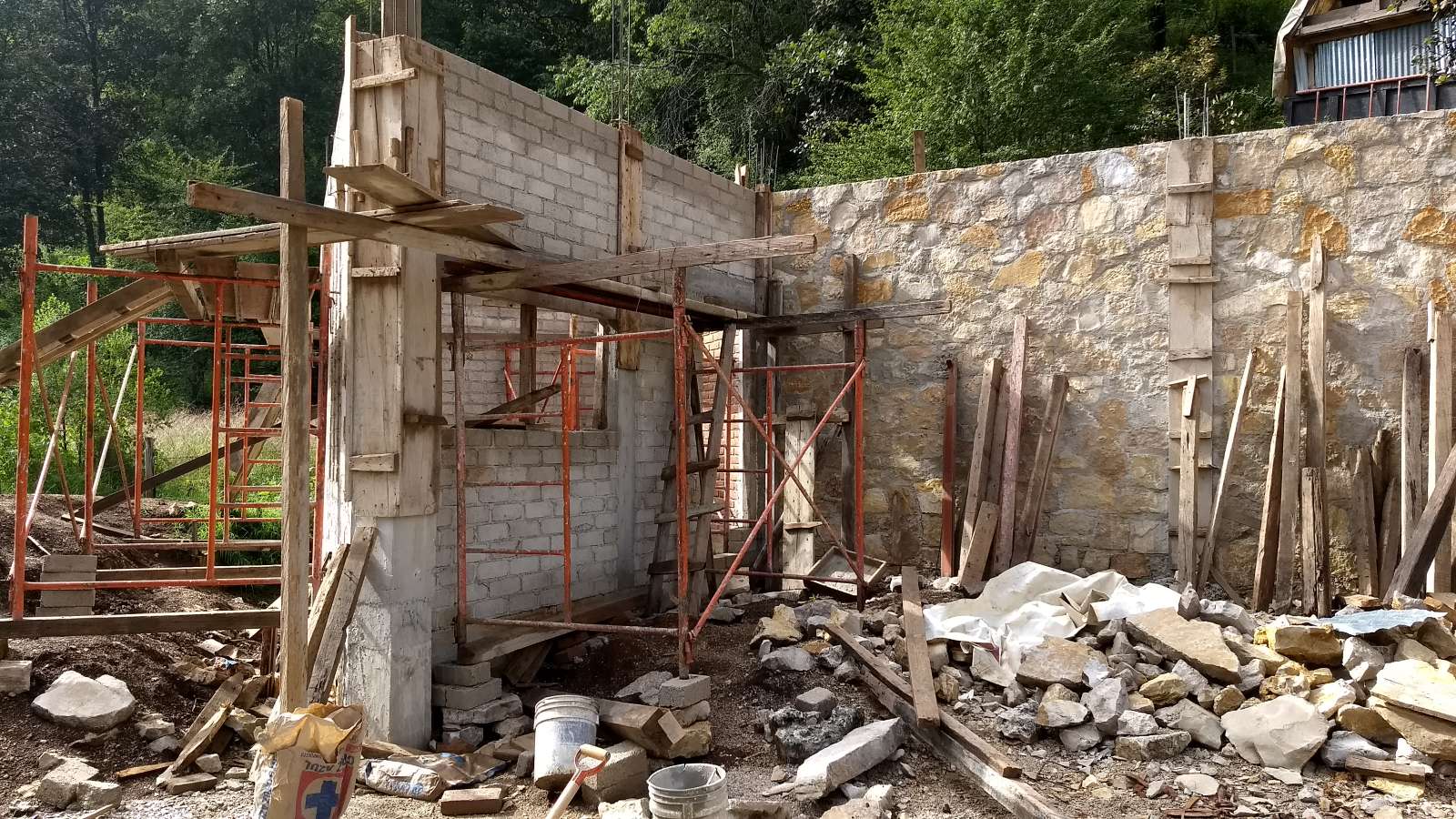
Block or brick? In my comparison, brick was not the cheap option
Short answer: brick was not cheaper in my build, but it was better to live with in the right places.
The figures above are for standard cement block. In my local pricing, brick came out dearer, not cheaper: you need about 13.5 bricks for every 4 blocks, and at MX$7 a brick versus MX$18 a block, that is roughly 30% more on the walling units alone. Cement and sand also increased heavily, and walling labour worked out close to double overall. The columns and cadenas are identical either way, which stops the whole structure from tripling, but brick was still clearly the more expensive walling option.
The main reason to consider brick is thermal comfort. Cement block is noticeably cold to the touch compared with brick, and that difference carries into how the house feels. Brick absorbs and releases heat more gradually, helping to even out hot days and cool nights. Standard cement block is still thermal mass — it can store and release heat — but brick feels better to live with.
I ended up using three wall materials in different parts of the house: thermal block, standard cement block and brick. On the side of the house that is mostly in shade, thermal block made more sense because I wanted to slow heat loss rather than capture sun. On walls more exposed to the sun, thermal mass made more sense, especially in the cold winters here in San Cristóbal. Those walls can absorb heat during the day and release some of it later.
Brick also does not need to be rendered if you like the look of exposed brick, which claws back some of the extra cost. Render is one of the bigger line items later in the build, so using brick as an interior finish can be both practical and attractive. These are my figures and conditions in San Cristóbal; pricing, climate and the best material choice will differ elsewhere in Mexico. For the full side-by-side — cost, thermal comfort and where I used each — see my brick vs block in Mexico comparison.
03 / Finishes
Render, floors, doors, windows & paint
Finishing is where the cost quietly doubles. Render in particular is one of the largest single line items in the whole build — and the figure people forget. Note the render rate is labour only; cement and lime are extra. Rates are per square metre unless stated; whole-house figures are for a ~10×10 m two-storey home.
Cost breakdown
| Item | Cost | Mark |
|---|---|---|
| Render — exterior (labour) MX$180–200/m² labour only · whole house ~MX$40,000 | MX$40,000 | ✓ |
| Render — interior (labour) MX$180–200/m² labour only · 4 walls + ceiling · whole house ~MX$72,000 | MX$72,000 | ✓ |
| Render materials — cement & lime On top of labour · ½ bag cement per 2m² with a 50% lime mix · ~MX$35/m² | ~MX$22,000 | ~ |
| Floor tiling, all-in ~MX$560/m² (tiles ~MX$250 + labour ~MX$260 + adhesive & grout ~MX$50) · ~MX$110,000 for this house · deferrable — full breakdown below | ~MX$110,000 | ~ |
| Wooden doors, locally made & installed MX$7,000 each · typical 6 doors · wood grade is the lever (pine cheapest, pinabeto mid, cypress/”Nuculpat” best) · deferrable | MX$42,000 | ✓ |
| Window frames MX$3,000 each (pino abeto, 1×1m) — cypress/”Nuculpat” costs more but lasts | MX$3,000 ea | ✓ |
| Window glass Annealed 6mm, smaller windows; up to MX$30,000 if tempered/large | MX$10,000 | ✓ |
| Interior paint & sealer Extrapolated — see calculation below | ~MX$12,000–14,000 | ~ |
Floor & bathroom tiling — the full breakdown
Floor tiling runs about MX$560/m² all-in on my numbers, and the parts move. Basic tiles are MX$150–300/m² — I weighted toward the upper end of basic; budget hard and you can go cheaper, while luxury tiles climb well past this. Labour is around MX$260/m², give or take 20% by tile size: smaller tiles mean more cuts and more work, so they cost more to lay. On top of both, the adhesive and grout to bed and finish the tiles add roughly MX$50/m² — the piece that’s easy to forget. And watch the area that’s actually tiled — a bedroom floor is roughly 30 m², but a bathroom floor is only about 5 m².
Bathrooms are mostly walls, not floor. You can tile nothing (the extreme saving), tile to the ceiling (the maximum), or land in between. My own balance of cost, function and looks: tiles around the shower (about 2.2×2.3 m) plus a band 1.2 m high behind the toilet and sink — roughly 7.2 m² of wall, about MX$3,700 per bathroom on top of the floor. That’s the balance I’d choose again.
All of it is deferrable. I’m living in my house now with poured-concrete floors in some rooms — tiling is one of the easiest things to add later, room by room, as the budget allows.
Painting — the extrapolation
The base figure is real: Saya vinílica Promaster runs MX$2,160 for a 19 L bucket (~MX$114/L). The total wasn’t in the build notes, so here’s the working — adjust the coverage rate to your own walls:
~400 m² interior surface × 2 coats ÷ 10 m²/L = ~80 L ≈ 4–5 buckets ≈ MX$9,000–10,800
Add a sealer coat first (lime render is thirsty) at roughly MX$3,000, giving ~MX$12,000–14,000 in materials for the interior. Coverage on rough or very absorbent render can be a third lower — treat 10 m²/L as optimistic and buy a spare bucket. If you paint it yourself, that’s the whole cost; a painter adds labour on top.
04 / Electrical
Wiring, fixtures & the earth connection
If the mason wires it, expect to pay roughly the per-room figures. A proper electrician for the whole house costs more but does it properly — and they’ll plan two cable routes up a second storey where a mason leaves you with one.
Cost breakdown
| Item | Cost | Mark |
|---|---|---|
| Electrician — full house wiring (labour) | MX$12,000 | ✓ |
| Wire, switches & sockets (materials) | MX$10,000 | ✓ |
| Earth & street connections (mufa) Grounding plus the connection to the street supply | MX$5,000 | ✓ |
| Breaker box & fuses (consumer unit) | MX$800 | ✓ |
| Lighting conduit in roof & walls Per room, labour + conduit — not in the subtotal below | MX$2,000 /rm | ✓ |
| Whole-house electrical Plus MX$2,000 conduit per room | ~MX$27,800 |
05 / Plumbing & water
The cistern, the pump & getting water to the taps
This is the system people underestimate most. For bathroom supply you choose between CPVC (cut-and-glue, cheap, easy to repair) and TuboPlus (heat-fused, tougher, UV-resistant for roof runs). I used both. The water storage and pumping is the bulk of the cost. I’ve written the whole system up — cistern, pump, gravity feed, the pipe choice and the mistakes I’d avoid — in water system for a house in Mexico.
Cost breakdown
| Item | Cost | Mark |
|---|---|---|
| Cistern (cisterna), concrete-lined ~10,000 L · MX$20,000 labour + MX$10,000 materials | MX$30,000 | ✓ |
| Pump Two types; sized to the cistern-to-roof lift | ~MX$3,000 | ~ |
| Plumbing — pump from cistern up to roof tank Materials + labour | MX$10,000 | ✓ |
| Plumbing — roof tank to kitchen, 2 baths & boiler Materials + labour (TuboPlus) | MX$12,000 | ✓ |
| In-room supply pipework — 2 baths + kitchen TuboPlus | ~MX$1,800 | ✓ |
| Wastewater plumbing, whole house Very design-dependent | ~MX$6,000 | ✓ |
| Rooftop tank — 1,100 L Rotoplas | MX$3,800 | ✓ |
| Boiler / water heater Ranges MX$1,500–25,000; ~MX$5,000 is a fair average | ~MX$5,000 | ~ |
| Boiler connections & 2 shower valves MX$689 + 2 × MX$700 | ~MX$2,089 | ✓ |
| Water & plumbing system | ~MX$74,000 |
If the land has no water
I bought land with no water connection, so the build cost isn’t complete until you’ve solved water. In my area the two real options were rainwater catchment or a deep well (pozo profundo).
A local deep-well company quoted around MX$80,000 to drill, fit the piping, drop in a pump and connect it to the house — that price covered drilling to about 25 m, with an extra cost per metre beyond that. My water table sits around 18 m down, and they’d normally drill a few metres past it so the well keeps producing through the dry season. As a foreign resident, check the permit requirements before drilling a deep well on your property.
06 / Don’t forget these
The installations almost everyone leaves out of the budget
These rarely appear in a first estimate and then arrive all at once near the end. I’ve marked every one as an estimate — they vary widely by finish and supplier, so price them locally — but leaving them off entirely is the most common way a budget overruns.
Cost breakdown
| Item | Typical | Mark |
|---|---|---|
| Kitchen sink + tap, supplied & fitted Plumbing labour ~MX$2,500; sink unit & tap on top | ~MX$4,000–7,000 | ~ |
| Kitchen counter & cabinetry Concrete-cast counter is cheapest; carpentry much more | ~MX$15,000–40,000 | ~ |
| Toilets — the units themselves Per toilet; wax flange MX$40–600 extra | ~MX$1,500–3,000 ea | ~ |
| Bathroom basins, showers & fittings Per bathroom, fixtures only | ~MX$3,000–8,000 ea | ~ |
| Gas tank, regulator & hose 30 kg cylinder MX$2,499 · regulator MX$150 · hose ~MX$300 (varies with length) | ~MX$2,950 | ✓ |
| Stairs (for a second storey) Structure; handrails extra — DIY rails saved me 20,000+ | ~MX$10,000–25,000 | ~ |
| Sealing & crack repair on concrete roof Fester FT-201 adhesive ~MX$300 + geotextile + roof paint | ~MX$2,000–5,000 | ~ |
07 / Trust
How I worked these numbers out
Because the whole point of this page is that the figures are real, here’s exactly where they come from and what I did to them.
Every figure marked ✓ is what I paid on my own build, managing it myself in San Cristóbal in 2026. Figures marked ~ are mine to estimate — either I worked them out from my known costs (like the paint) or they’re typical local ranges you should confirm with a quote. I’ve left the arithmetic visible wherever I could so you can swap in your own quantities. Prices are Chiapas-specific and move with inflation and the peso; treat the year stamp as part of the number.
08 / Scope
What’s deliberately not on this page
Two things are left out on purpose, not by accident. The land purchase price itself swings too widely by location to fold into a build total — budget it separately at MX$3,000–5,000/m² near San Cristóbal. And the off-grid water systems — rainwater harvesting and greywater filtration — are their own substantial projects with their own payoffs, so they get their own write-up rather than a buried line here.
09 / Questions
Common questions
How much does it cost to build a house in Mexico?
There’s no single figure — it scales with rooms and bathrooms. On this real 2026 build in Chiapas, budget roughly MX$65,000 in land paperwork and permits before you start, about MX$70,000 of shell per room on top of a ~MX$120,000 foundation, then finishes (render alone can top MX$110,000 for a two-storey home) and an ~MX$74,000 water system. Build your own total from the line items above.
How much does it cost to build a house in Mexico per square metre?
I don’t price my build per square metre, because that figure hides too much — it shifts with whether you measure the ground-floor footprint or the floor area across two storeys, with the finish level, and with the slope of the land. For a rough sense: my fully finished worked example, about MX$1.11M for a six-room two-storey home, works out to the mid-MX$5,000s per m² of floor. But that’s my self-managed Chiapas build excluding the land — not a contractor’s turnkey quote, which runs higher because it includes their management and margin. I’d estimate from rooms instead: about MX$70,000 of shell per room on the footings, then finishes, water, electrics and legal on top.
What’s the cheapest practical way to build a house in Mexico?
The biggest saving isn’t haggling on materials — it’s building to a habitable stage and finishing later. On my numbers the move-in core came to about MX$960,000, against about MX$1.11M fully finished; the gap is floor tiling and interior doors, which you add room by room as money allows. I’m living in mine now with concrete floors in some rooms and no doors on others. Beyond that: build upward rather than outward (the footings are the costly part, and upstairs rooms reuse them), do the simple labour yourself where you can — DIY handrails alone saved me over MX$20,000 — and self-manage instead of paying an architect or maestro, if you have the time to be on site.
How long does it take to build a house in Mexico?
Longer than the cost tables suggest, because two clocks run. Before a single block is laid, the land paperwork took me six months from deposit to the deed being registered in my name. Then the build depends on how you pay: a fixed price for the whole job moves fastest, while paying builders weekly — which buys flexibility to change the design as you go — slows progress, and a build can stretch to a couple of years. I self-managed mine while working full time, which stretched it further. Budget the waiting, not just the spending.
Is it cheaper to pay builders weekly or for the whole job?
Weekly pay gives you flexibility to change the design or stop the work, and time to learn — but it incentivises slow progress, and a build can stretch to a couple of years. A fixed price for the whole job moves faster but builders won’t wait around for the electrician or plumber you bring in. Neither is simply cheaper; they suit different amounts of your own time and attention.
What does obra gris mean?
It’s the bare grey shell of the building — foundation, walls, columns, and roof and floor slabs — with no electrics, plumbing, render or finishes. It’s how local builders quote the first phase. On this build, obra gris ran about MX$70,000 per room on top of the foundation.
Do I need an architect?
No — most homes in Chiapas are built without one. You have three routes: hire an architect, hire a maestro de obra — an experienced lead builder who runs the day-to-day site and coordinates the masons for a fee — or manage it yourself. Each trades cost against control and stress. Skipping the architect saves money but means no one is planning the details — lighting, plumbing routes, finishes — unless you do.
Does this cost include the land itself?
No — every total on this page excludes the land purchase, because land prices swing too widely by location to fold in honestly. Near San Cristóbal, budget it separately: roughly MX$3,000/m² on the outskirts with basic services, up to about MX$5,000/m² closer to markets and the more desirable areas. What the page does include is the land paperwork — the SRE permit, lawyer, registry and planning permission — which came to about MX$65,000 before a single block was laid.
Can a foreigner buy land and build in Mexico?
In my case, yes. Buying outside the restricted coastal/border zone needed a permit from the SRE, handled by a local lawyer, and I was a permanent resident at the time — roughly MX$4,000 for the permit and MX$30,000 for the lawyer’s paperwork and registry, and about six months from deposit to the land being registered in my name. Rules differ by location and restricted-zone status and change over time, so confirm the current requirements with a notary or lawyer for your specific property.
Do I need a building permit to build a house in Mexico?
On my build I paid for planning permission, charged at 2% of the assessed land value (not the price I paid) — MX$5,622 in my case. That’s separate from the SRE permit a foreigner needs to buy the land, and it’s part of the ~MX$65,000 of paperwork before any block is laid. Requirements and costs vary by municipality and change over time, so check what your local authority (the municipio) wants for your specific plot — this is what one San Cristóbal build cost, not a national rule or legal advice.
How much does it cost to get water on land with no connection?
I bought land with no water connection, so the build wasn’t finished until I’d solved it. A local company quoted around MX$80,000 to drill a deep well (pozo profundo) to about 25 metres, fit the piping and pump, and connect it to the house — my water table sits around 18 metres down. The other option is rainwater catchment. As a foreign resident, check the permit requirements before drilling. The full system — cistern, pump, pipe choice and the mistakes I’d avoid — is in water system for a house in Mexico.

Written by Luke Burchell
I built and managed the construction of my own house in San Cristóbal de las Casas, Chiapas — coordinating the masons, plumbers, electricians, land paperwork, water systems and finishing work myself, while living locally. The figures here are what it actually cost, shared so you can plan yours from real numbers.